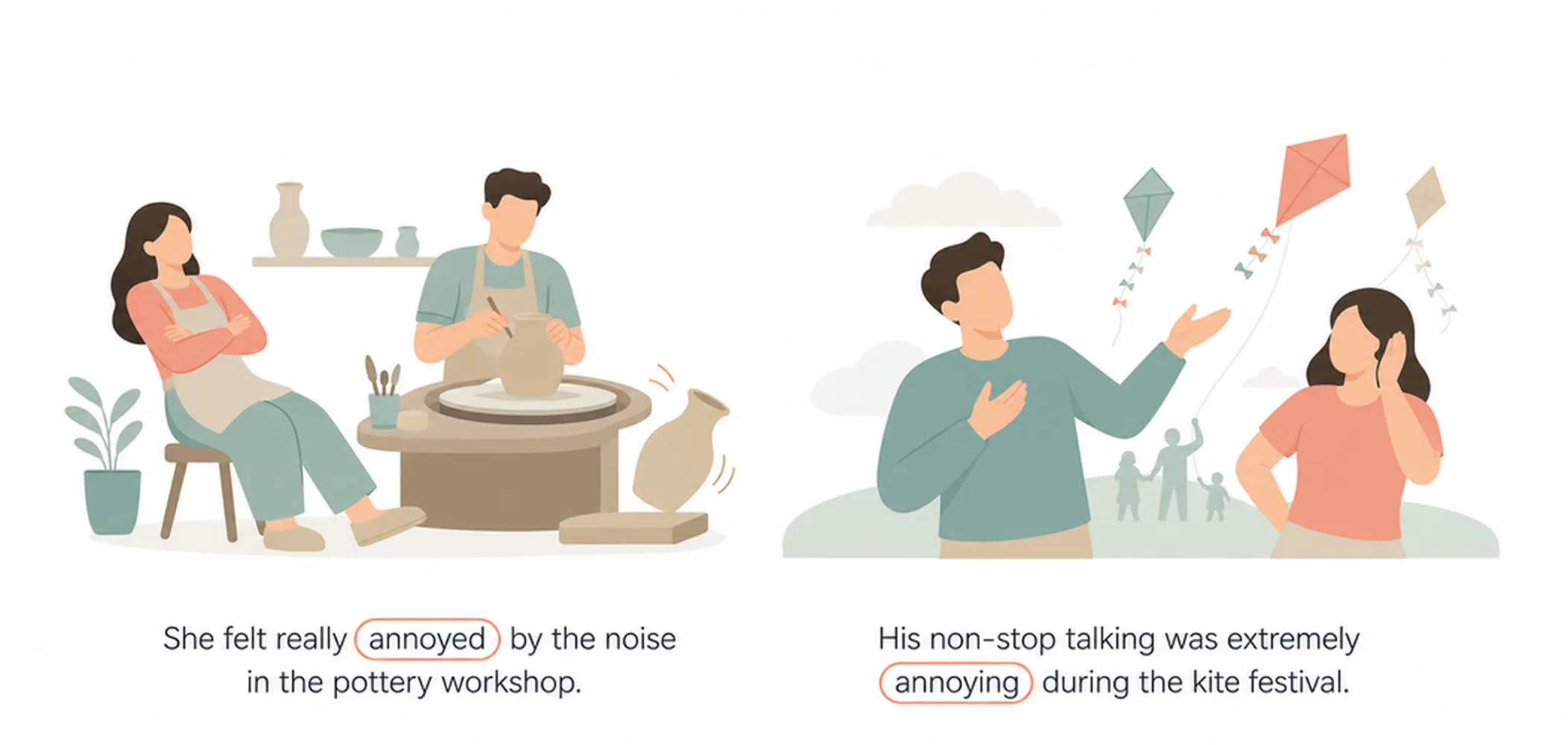
The Key Difference
Annoyed and annoying are both participle adjectives, but they describe different perspectives. Use annoyed (-ed form) to describe how a person feels—it refers to the emotional state of the person experiencing something negative. Use annoying (-ing form) to describe the quality of a person, thing, or situation that causes this feeling. In simple terms: you feel annoyed, but something is annoying.
Annoyed vs Annoying: Side by Side
Annoyed is a past participle adjective that describes the emotional reaction of a person. It answers the question 'How does this make me feel?' Annoying is a present participle adjective that describes the characteristic or quality of a person or thing. It answers the question 'What is causing this feeling?' When comparing these two, remember: annoyed = the feeling (subject of the feeling), annoying = the cause (what triggers the feeling).
Quick Memory Tip
Think of -ed adjectives as describing emotions or feelings about a person (I feel annoyed), while -ing adjectives describe the person or thing itself (That person is annoying). If you can replace the adjective with 'feeling' or 'feeling' + emotion, use -ed. If it describes a quality or characteristic, use -ing.
Annoyed vs Annoying: Quick Comparison
| Category | Annoyed | Annoying |
|---|---|---|
| Form | Past participle used as an adjective (participial adjective) | Present participle used as an adjective (participial adjective) |
| When to use | Use to describe how a person (or living being) feels — the emotion experienced by someone as a result of something irritating | Use to describe a thing, situation, or person that causes irritation or frustration in others |
| What it describes | The receiver of the irritation — the one who feels bothered or irritated | The cause of the irritation — the thing or person producing the annoying effect |
| Question it answers | "How does the person feel?" | "What is the thing or person like?" |
| Positive example | "She was annoyed by the constant interruptions during her presentation." | "The constant interruptions during her presentation were annoying." |
| Negative example | "He was not annoyed at all by the noise outside." (❌ incorrect: "He was not annoying by the noise" — noise cannot make a person annoying) |
"The dripping tap is not annoying to everyone." (❌ incorrect: "The dripping tap is not annoyed" — objects cannot feel emotions) |
| Question example | "Are you annoyed about what happened at the meeting?" | "Do you find his habit of tapping his fingers annoying?" |
| Key signal words | feel, feel a bit, seem, look, get, become, was, were, I am, he is, she is + annoyed | it is, that is, how, very, quite, really, find it, what a + annoying |
| 🔑 Key Difference: Annoyed describes the emotional state of a person — it tells us how someone feels (the subject is affected by something). Annoying describes the characteristic of a thing, situation, or person — it tells us that something causes irritation (the subject produces the irritating effect). A simple test: if you can replace the word with "irritated", use annoyed; if you can replace it with "irritating", use annoying. | ||
Examples






What to Remember
- Use -ed participle adjectives (annoyed) to describe how a person feels or their emotional state.
- Use -ing participle adjectives (annoying) to describe the quality or characteristic that causes the feeling.
- The -ed form focuses on the person experiencing the emotion; the -ing form focuses on the cause.
- Many participle adjectives follow this pattern: interested/interesting, bored/boring, excited/exciting, confused/confusing.
- Avoid reversing the forms; say "I am annoyed" not "I am annoying" for your own feelings.