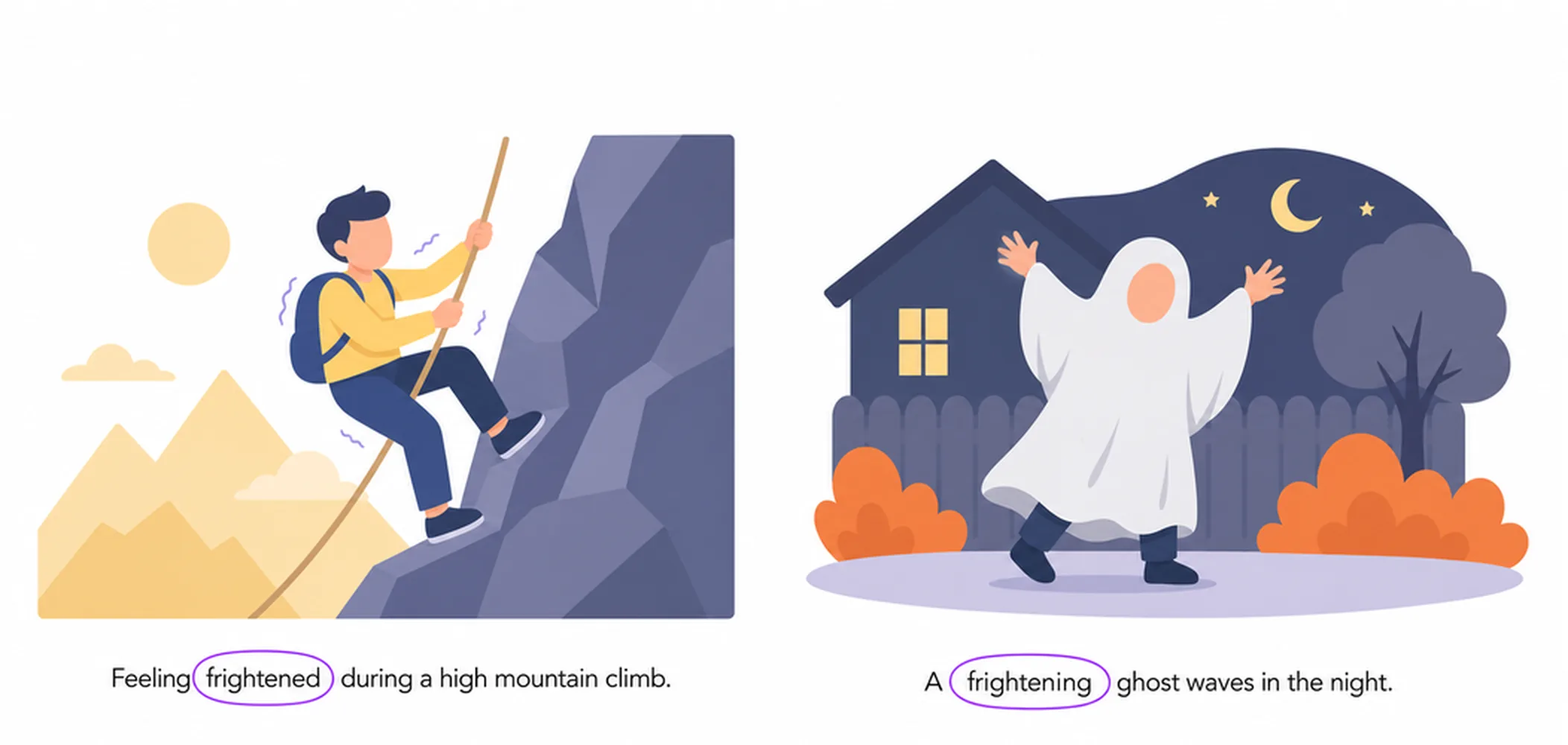
The Key Difference
Frightened and frightening look similar, but they describe different things. Use frightened (-ed form) to describe how a person feels—it shows emotion. Use frightening (-ing form) to describe something that causes that emotion—it's about the quality of the thing itself. This pattern applies to many participle adjectives: surprised/surprising, bored/boring, interested/interesting, and so on.
Frightened vs Frightening at a Glance
FRIGHTENED (-ed): Describes the person or animal experiencing the emotion. It answers 'How does the person feel?' FRIGHTENING (-ing): Describes the person, thing, or situation that creates the emotion. It answers 'What quality does it have?' Think of it this way: a frightened person saw something frightening.
Frightened vs Frightening: Side-by-Side Comparison
| Dimension | Frightened | Frightening |
|---|---|---|
| Form | Past participle used as an adjective (ending in -ed) | Present participle used as an adjective (ending in -ing) |
| Meaning | Describes a feeling or emotion experienced by a person or animal — the state of being afraid | Describes a quality or characteristic of a thing, situation, or person — the ability to cause fear |
| What it describes | The person or being who feels the fear (the receiver of the emotion) | The thing, event, or situation that causes the fear (the source of the emotion) |
| When to use | Use when talking about how someone feels. The subject is affected by fear. Typically follows a linking verb such as be, feel, or seem. | Use when describing something that produces or causes fear. The subject is the source of the fear. Can appear before a noun or after a linking verb. |
| Positive example | "The child was frightened by the loud thunder." → The child experienced fear. |
"The loud thunder was frightening for everyone in the room." → The thunder caused fear. |
| Negative example | "She was not frightened at all during the horror film." → She did not feel afraid. |
"The horror film was not frightening to her." → The film did not cause fear. |
| Question example | "Were you frightened when the alarm went off?" → Asking about someone's emotional reaction. |
"Was the alarm frightening to the students?" → Asking about the effect or quality of the alarm. |
| Question it answers | "How does the person feel?" → They feel frightened (afraid). |
"What is this thing like?" → It is frightening (it causes fear). |
| Key signal words | feel, seem, look, be + frightened; often followed by of, by, or about Example: frightened of spiders, frightened by the noise |
be, seem, look, sound + frightening; often followed by to or for Example: frightening to children, a frightening experience |
| 🔑 Key Difference: Use frightened to describe how a person or animal feels (they are the one experiencing fear), and use frightening to describe what a thing, situation, or event is like (it is the cause of fear). A simple test: if you can replace the word with "afraid", use frightened; if you can replace it with "scary", use frightening. | ||
Formula
✔ Positive
Subject (person/animal)
+
be
+
frightened
+
(+ preposition + cause)
The children are frightened of the dark.
Formula
Frightened
+
adjective + noun
The frightened witness couldn't speak clearly.
Examples
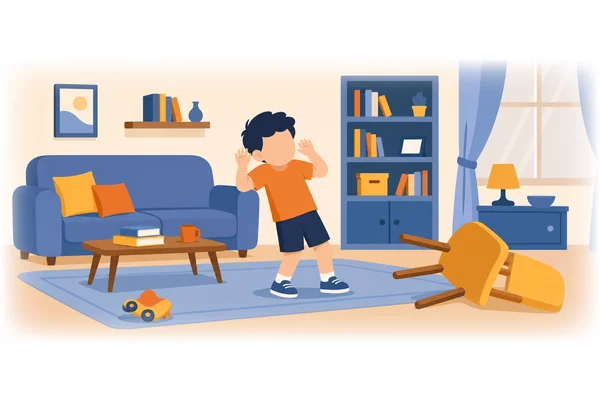
The child was frightened by the loud noise.
Describes emotion · Adjective describing a person
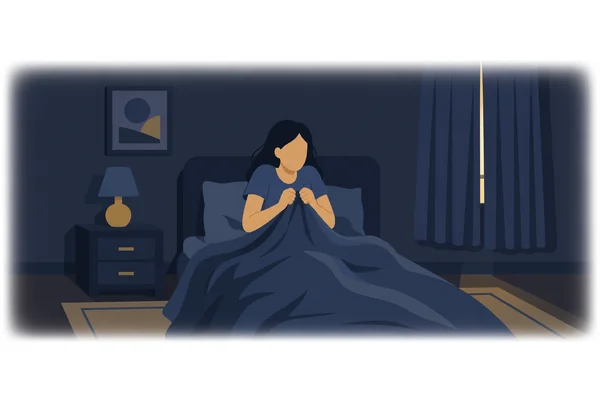
She felt frightened when she woke up in the dark room.
Describes feeling · After linking verb 'felt'
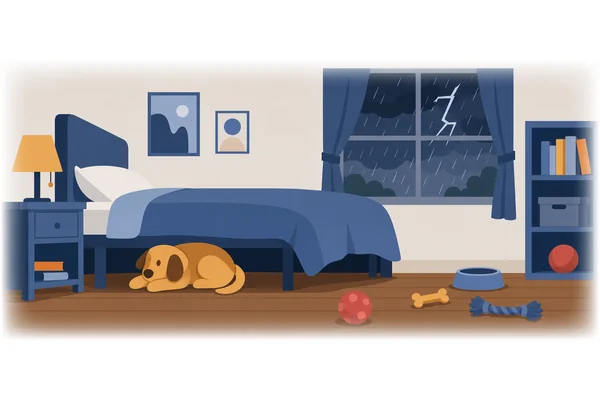
The frightened dog hid under the bed during the storm.
Describes state · Modifying noun 'dog'
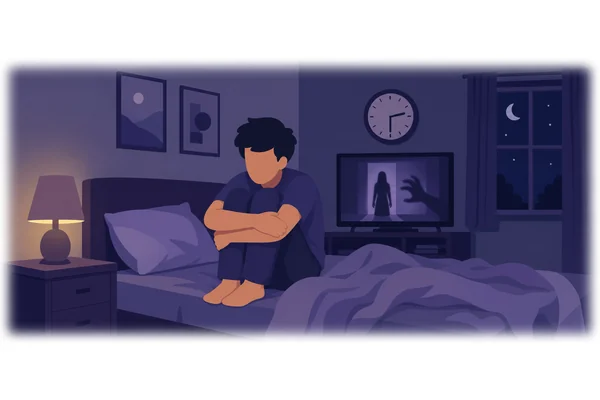
That's a frightening movie—I couldn't sleep afterwards.
Describes quality · Modifying noun 'movie'

The news was frightening, so everyone stayed home.
Describes quality · After linking verb 'was'
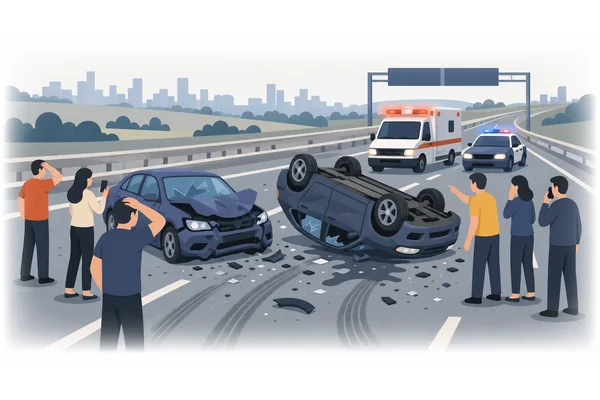
We saw a frightening accident on the highway yesterday.
Describes quality · Modifying noun 'accident'
When to use it
Describing Emotions
Use -ed adjectives when talking about how people or animals feel. This is the most natural context for the -ed form.
"The passengers were frightened after the turbulence."
Describing Causes
Use -ing adjectives when describing what creates the emotion. Focus on the thing itself, not the person experiencing it.
"The haunted house had many frightening rooms and corridors."
Context Clues
Look for emotional verbs (feel, seem, appear, become, get) before -ed adjectives; -ing adjectives often follow nouns they describe.
"She seemed frightened, and the frightening sounds continued all night."
Signal words
feel
seem
appear
become
get
be
look
cause
make
create
Common Mistakes
✕
Wrong
I am frightening of spiders.
✓
Correct
I am frightened of spiders.
-ed form describes the person's emotion; -ing describes what causes the emotion
✕
Wrong
The movie was very frightened and made us sad.
✓
Correct
The movie was very frightening and made us sad.
A movie has the quality 'frightening'; people experience being 'frightened'
✕
Wrong
My sister is frightened by horror films because they are frightened.
✓
Correct
My sister is frightened by horror films because they are frightening.
Horror films themselves are frightening; your sister becomes frightened when watching them
KEY TAKEAWAYS
What to Remember
- Use -ed participle adjectives to describe how people feel or their emotional state.
- Use -ing participle adjectives to describe the quality or characteristic of something that causes emotion.
- The -ed form focuses on the subject's reaction; the -ing form focuses on the object's property.
- This pattern applies consistently: frightened/frightening, bored/boring, interested/interesting, surprised/surprising, and many other pairs.
- Do not reverse the forms—saying "a frightened movie" or "a frightened person" is incorrect.