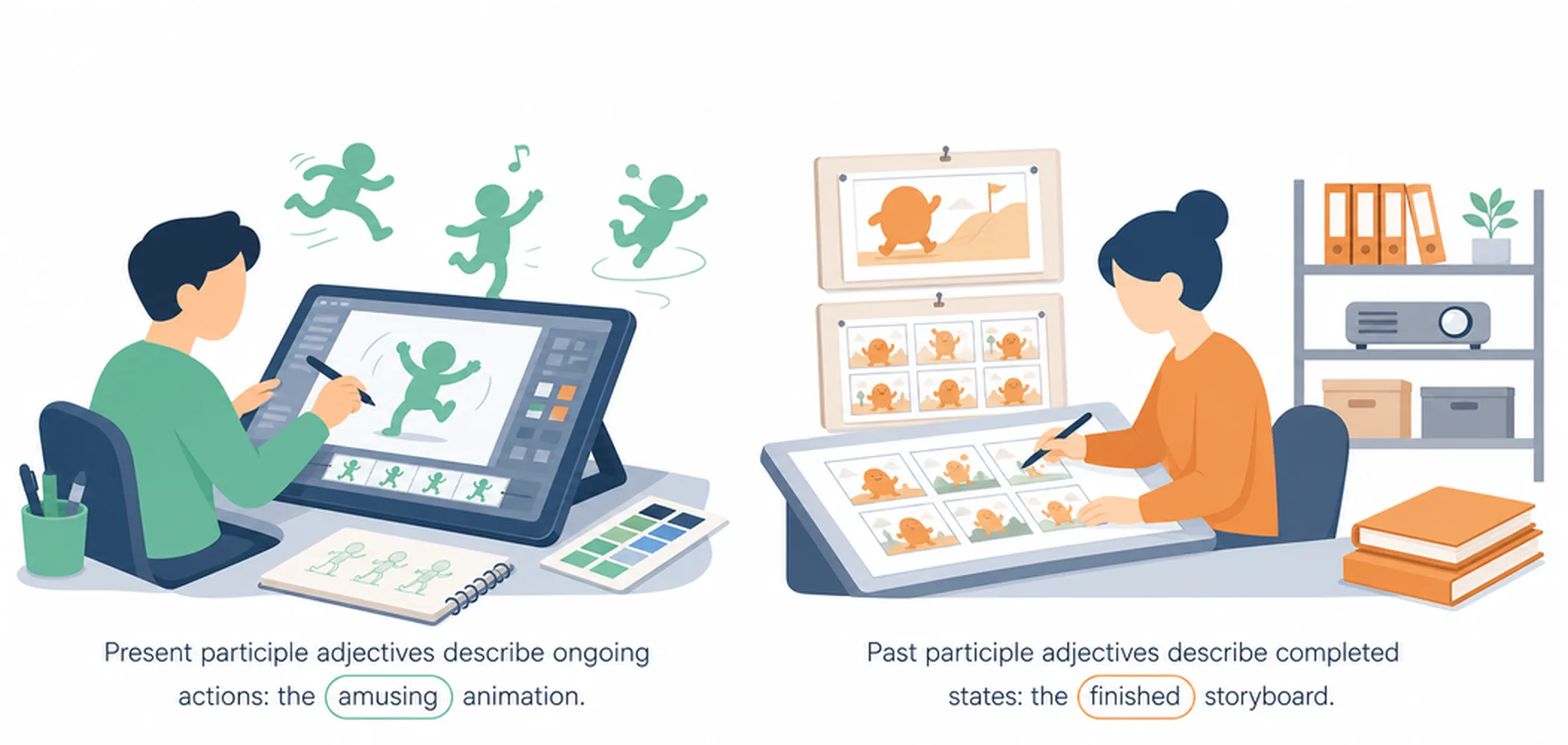
What are participle adjectives?
Participle adjectives are adjectives formed from verb participles. They come in two forms: -ing participles and -ed participles. Both types can describe nouns, but they have different meanings. Participle adjectives are very common in English and allow us to create richer descriptions with fewer words. Unlike regular adjectives, they retain the sense of action or state from their original verbs.
The difference: -ing vs -ed participles
-ing participles describe the effect or quality that something or someone causes or produces. They often mean "causing" or "producing." For example, "a boring lesson" means the lesson causes boredom. -ed participles describe the state or feeling of someone or something that experiences an effect. They often mean "affected by" or "having experienced." For example, "a bored student" means the student feels boredom. This distinction is crucial: the -ing form is often about the cause, while the -ed form is about the result or experience.
Common uses and patterns
Participle adjectives work like regular adjectives—they can come before a noun ("an exhausted athlete") or after linking verbs like "be," "feel," "look," and "seem" ("The athlete looks exhausted"). Many common pairs follow predictable patterns: interesting/interested, exciting/excited, frustrating/frustrated, confusing/confused. You'll notice that -ing participles are often used to describe the inherent quality of something, while -ed participles frequently appear after "be" to describe emotional states or conditions.
Participle Adjectives: -ing vs -ed at a Glance
| Dimension | -ing Participle Adjectives | -ed Participle Adjectives |
|---|---|---|
| Form | Base verb + -ing (e.g., bore → boring, excite → exciting) |
Base verb + -ed (regular) or irregular past participle (e.g., bore → bored, excite → excited) |
| Core Meaning | Describes a cause — the thing or person that produces the feeling or effect in someone else. | Describes an experiencer — the person (or occasionally thing) that receives or feels the effect. |
| What It Describes | Usually a thing, situation, or non-human subject that triggers an emotion. e.g., a film, a job, the news |
Usually a person (or group of people) who is affected by something and feels an emotion. e.g., a student, a worker, a crowd |
| Typical Subject Type | Non-person / inanimate nouns are most common as the subject. "The lecture is interesting." |
Person / animate nouns are most common as the subject. "The student is interested." |
| Paired Example 1 (bore) |
boring — The meeting was boring. (The meeting caused the feeling of boredom.) |
bored — She felt bored during the meeting. (She experienced the feeling of boredom.) |
| Paired Example 2 (excite) |
exciting — The match was exciting. (The match caused excitement.) |
excited — The fans were excited. (The fans felt excitement.) |
| Paired Example 3 (confuse) |
confusing — The instructions were confusing. (The instructions caused confusion.) |
confused — He looked confused. (He experienced confusion.) |
| Paired Example 4 (amaze) |
amazing — The view was amazing. (The view caused amazement.) |
amazed — We were amazed by the view. (We felt amazement.) |
| Paired Example 5 (tire) |
tiring — The hike was tiring. (The hike caused fatigue.) |
tired — They were tired after the hike. (They felt fatigue.) |
| Common Mistakes | ❌ "I am boring" (unless you mean you yourself are dull and cause others to feel bored — an embarrassing mix-up!) | ❌ "The film was bored" (a film cannot experience emotions, so this is incorrect) |
| Position in Sentence | Can appear before a noun (attributive) or after a linking verb (predicative). "an exciting game" / "The game is exciting." |
Can appear before a noun (attributive) or after a linking verb (predicative). "a bored student" / "The student is bored." |
| Key Signal Words / Collocations | fascinating, terrifying, shocking, depressing, overwhelming, satisfying, relaxing, worrying, disappointing | fascinated, terrified, shocked, depressed, overwhelmed, satisfied, relaxed, worried, disappointed |
| Quick Test | Ask: "Does this thing/person cause the feeling?" If yes → use -ing |
Ask: "Does this person feel or experience the emotion?" If yes → use -ed |
| 🔑 Key Difference: The -ing form describes the source or cause of an emotion — it tells us what something is like ("The film is boring"). The -ed form describes the emotional state of the experiencer — it tells us how someone feels ("I am bored"). A simple rule: if a person can feel it, use -ed; if something causes that feeling, use -ing. | ||
Examples






What to Remember
- Participle adjectives are formed from verb participles and come in two main forms: -ing and -ed.
- ing participles describe the effect or quality that something or someone causes or produces.
- ed participles describe how someone feels or what state someone is in as a result.
- Participle adjectives retain the sense of action or state from their original verbs, unlike regular adjectives.
- Participle adjectives allow richer descriptions with fewer words, making them very common in English writing.