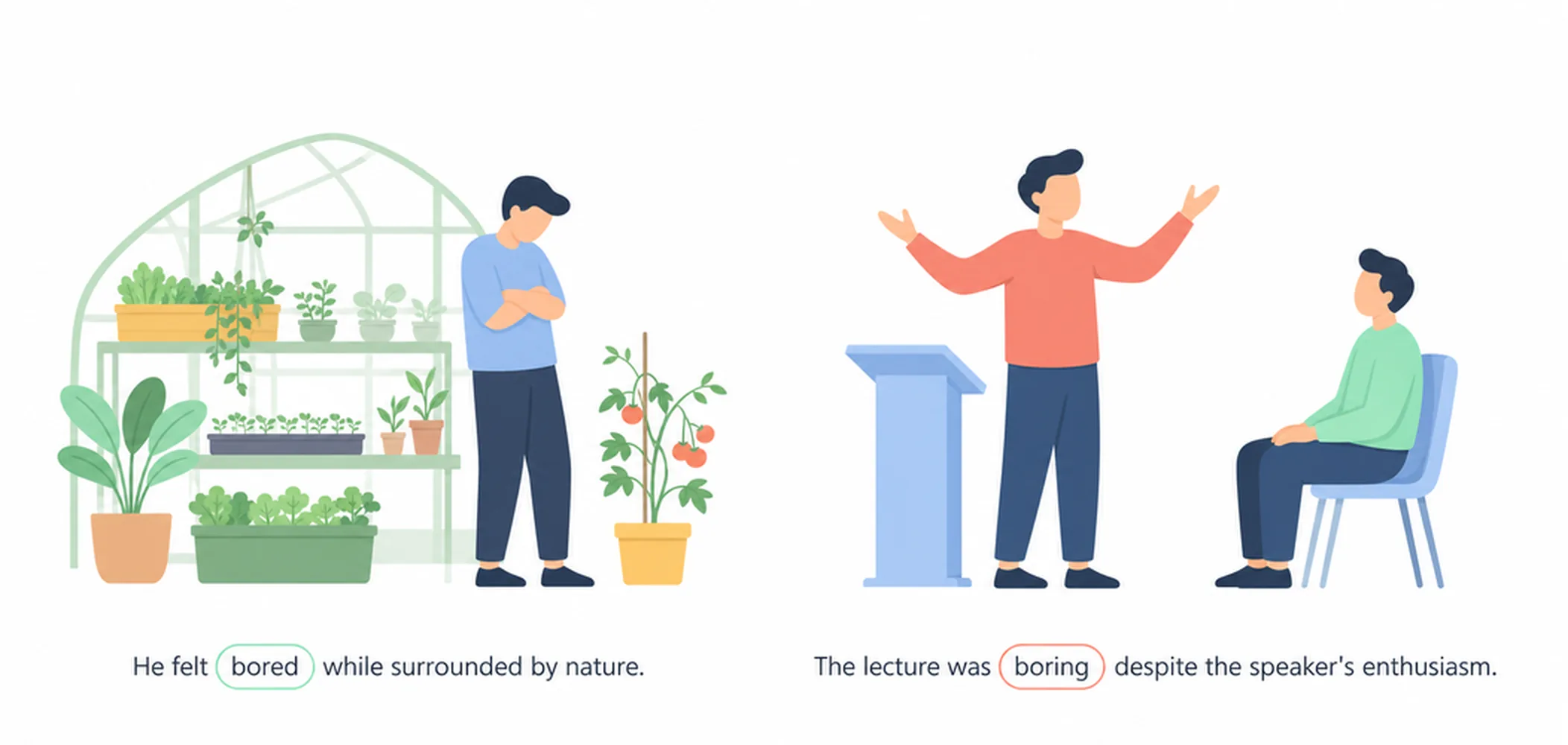
The Core Difference
Both 'bored' and 'boring' come from the same verb, but they describe different things. Use -ed adjectives when you want to describe how a person feels or their emotional state. Use -ing adjectives when you want to describe the thing or person that causes that feeling. This distinction applies to many pairs: tired/tiring, excited/exciting, interested/interesting, and frustrated/frustrating.
The Person vs. The Source
Think of it this way: the -ed form shows the receiver of the emotion (the person experiencing it), while the -ing form shows the cause or source. A movie can be boring (it causes boredom), and you can be bored (you experience boredom). The person is bored; the activity is boring. This pattern is consistent across participle adjectives and helps you choose the correct form every time.
Bored vs Boring at a Glance
| Dimension | Bored | Boring |
|---|---|---|
| Form | Past participle used as an adjective (participial adjective) | Present participle used as an adjective (participial adjective) |
| When to use | Use to describe how a person (or animal) feels — the emotion experienced by someone as a result of something uninteresting | Use to describe the thing, person, or situation that causes the feeling of boredom in someone else |
| Applies to | The person (or sentient being) who experiences the emotion — e.g., a student, a child, an employee | The cause of the emotion — e.g., a lecture, a film, a task, a conversation |
| Positive example | "The students were bored during the long lecture." | "The long lecture was extremely boring." |
| Negative example | "She was not bored at all — she found the topic fascinating." | "The film was not boring; it kept everyone on the edge of their seats." |
| Question example | "Are you bored with your current job?" | "Is your current job boring?" |
| Key signal words | Often follows feel, seem, look, appear, be + person as subject — e.g., "I feel bored", "He looks bored" | Often follows be, seem, sound, find it + thing as subject — e.g., "It seems boring", "I find it boring" |
| 🔑 Key Difference: Bored describes the feeling inside a person (the receiver of the emotion), while boring describes the external cause (the thing, person, or situation that produces the emotion). A simple test: if you can replace it with "uninterested," use bored; if you can replace it with "uninteresting," use boring. | ||
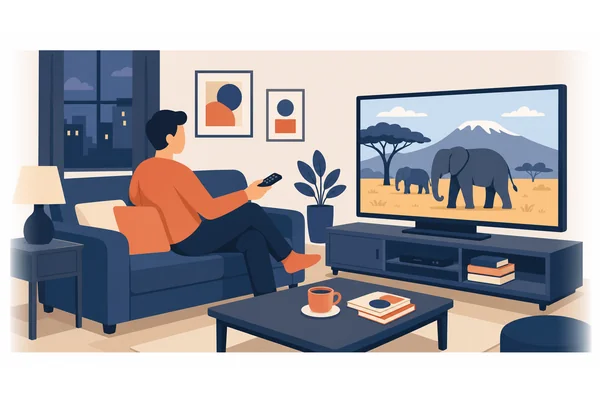
Examples





What to Remember
- Use -ed adjectives to describe how a person feels or their emotional state.
- Use -ing adjectives to describe the thing or person that causes the emotion.
- The -ed form shows the receiver of the emotion experiencing the feeling.
- The -ing form shows what or who creates or provokes that emotion.
- This distinction applies to many verb pairs: tired/tiring, excited/exciting, interested/interesting, frustrated/frustrating.