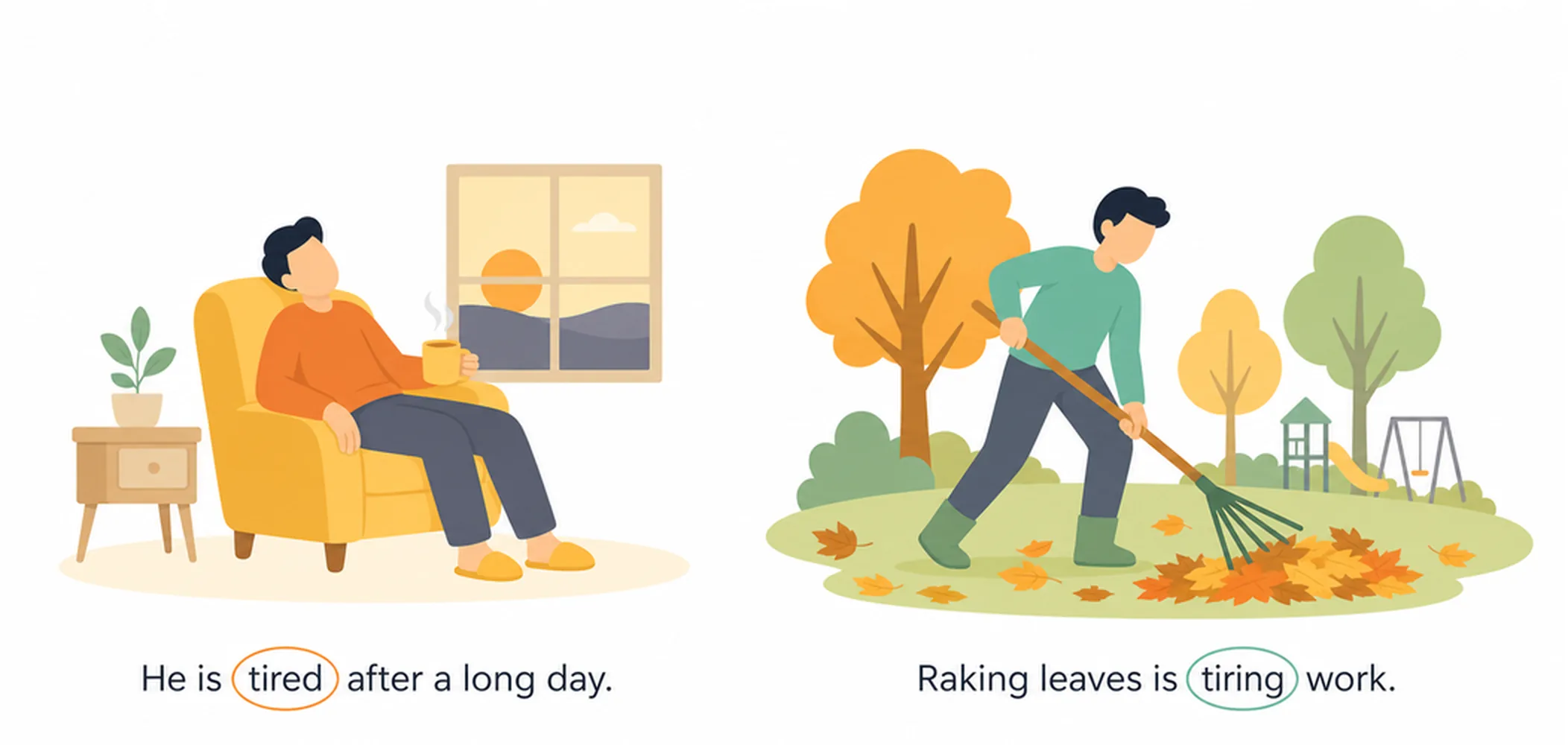
The Key Difference
Both 'tired' and 'tiring' come from the verb 'tire,' but they describe different things. Use the -ed form (tired) when you want to describe how a person feels or their state. Use the -ing form (tiring) when you describe what causes that feeling—the thing or activity that produces the emotion. This distinction applies to many participle adjectives: bored/boring, interested/interesting, frustrated/frustrating.
-ed Adjectives: Describing Feelings & States
The -ed form describes how someone feels or their emotional/physical condition. The person or thing is the experiencer of the emotion.
-ing Adjectives: Describing What Causes the Feeling
The -ing form describes the quality of something that produces an emotion or effect. The noun is the cause, not the experiencer.
How to Remember
Ask yourself: Is this about how someone FEELS (use -ed), or what CAUSES that feeling (use -ing)? Another way: -ed = passive experience, -ing = active cause. If you can replace the word with 'the person feels X' or 'this thing makes people feel X,' you'll know which form to use.
Quick Comparison Table
-ED FORM: Subject = experiencer (person/animal feeling something) | Example: 'I am tired' | -ING FORM: Subject = cause (thing that produces the feeling) | Example: 'This work is tiring' | The movie is boring vs. The audience is bored
Tired vs Tiring — Side-by-Side Comparison
| Dimension | Tired | Tiring |
|---|---|---|
| Form | Past participle used as an adjective (-ed form) | Present participle used as an adjective (-ing form) |
| Grammatical Role | Describes how a person (or animate being) feels — the receiver of the feeling | Describes what a thing, situation, or activity causes — the source of the feeling |
| What the Subject Represents | A person or living thing experiencing fatigue or exhaustion | A task, event, journey, or situation that produces fatigue in others |
| Feeling Conveyed | The subject is exhausted, drained, or weary as a result of something | The subject is exhausting, draining, or wearisome — it makes others feel fatigued |
| When to Use | Use when describing the emotional or physical state of a person; the subject is affected by fatigue | Use when describing the quality of something that drains energy; the subject is the cause of fatigue |
| Positive Example | She was tired after the long hike. → She experienced fatigue. |
The long hike was tiring. → The hike caused fatigue in others. |
| Negative Example | He was not tired at all after the short walk. → He did not feel fatigue. |
The short walk was not tiring at all. → The walk did not cause fatigue. |
| Question Example | Are you tired after work? → Asking about how the person feels. |
Is your job tiring? → Asking about the nature of the job. |
| Typical Sentence Patterns |
[Person] + feel/am/is/are + tired [Person] + look + tired Tired + [person] + verb |
[Thing/Activity] + is/was + tiring [Thing] + can be + tiring A + tiring + [noun] |
| Key Signal Words | feel, seem, look, am, is, are, was, were (linking verbs with a person as subject) | exhausting, draining, demanding, hard, difficult (synonyms); typically paired with tasks, journeys, jobs, or activities |
| 🔑 Key Difference: Tired describes how a person feels (the subject is the one experiencing fatigue), while tiring describes what a thing or activity does (the subject causes fatigue in others). A simple test: if you can replace the adjective with "exhausted," use tired; if you can replace it with "exhausting," use tiring. | ||
Examples






What to Remember
- Use -ed participle adjectives to describe a person's emotional state or feeling.
- Use -ing participle adjectives to describe what causes the emotion or feeling.
- The -ed form describes the affected person; the -ing form describes the cause.
- This pattern applies to many adjectives: bored/boring, interested/interesting, frustrated/frustrating.
- Don't confuse the forms: a person is tired, but the work is tiring.