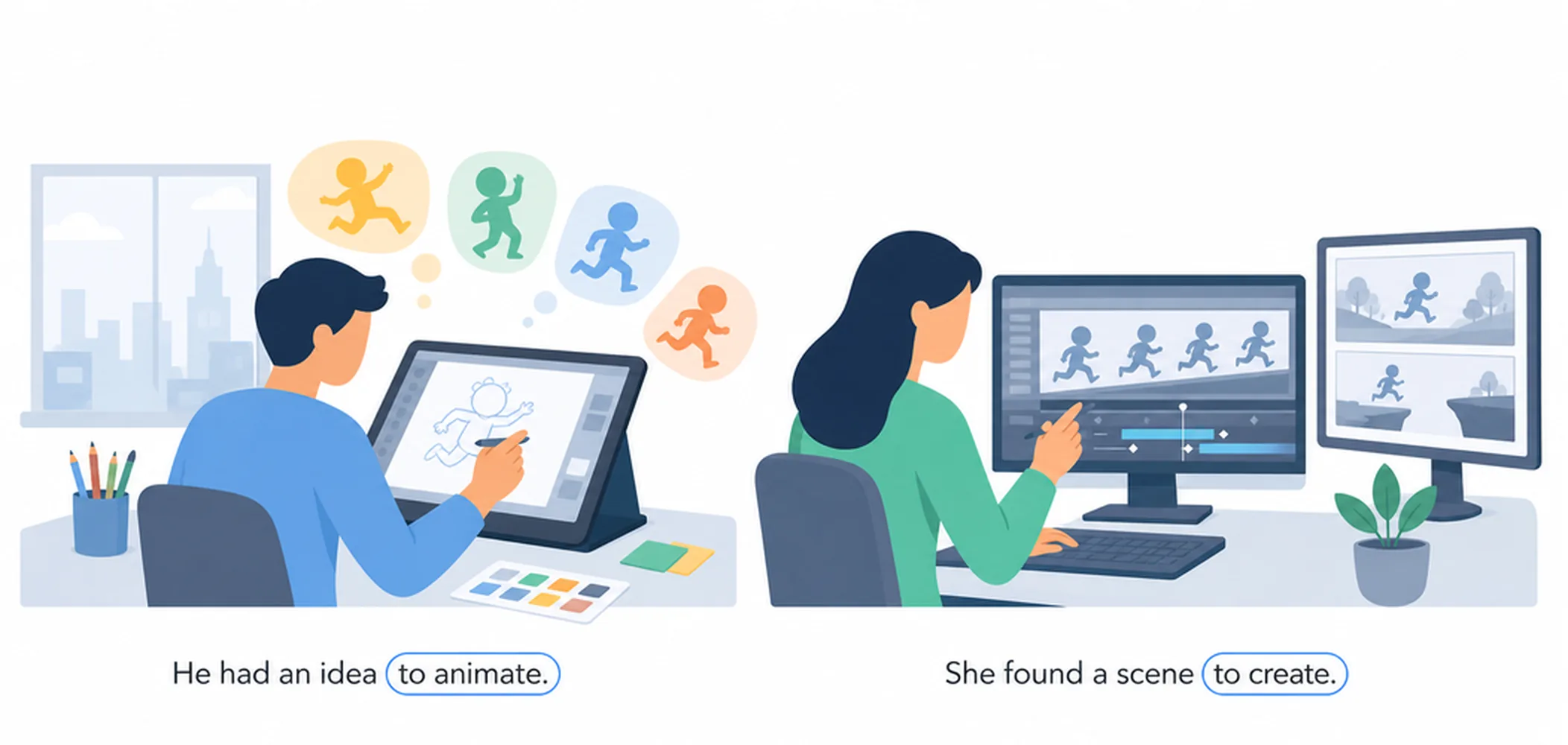
What is Postmodification with Infinitive Phrases?
Postmodification means adding extra information after a noun to describe or explain it. An infinitive phrase is a group of words that starts with the infinitive form of a verb (to + verb). When you use an infinitive phrase after a noun, you give more details about what the noun is, what it does, or what you can do with it. For example: "I have a book to read" — the phrase "to read" modifies the noun "book" and tells us the purpose of the book.
Why Use Infinitive Phrases?
Infinitive phrases help you write longer, more natural sentences without using extra clauses. Instead of saying "I need a person who can help me", you can say "I need a person to help me". Both mean the same thing, but the infinitive phrase is shorter and sounds more fluent. This is very common in spoken and written English, especially when you want to describe the purpose or function of something.
Common Patterns
The most common nouns that take infinitive phrases are: things with a purpose (book, tool, place), people with a role (person, teacher, doctor), and abstract nouns (ability, chance, decision). After these nouns, you can add "to + verb" to show what the noun is for or what can be done with it. The infinitive phrase always comes directly after the noun, with no other words between them in most cases.
Types of Nouns and Their Infinitive Postmodifiers
| Noun Type | Infinitive Pattern | Example | Note |
|---|---|---|---|
| Purpose nouns | noun + to-infinitive | a tool to measure pressure | Infinitive expresses what the noun is used for |
| Role / function nouns | noun + to-infinitive | the person to contact | Identifies who fulfils a particular function |
| Sequence / order nouns | ordinal noun + to-infinitive | the first student to arrive | Common with first, last, next, only |
| Abstract quality nouns | noun + to-infinitive | the ability to adapt | Nouns like ability, desire, tendency, need |
| Opportunity / chance nouns | noun + to-infinitive | an opportunity to speak | Nouns like chance, opportunity, time, moment |
| Decision / plan nouns | noun + to-infinitive | a plan to expand the network | Nouns like decision, plan, proposal, attempt |
| Way / method nouns | noun + to-infinitive | the best way to solve it | Nouns like way, method, approach, means |
| Quantity / amount nouns | noun + to-infinitive | enough money to buy a ticket | Often preceded by enough or too much/little |
Examples






What to Remember
- Infinitive phrases begin with "to + verb" and come after a noun to add information.
- Use infinitive phrases to show the purpose, function, or what you can do with something.
- The infinitive phrase modifies the noun that comes directly before it in the sentence.
- Infinitive phrases are common after nouns like "book," "way," "time," "place," and "reason."
- Don't confuse infinitive phrases with gerunds; infinitive phrases use "to + verb," not "-ing" forms.