What is a Complex Noun Phrase?
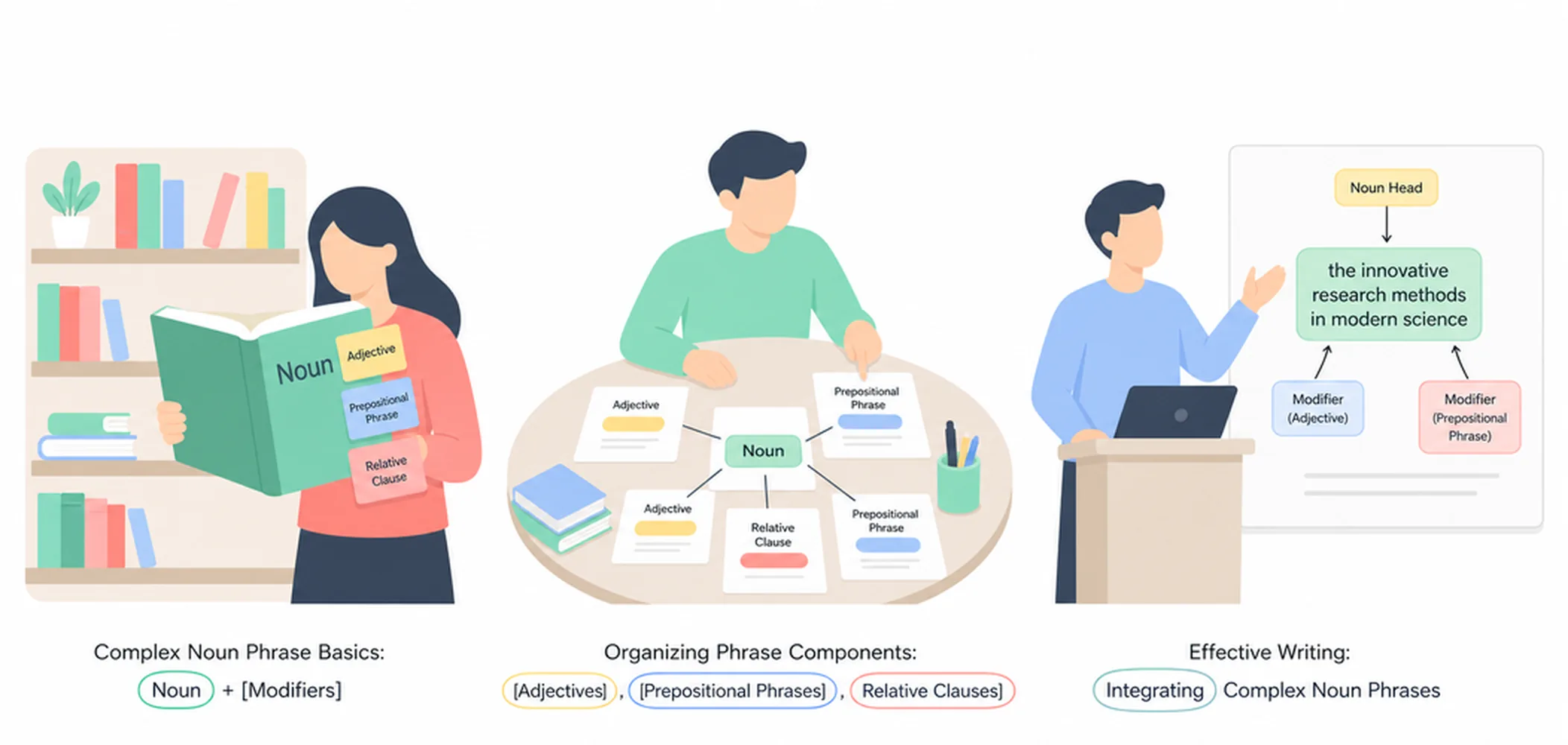
A complex noun phrase is a noun with one or more words or groups of words added before or after it. These additions, called modifiers, give more detailed information about the noun. In academic writing, complex noun phrases help you express complicated ideas more precisely and professionally. Instead of using many short sentences, you can pack more information into one phrase.
Pre-modifiers: Words Before the Noun
Pre-modifiers come before the main noun. They usually include adjectives, nouns used as adjectives, or numbers. For example, 'the rapid technological change' uses two adjectives (rapid, technological) before the noun 'change'. In academic writing, pre-modifiers help classify and describe your subject quickly. Common patterns include: adjective + noun ('previous research'), noun + noun ('climate data'), or multiple adjectives ('significant historical events').
Post-modifiers: Words After the Noun
Post-modifiers come after the noun and provide additional detail. They can be prepositional phrases ('the impact of globalization'), relative clauses ('the study that examined 500 participants'), or participle phrases ('the data collected in 2023'). Post-modifiers are especially useful in academic writing because they allow you to add important restrictions and explanations. They help you be more specific about which exact thing you mean, making your argument clearer.
Complex Noun Phrase Structures
Complex Noun Phrase Structures
Complex noun phrases in academic writing are built from several structural components arranged in a predictable order. These components include determiners, pre-modifiers (adjectives and noun modifiers), the head noun, and post-modifiers (prepositional phrases and relative clauses). Understanding these structures allows you to write more precise and detailed academic sentences.
Structure 1: Basic Pre-modified Noun Phrase
| Component | Function | Example |
|---|---|---|
| Determiner | Marks the beginning and specificity of the noun phrase | the, a, this, that |
| Adjective (Pre-modifier) | Describes qualities of the noun | rigorous, comprehensive, detailed |
| Noun Modifier | A noun used to modify another noun | peer-review, literature, research |
| Head Noun | The central noun being modified | process, review, data |
Example: The rigorous peer-review process ensures the quality of published research.
Analysis: Determiner (the) + Adjective (rigorous) + Noun modifier (peer-review) + Head noun (process)
Structure 2: Full Complex Noun Phrase with Pre- and Post-modifiers
| Component | Function | Example |
|---|---|---|
| Determiner | Marks the beginning and specificity | a, the, this |
| Adjective (Pre-modifier) | Describes qualities before the head noun | comprehensive, empirical, recent |
| Noun Modifier | A noun used to modify the head noun | literature, data, policy |
| Head Noun | The central noun | review, analysis, framework |
| Prepositional Phrase (Post-modifier) | Provides additional detail about location, time, or relationship | of recent studies, in climate science, by leading researchers |
| Relative Clause (Post-modifier) | Provides additional information with a dependent clause | that addresses climate adaptation, which demonstrates effectiveness |
Example: A comprehensive literature review of recent empirical studies that address climate adaptation was conducted.
Analysis: Determiner (a) + Adjective (comprehensive) + Noun modifier (literature) + Head noun (review) + Prepositional phrase (of recent empirical studies) + Relative clause (that address climate adaptation)
Structure 3: Noun Phrase with Negative Pre-modifiers
| Component | Function | Example |
|---|---|---|
| Determiner | Marks the beginning | the, a, this |
| Negative Prefix or Adjective | Negates or reverses the meaning of the following word | un-, in-, dis-; unlikely, inadequate, unclear |
| Adjective (Pre-modifier) | Further describes the noun | common, published, expected |
| Head Noun | The central noun | finding, result, outcome |
| Prepositional Phrase (Post-modifier) | Provides contextual detail | in the literature, of the study, among experts |
Example: The unlikely published result of the controversial study surprised many researchers.
Analysis: Determiner (the) + Negative adjective (unlikely) + Adjective (published) + Head noun (result) + Prepositional phrase (of the controversial study)
In academic writing, mastering these noun phrase structures enables you to convey complex ideas precisely. Use simple pre-modified structures for straightforward statements, and employ full structures with post-modifiers when you need to provide multiple layers of contextual information. Negative pre-modifiers should be used carefully to avoid ambiguity or overly complex sentences.
Examples






What to Remember
- A complex noun phrase adds modifiers before or after a noun to provide more detailed information.
- Pre-modifiers come before the main noun and include adjectives, nouns used as adjectives, or numbers.
- Post-modifiers come after the main noun and include prepositional phrases, relative clauses, or participle phrases.
- In academic writing, complex noun phrases replace multiple short sentences with more precise, professional expressions.
- Avoid overloading noun phrases with too many modifiers, as this reduces clarity and readability.