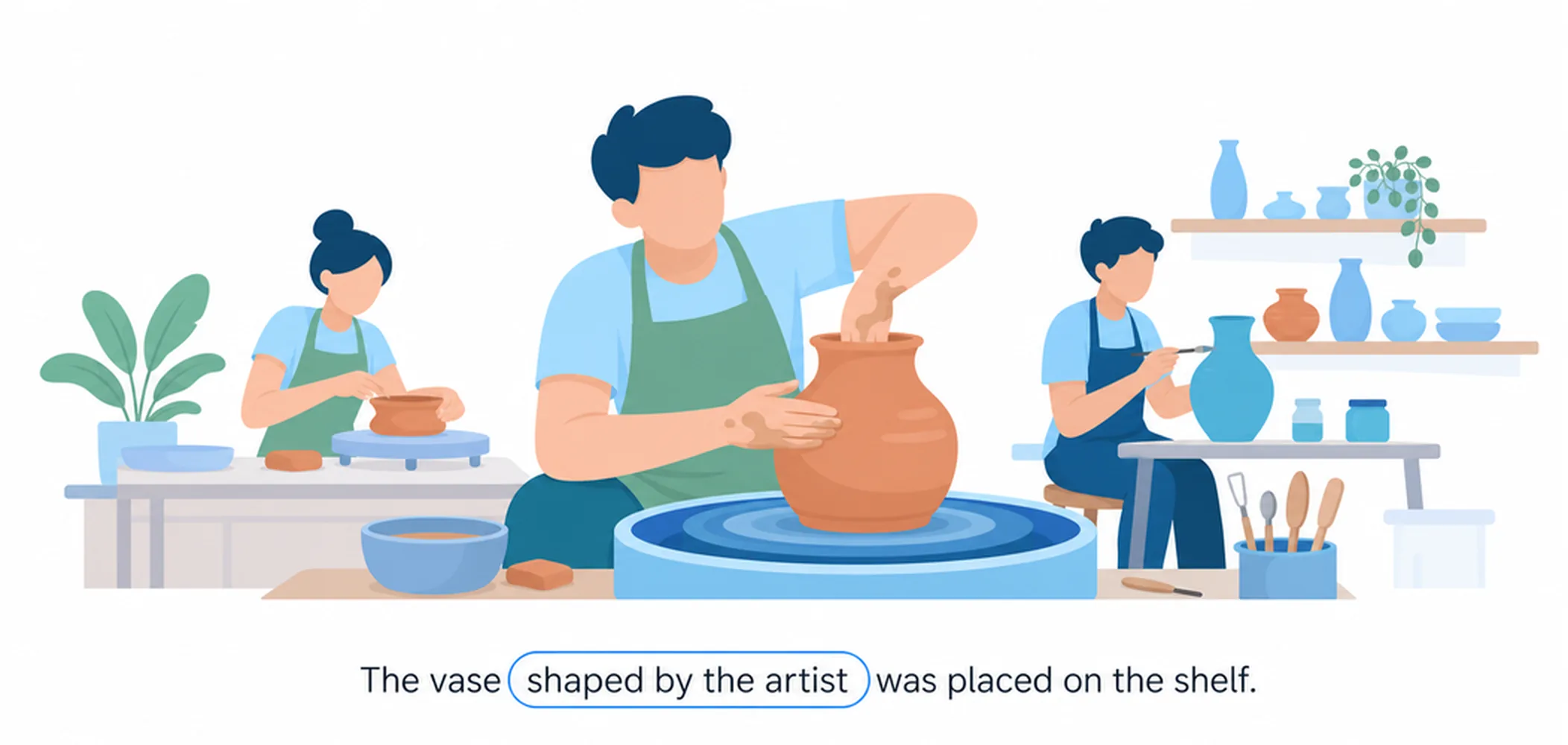
What is a Participle Phrase?
A participle phrase is a group of words that starts with a present participle (verb + -ing) or past participle (verb + -ed). When we place this phrase directly after a noun, it describes or adds information about that noun. This is called postmodification. It helps us write longer, more detailed sentences without using extra clauses. For example, instead of saying "The man who was sitting in the corner was nervous," we can say "The man sitting in the corner was nervous."
Present and Past Participles in Postmodification
Present participles (-ing) describe actions happening now or actions performed by the noun. They show active meaning. Past participles (-ed) describe actions that happened before or actions done to the noun. They show passive meaning. Both types make sentences more fluent and professional. You can use them in formal writing, academic texts, and everyday communication.
Why Use Participle Phrases?
Participle phrases help you write efficiently. Instead of creating multiple sentences or long relative clauses, you can express the same information in a shorter, clearer way. This is especially useful in academic writing, professional emails, and storytelling. The reader gets more information in fewer words, making your writing more sophisticated and easier to read.
Pro Tip for B1 Learners
Start by replacing relative clauses with participle phrases. Look for sentences with "who is" or "which was" and try to simplify them. For example: "Students who are studying hard" becomes "Students studying hard." This exercise helps you recognize and produce participle phrases naturally.
Present Participle vs Past Participle: Side-by-Side Comparison
| Aspect | Present Participle (-ing) Postmodifier | Past Participle (-ed / irregular) Postmodifier |
|---|---|---|
| Form | Base verb + -ing e.g., running, carrying, describing |
Base verb + -ed (regular) or irregular past participle form e.g., written, broken, organised |
| Meaning / Voice | Active meaning — the noun performs the action described by the participle. The noun is the agent/doer. |
Passive meaning — the action has been done to the noun; the noun is the receiver of the action. |
| When to Use | Use when the modified noun is actively doing something or is in the process of an action — ongoing, simultaneous, or habitual activity. | Use when the modified noun has had something done to it — a completed or received action, often implying a resulting state. |
| Positive Example | The woman carrying a red umbrella is my aunt. (The woman is carrying it — active.) |
The documents signed by the manager are on the desk. (The documents were signed — passive.) |
| Further Positive Example | The students sitting at the back missed the announcement. (The students are actively sitting there.) |
The bridge built in 1892 still stands today. (The bridge was built — it received the action.) |
| Negative / Incorrect Usage Example | ✗ The letter writing by the secretary… Incorrect — the letter does not write; it was written. A past participle is needed here. |
✗ The dog trained people in the park… Incorrect — if the dog is doing the training, use training. Trained implies the dog was trained by someone. |
| Relationship to a Relative Clause | Equivalent to an active relative clause: The man running = the man who is running |
Equivalent to a passive relative clause: The car stolen = the car that was stolen |
| Position in Sentence | Placed immediately after the noun it modifies. The child eating the cake smiled. |
Placed immediately after the noun it modifies. The cake eaten by the child was delicious. |
| Key Signal Words / Phrases | -ing form; often followed by an object, complement, or adverbial; implies the noun is doing, going, moving, producing. | -ed / irregular form; often followed by by + agent; implies the noun is made, built, written, chosen, broken, destroyed. |
| Time Reference | Generally describes an action simultaneous with or ongoing at the time of the main clause. | Generally describes an action completed before or resulting in the state relevant to the main clause. |
| 🔑 Key Difference: The core distinction is one of voice and agency. A present participle (-ing) postmodifier signals that the noun is the active doer of the action ("the dog barking loudly" — the dog barks), while a past participle (-ed/irregular) postmodifier signals that the noun is the passive receiver of the action ("the dog rescued from the shelter" — someone rescued the dog). Choosing the wrong form fundamentally changes — or destroys — the intended meaning of the sentence. | ||
Examples






What to Remember
- A participle phrase starts with a present participle (-ing) or past participle (-ed form).
- Place the participle phrase directly after the noun it describes to postmodify it.
- Use present participles (-ing) for active actions and past participles (-ed) for passive meanings.
- Postmodification avoids repeating relative clauses, making sentences more concise and natural sounding.
- Ensure the participle phrase clearly connects to the nearest noun to avoid confusion.