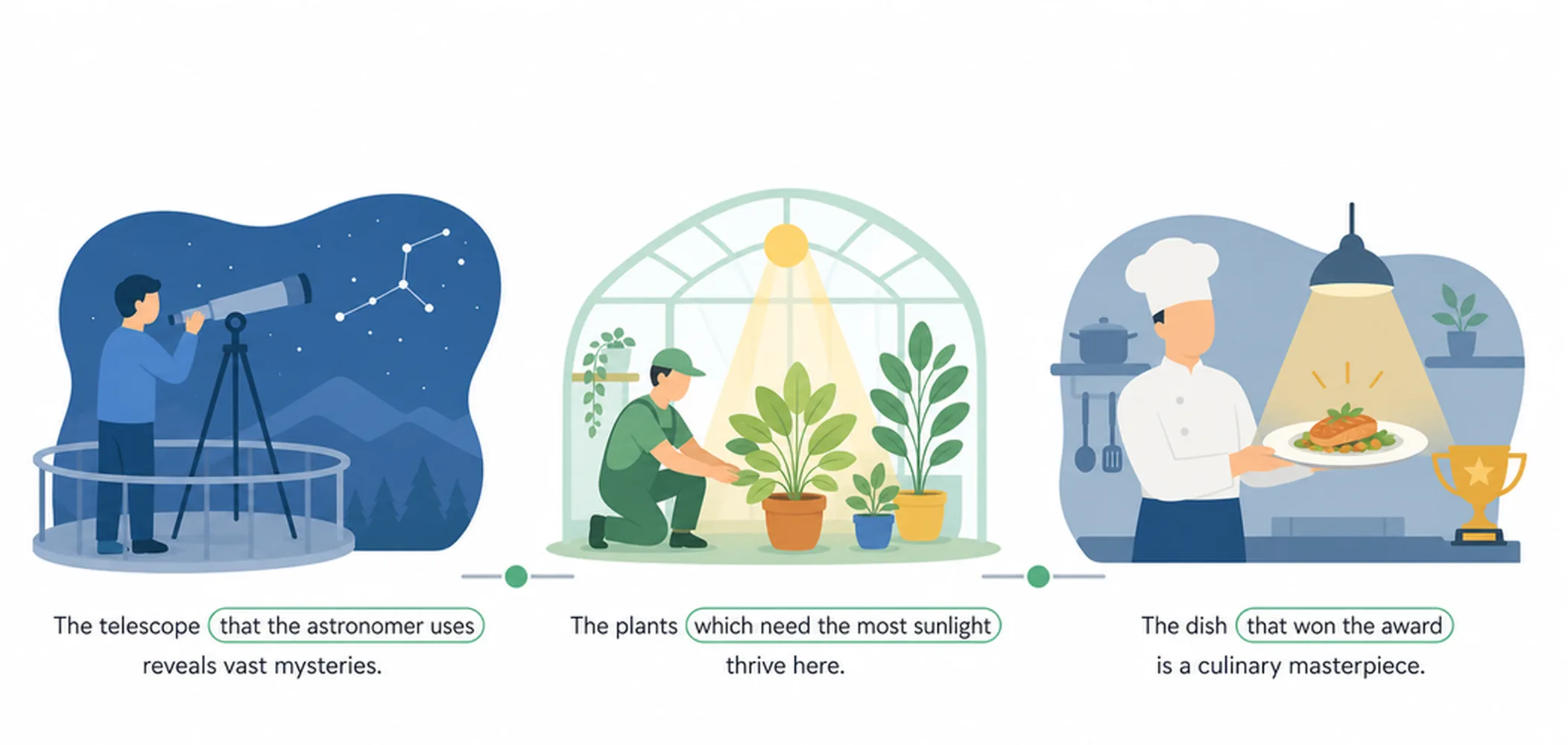
What is Postmodification?
Postmodification means adding information AFTER a noun to describe or identify it. One common way to do this is with a relative clause. A relative clause is a group of words that tells us more about a noun. It usually starts with a relative pronoun like 'who', 'which', 'that', or 'where'. For example: 'The book that I bought yesterday is excellent.' The relative clause 'that I bought yesterday' comes after the noun 'book' and gives us extra information about which book we are talking about.
Two Types of Relative Clauses
There are two important types: restrictive and non-restrictive clauses. A restrictive clause is essential — it identifies which person or thing you mean. You do NOT use commas. Example: 'The students who scored above 80% passed the exam.' Here, the clause tells us WHICH students passed. A non-restrictive clause adds extra, non-essential information. You USE commas before and after it. Example: 'My sister, who lives in Paris, is a teacher.' The clause tells us where she lives, but we already know who she is. Without this clause, the sentence still makes complete sense.
Common Relative Pronouns
Different relative pronouns work with different noun types. Use 'who' or 'that' for people: 'The woman who helped me yesterday was very kind.' Use 'which' or 'that' for things and animals: 'The car which my parents bought last year is blue.' Use 'where' for places: 'The office where I work is near the station.' You can also use 'whose' to show possession: 'The student whose homework was excellent received a prize.' At B1 level, 'that' is the most common and safe choice for things, and 'who' for people.
Restrictive vs Non-Restrictive Relative Clauses — Side-by-Side Comparison
| Dimension | Restrictive Relative Clause | Non-Restrictive Relative Clause |
|---|---|---|
| Purpose | Identifies or defines the noun — it restricts the noun's reference to a specific subset, making the noun's meaning more precise. The clause is essential to understanding which person or thing is meant. | Adds extra, supplementary information about a noun that is already fully identified. The clause is parenthetical and provides background detail rather than identification. |
| Comma Usage | No commas are used. The clause is written immediately after the noun without any punctuation separation, showing it is tightly integrated into the sentence meaning. | Always set off by commas (or dashes/parentheses). A comma appears before the relative pronoun and after the clause if the sentence continues, marking it as additional, removable information. |
| Omissibility | Cannot be removed without fundamentally changing the meaning or making the sentence unclear. Removing it leaves the reader unsure which specific person or thing is being discussed. | Can be removed without changing the core meaning of the sentence. The main clause remains grammatically complete and still refers to the same specific noun even without the extra detail. |
| Pronoun Choices | Can use who, whom, which, or that. In informal English, that is very common with both people and things. The relative pronoun can also be omitted (zero relative) when it is the object of the clause. | Uses who, whom, or which only. That is generally not used in non-restrictive clauses. The zero relative (omission of the pronoun) is not possible in non-restrictive clauses. |
| Positive Example | The student who studied hardest passed the exam. Here, the clause identifies which specific student is meant — the one who studied hardest — distinguishing them from other students. |
Maria, who studied hardest, passed the exam. Here, Maria is already fully identified by name; the clause simply adds the extra fact that she studied hardest. It could be removed without confusion. |
| Negative Example | Employees who do not meet targets will not receive a bonus. The clause restricts employees to only those who fail to meet targets — a specific group, not all employees. |
The annual bonus, which is not guaranteed, depends on company performance. The bonus is already identified as the annual bonus; the clause adds a clarifying but non-essential remark about its nature. |
| Question Example | Is the book that I ordered available yet? The clause tells us exactly which book is being asked about — the one the speaker ordered — not just any book. |
Have you read War and Peace, which is considered a classic? The title already identifies the book; the clause adds a widely known fact as extra commentary within the question. |
| Key Signal Words / Tests | Often introduced by that, who, or which. Test: ask "Does removing the clause change which noun I mean?" If yes, the clause is restrictive. Common with indefinite or general nouns (a man who…, all students who…). | Often introduced by who, whom, or which (never that). Test: ask "Is the noun already uniquely identified before the clause?" If yes, the clause is non-restrictive. Common with proper nouns, unique nouns, or nouns with definite articles referring to one specific item. |
Examples





What to Remember
- Postmodification adds descriptive information after a noun to identify or describe it more clearly.
- Relative clauses are the main tool for postmodification and begin with who, which, that, or where.
- Use who for people, which for things, and that for both people and things.
- The relative clause directly follows the noun it describes and provides essential or extra information.
- Omit the relative pronoun only when it is the object of the relative clause, not the subject.