Grammar B1 Complex Noun Phrases

Premodification — adjectives before nouns

Premodification — adjectives before nouns

What is Premodification?

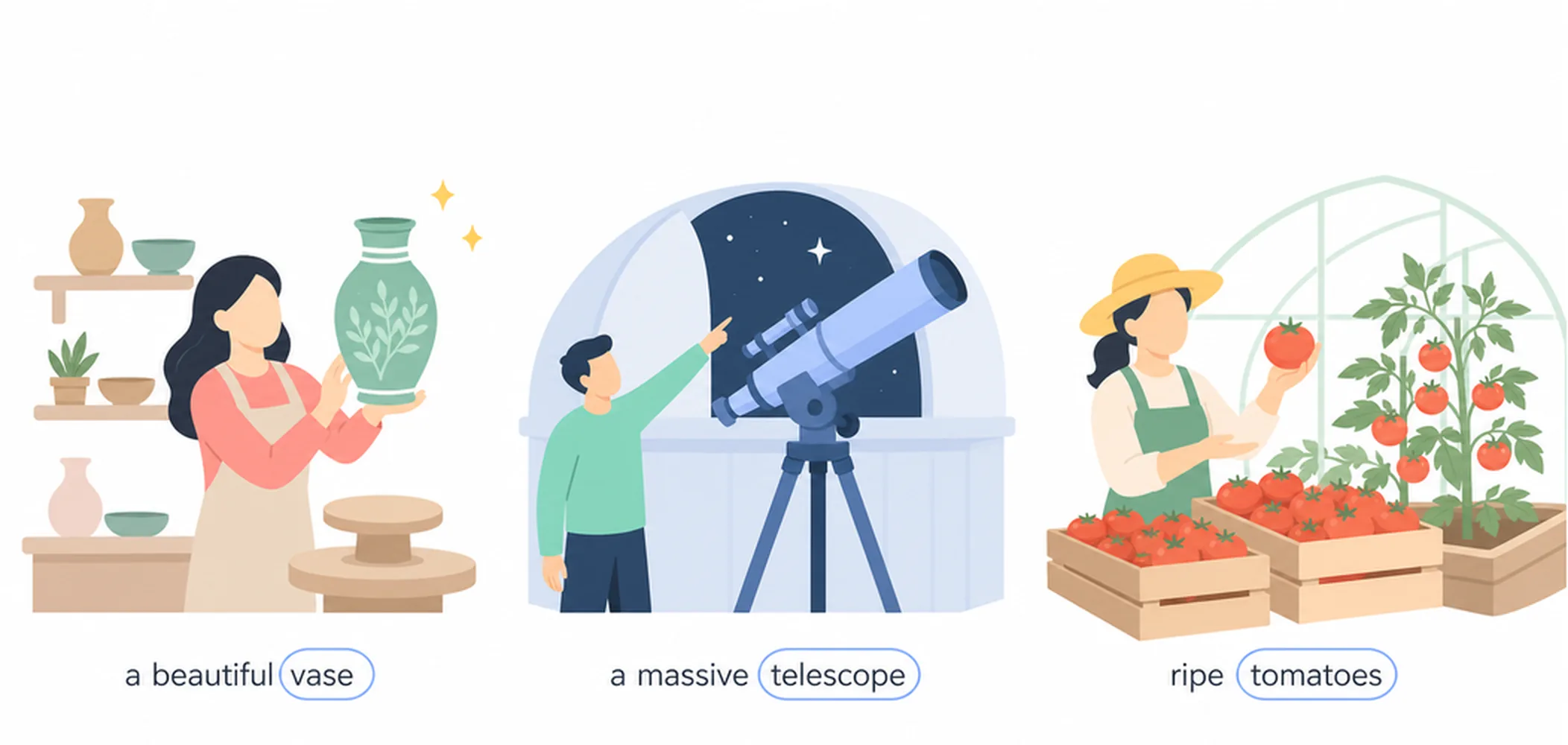
Premodification means placing adjectives before a noun to describe it. When we add adjectives before a noun, we give more information about that noun. For example, instead of saying 'a car', we can say 'a fast red car' or 'an expensive sports car'. The adjectives come between the article (a, an, the) and the noun. This is a natural and common way to make your descriptions more detailed and interesting in English.

Basic Structure of Premodification

The basic pattern is: Article + Adjective(s) + Noun. You can use one adjective or several adjectives together. When using multiple adjectives, there is usually a natural order: opinion adjectives come first (beautiful, ugly, wonderful), then size adjectives (big, small, tiny), then colour adjectives (red, blue, green), and finally material or type adjectives (wooden, plastic, sports). For example: 'a beautiful small red wooden box' follows this natural order. However, in everyday English, we often use just one or two adjectives, and the order is flexible.

Why Use Premodification?

Using premodified nouns helps you communicate more clearly and efficiently. Instead of using separate sentences, you can combine information into one noun phrase. For example, you can say 'a modern glass building' instead of 'a building that is modern and made of glass'. This makes your speaking and writing more natural and more advanced. Premodification is especially useful in descriptions, storytelling, and professional writing.

Adjective Order in Premodification

Position Category Example Word In a Phrase
1 Opinion lovely a lovely old lamp
2 Size tiny a lovely tiny old lamp
3 Age ancient a lovely tiny ancient lamp
4 Shape oval a lovely tiny ancient oval mirror
5 Colour crimson a lovely tiny ancient oval crimson mirror
6 Origin Italian a lovely tiny ancient oval crimson Italian leather bag
7 Material leather a lovely tiny ancient oval crimson Italian leather bag
8 Type / Purpose sleeping a lovely tiny ancient oval crimson Italian leather sleeping bag
Cumulative Example: Notice how adjectives build in order from left to right. The complete phrase "a lovely tiny ancient oval crimson Italian leather sleeping bag" demonstrates the correct adjective order sequence, with each new adjective added in its proper position.
Formula
Formula
Article + Adjective(s) + Noun
a beautiful red rose

Examples

He drove a sleek black car down the highway.
Everyday usage · Adjectives before noun
The old wooden house at the end of the street needs repair.
Description · Multiple adjectives
He drove a fast expensive sports car down the highway.
Everyday usage · Three adjectives in order
We visited a small traditional Italian restaurant last weekend.
Daily conversation · Opinion + type adjectives
The soft morning light came through the large windows.
Descriptive writing · Time + quality adjectives
They live in a comfortable modern apartment in the city centre.
Everyday usage · Opinion + time adjectives
When to use it
Shopping & Describing Products
Use premodification to clearly describe what you want to buy. This helps shop assistants understand exactly what you're looking for.
"I'm looking for a small black leather handbag."
Real Estate & Accommodation
When describing apartments or houses, premodified nouns make your description more professional and detailed.
"We found a spacious modern three-bedroom apartment near the park."
Writing & Storytelling
Premodification makes your writing more interesting and vivid by adding colour and detail to your descriptions.
"The ancient stone castle stood on top of the misty green mountain."
Conversation & Social Interaction
Use premodified nouns to express yourself more naturally and efficiently in everyday conversations.
"My new Italian friend teaches at the local university."
Signal words
adjective noun premodification before the noun article description detailed natural order
Common Mistakes
Wrong
a car red fast
Correct
a fast red car
Adjectives follow a natural order: opinion (fast) before colour (red) before noun.
Wrong
a beautiful very old house
Correct
a very beautiful old house OR a beautiful very old house
Adverbs like 'very' come before the adjective they modify, not between two adjectives.
Wrong
an interesting book English
Correct
an interesting English book
Nationality/type adjectives (English) usually come before the noun, after opinion adjectives.
Wrong
a big house comfortable
Correct
a big comfortable house
All adjectives must come before the noun, not after it (unless using 'is' or another verb).
KEY TAKEAWAYS

What to Remember

  • Adjectives come between the article and the noun to add description.
  • The basic pattern is: Article + Adjective(s) + Noun.
  • You can use one adjective or multiple adjectives before a noun.
  • Premodification makes descriptions more detailed and detailed without changing the noun.
  • Articles (a, an, the) always come before adjectives, not after them.
← Previous
What are complex noun phrases?
Next →
Postmodification — relative clauses after nouns