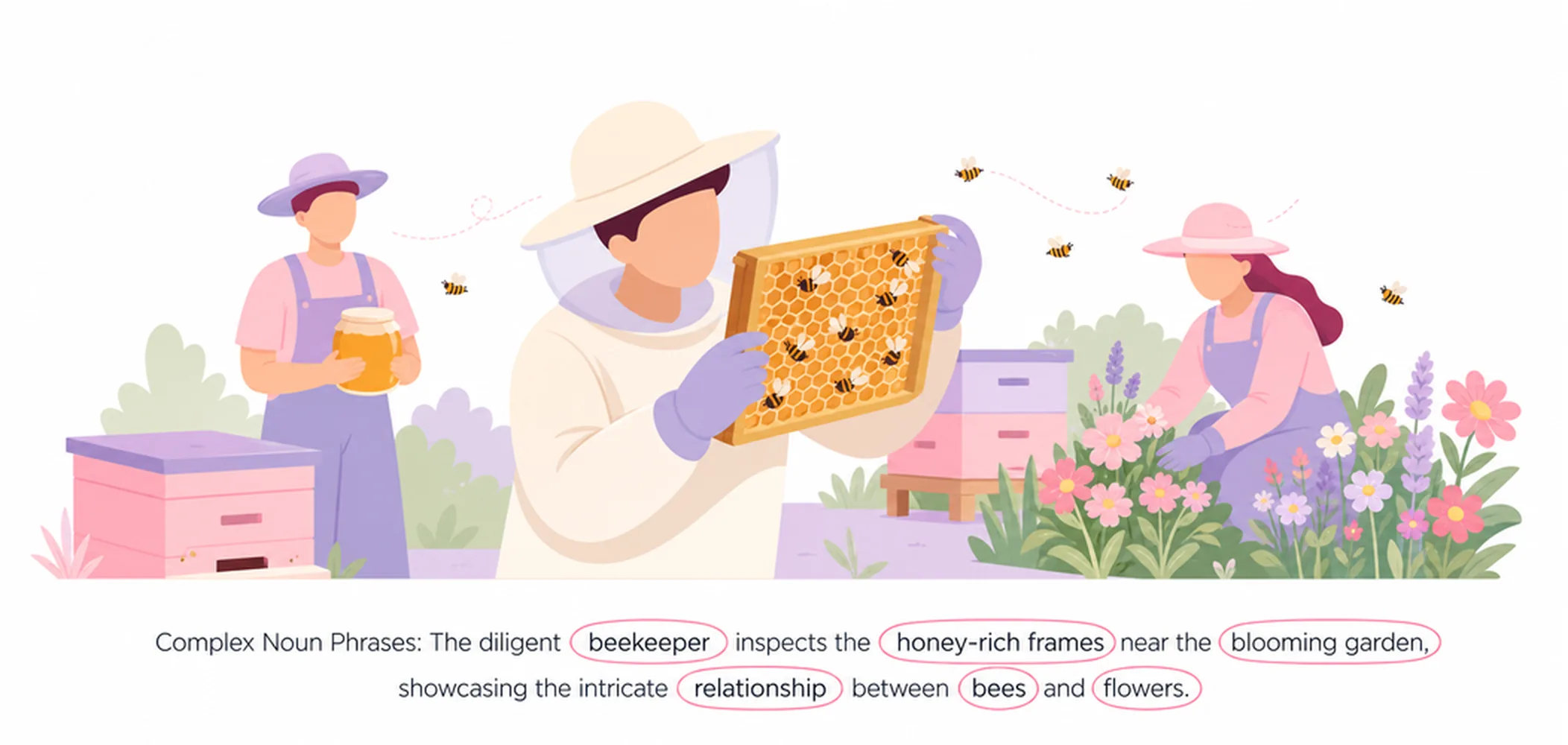
What is a Complex Noun Phrase?
A complex noun phrase is a noun with one or more words or groups of words that modify it. Instead of using just a simple noun like 'house' or 'book', we add extra information around it to make it more detailed. For example, 'the old wooden house on the hill' is a complex noun phrase. The noun 'house' is the core word, and the other parts (the, old, wooden, on the hill) all give us more information about it. Complex noun phrases help us communicate more precisely and make our writing richer.
Main Types of Complex Noun Phrases
Complex noun phrases can be built in several ways. The most common way is to add adjectives before the noun: 'a beautiful red car'. You can also add prepositional phrases after the noun: 'the book on the table'. Another way is to use relative clauses (clauses that start with who, which, or that): 'the student who won the competition'. Sometimes we combine these methods together: 'the tall woman in the blue dress who works at the hospital'. Each method gives us different ways to add meaning and detail to our nouns.
Why We Use Complex Noun Phrases
Using complex noun phrases makes our language more interesting and helps us avoid repetition. Instead of saying 'I have a dog. The dog is brown. The dog is friendly. I found the dog yesterday,' we can say 'I found a friendly brown dog yesterday.' This is clearer and sounds more natural. In academic and professional English, complex noun phrases help us be specific and communicate detailed information efficiently. Learning to use them well is an important skill for more advanced English.
Types of Complex Noun Phrase Modifiers Compared
| Feature | Adjective Pre-modifier | Noun Pre-modifier | Prepositional Phrase Post-modifier | Relative Clause Post-modifier | Participle Phrase Post-modifier |
|---|---|---|---|---|---|
| Position | Before the head noun (pre-modification) | Before the head noun (pre-modification) | After the head noun (post-modification) | After the head noun (post-modification) | After the head noun (post-modification) |
| Structure | Adjective + head noun (one or more adjectives placed directly before the noun) |
Noun + head noun (a noun used attributively to describe another noun) |
Head noun + preposition + noun phrase (e.g., of, in, on, with, at) |
Head noun + relative pronoun + clause (who, which, that, whom, whose) |
Head noun + present or past participle + phrase (-ing for active; -ed/-en for passive) |
| When to Use | To describe qualities, characteristics, or attributes of the noun (size, colour, opinion, age, etc.) | To indicate the purpose, type, or category of the head noun, often forming a compound concept | To specify location, origin, belonging, or association related to the head noun | To add a defining or non-defining clause that identifies or gives extra information about the head noun | To describe an action or state associated with the head noun, often replacing a relative clause for conciseness |
| Positive Example | the tall, elegant woman → "tall" and "elegant" are adjectives modifying "woman" |
the stone wall → "stone" is a noun modifying the head noun "wall" |
the woman from the village → "from the village" is a prepositional phrase modifying "woman" |
the woman who lives next door → "who lives next door" is a relative clause modifying "woman" |
the woman carrying a red umbrella → "carrying a red umbrella" is a present participle phrase modifying "woman" |
| Contrastive Example | a mysterious stranger (adjective) vs. a stranger from out of town (prepositional phrase) → Adjective pre-modifiers are more compact; post-modifiers provide more detail |
a coffee cup (noun modifier) vs. a cup made of ceramic (participle phrase) → Noun pre-modifiers express type or purpose; post-modifiers express composition or action |
the book on modern art (post-modifier specifies topic) vs. a modern art book (pre-modifiers create a compound concept) → Post-modifiers add detail; pre-modifiers create fixed categories |
the house that was built in 1920 (defining relative clause) vs. the house, which overlooks the lake, is historic (non-defining relative clause) → Defining clauses identify which noun; non-defining clauses add extra information |
the letter written in invisible ink (passive sense) vs. the child playing in the garden (active sense) → Past participles suggest passive action; present participles suggest active action |
| Question Example | Did you see the old, abandoned factory? → "old" and "abandoned" pre-modify "factory" |
Have you visited the city library? → "city" (noun) pre-modifies "library" |
Is that the report on the new policy? → "on the new policy" post-modifies "report" |
Did you speak to the man who called earlier? → "who called earlier" post-modifies "man" |
Can you find the documents filed last week? → "filed last week" (past participle phrase) post-modifies "documents" |
| Key Signal Words / Markers | Descriptive adjectives: big, beautiful, ancient, dark, heavy, important, unusual | Compound-style nouns used attributively: stone, silver, kitchen, garden, school, city, water | Prepositions: of, in, on, at, with, by, about, from, under, between, for, without | Relative pronouns: who, whom, whose, which, that Relative adverbs: where, when, why |
Present participles: -ing (running, carrying, showing) Past participles: -ed / -en (broken, written, known, frozen) |
| Key Difference: Pre-modifiers (adjectives and nouns) appear before the head noun and give compact, condensed information about its qualities or type. Post-modifiers (prepositional phrases, relative clauses, and participle phrases) appear after the head noun and provide more detailed, expanded information — specifying location, identity, or associated actions. The more modifier types combined within a single noun phrase, the more complex that noun phrase becomes. | |||||
Examples






What to Remember
- A complex noun phrase is a noun with modifiers that add extra information about it.
- Modifiers can be adjectives, prepositional phrases, or other word groups placed before or after the noun.
- The core noun is the essential part; all other words modify and describe it.
- Complex noun phrases help you communicate more precisely and make your writing more detailed.
- Don't confuse complex noun phrases with compound nouns; complex phrases have modifiers, compounds are single fixed terms.