Grammar B2 Discourse Markers & Cohesion

Discourse markers in academic writing

Discourse markers in academic writing

What Are Discourse Markers?

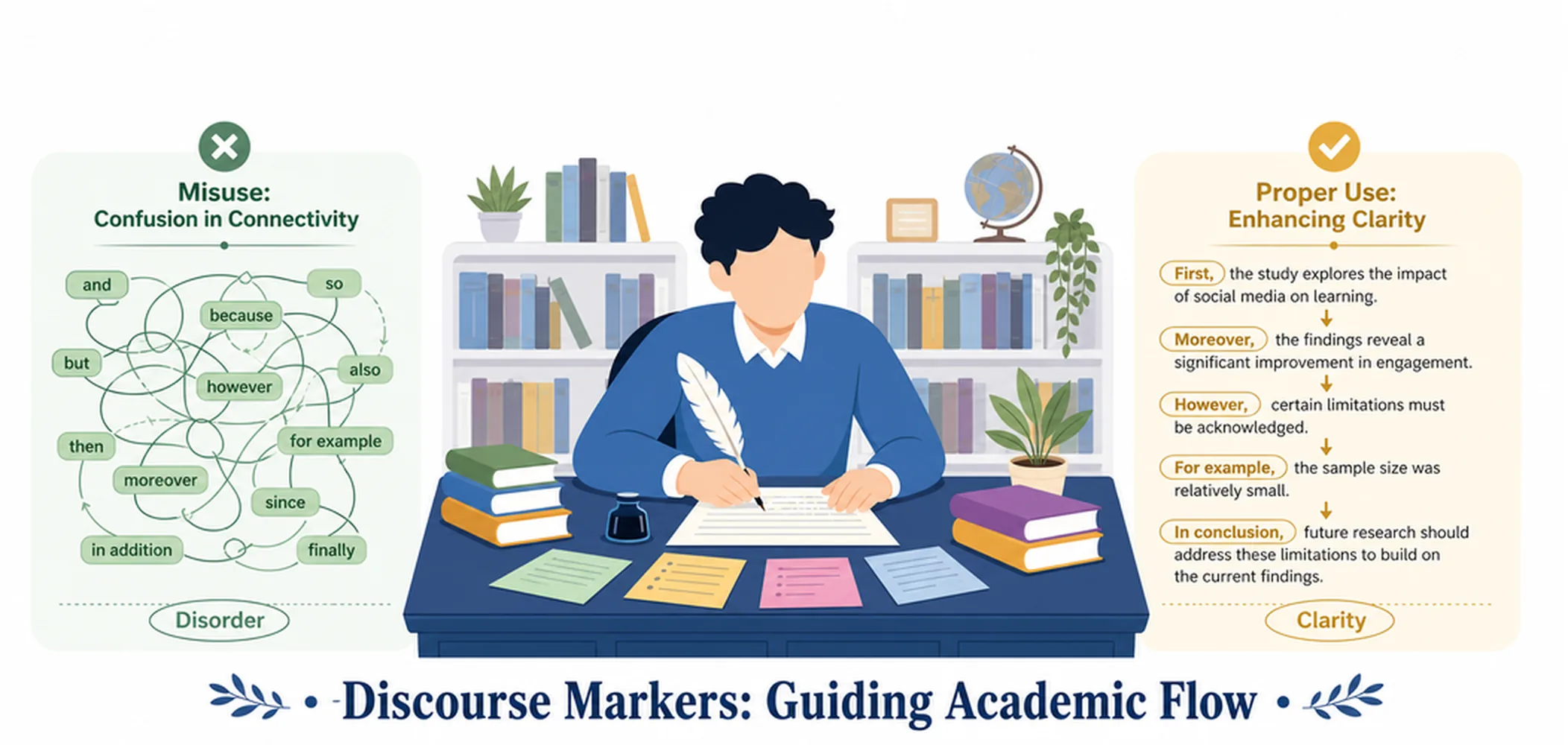
Discourse markers are words and phrases that connect sentences and ideas together in writing. They help readers understand the relationship between different parts of your text. In academic writing, discourse markers are essential for creating clear, organized arguments. They signal whether you are adding information, showing contrast, explaining cause and effect, or drawing conclusions. Without them, your writing can feel disconnected and hard to follow.

Main Types of Discourse Markers

There are four main categories of discourse markers used in academic writing. Addition markers (such as furthermore, moreover, in addition) help you add more information or examples. Contrast markers (such as however, in contrast, nevertheless) show that two ideas are different or opposite. Cause and effect markers (such as therefore, consequently, as a result) explain why something happens. Finally, conclusion markers (such as in conclusion, to summarize, ultimately) help you wrap up your argument or summarize key points. Choosing the right marker makes your ideas flow smoothly and helps your reader understand your logic.

Using Discourse Markers Correctly

Discourse markers can appear at different positions in a sentence. Some are placed at the beginning of a sentence, followed by a comma (Furthermore, this research shows...). Others can appear in the middle of a sentence (The data, however, suggests otherwise). In academic writing, it is important to use a variety of markers and avoid repeating the same ones too often. Be careful not to overuse discourse markers, as this can make your writing seem stiff or unnatural. The best academic writing uses markers smoothly, without drawing attention to them.

Discourse Markers Quick Reference Table

Category Logical Relationship Examples Usage Note
Addition Adds information to support or extend a point furthermore, moreover, in addition, additionally, also, besides, likewise Use at the start of a sentence or clause; furthermore and moreover imply the added point is stronger or more important.
Contrast Signals opposition, limitation, or an unexpected difference between ideas however, nevertheless, nonetheless, on the other hand, in contrast, yet, although, while, whereas, despite this However is most common; nevertheless/nonetheless concede a point but push back; whereas/while compare within one sentence.
Cause & Effect Shows that one idea produces, causes, or results from another therefore, thus, consequently, as a result, hence, for this reason, owing to, due to, because of, this leads to Therefore/thus introduce logical conclusions; consequently/as a result stress real-world outcomes; hence is more formal.
Conclusion Summarises, restates, or draws a final inference from the argument in conclusion, to conclude, in summary, to summarise, overall, on balance, ultimately, in short, to sum up Reserved for the final paragraph; avoid using in conclusion mid-essay; overall/on balance suit evaluative or argumentative writing.

Examples

The study found significant results. Moreover, the findings were confirmed in three separate experiments.
Addition marker · Academic writing
Previous research suggested this conclusion. However, recent evidence contradicts this interpretation.
Contrast marker · Formal tone
The temperature increased by 5 degrees. Consequently, the plants grew faster than expected.
Cause and effect marker · Scientific writing
We examined four different methods, each with distinct advantages. In conclusion, the third method proved most effective.
Conclusion marker · Wrapping up arguments
The data shows a clear trend. Furthermore, this pattern appears in all demographic groups.
Addition marker · Building arguments
Many experts believe this approach works. Nevertheless, we should consider alternative solutions.
Contrast marker · Formal academic style
When to use it
Building Arguments
Use addition markers to support your main point with extra evidence, examples, or related ideas. This strengthens your argument and makes it more convincing.
"The economy improved in 2023. In addition, employment rates reached record highs."
Showing Balance
Use contrast markers when you want to present different viewpoints or acknowledge limitations. This shows you understand complexity in your topic.
"Some studies support this theory. On the other hand, other research questions its validity."
Explaining Relationships
Use cause and effect markers to show why something happened or what resulted from it. This makes your reasoning clear and logical.
"The company reduced costs significantly. As a result, profit margins increased by 12%."
Concluding Points
Use conclusion markers at the end of arguments or essays to summarize and emphasize your main message to the reader.
"In summary, the research confirms the original hypothesis on three key measures."
Signal words
furthermore moreover in addition also additionally however in contrast nevertheless on the other hand conversely therefore consequently as a result thus in conclusion to summarize ultimately in summary
Common Mistakes
Wrong
The results were positive. But furthermore, we found unexpected patterns.
Correct
The results were positive. Furthermore, we found unexpected patterns.
Don't use 'but' with 'furthermore' — choose one connector, not two.
Wrong
The data shows clear trends, however our sample was small.
Correct
The data shows clear trends. However, our sample was small.
Use a period before 'however' at the start of a sentence, not a comma.
Wrong
High temperatures caused crop failure. Therefore the farmers needed financial help.
Correct
High temperatures caused crop failure. Therefore, the farmers needed financial help.
Use a comma after discourse markers at the beginning of sentences.
Wrong
This method is quick, efficient, and moreover inexpensive.
Correct
This method is quick and efficient. Moreover, it is inexpensive.
Don't use 'moreover' in a list; use it to connect separate sentences.
KEY TAKEAWAYS

What to Remember

  • Use discourse markers to connect sentences and show relationships between ideas clearly.
  • Place discourse markers at the beginning or middle of sentences, not randomly throughout.
  • Choose the correct marker for your purpose: addition, contrast, cause and effect, or conclusion.
  • Avoid overusing discourse markers or your writing will feel repetitive and artificial.
  • Ensure your discourse marker logically matches the relationship between the sentences it connects.
← Previous
Discourse markers in spoken English
Next →
Discourse markers — 50 examples