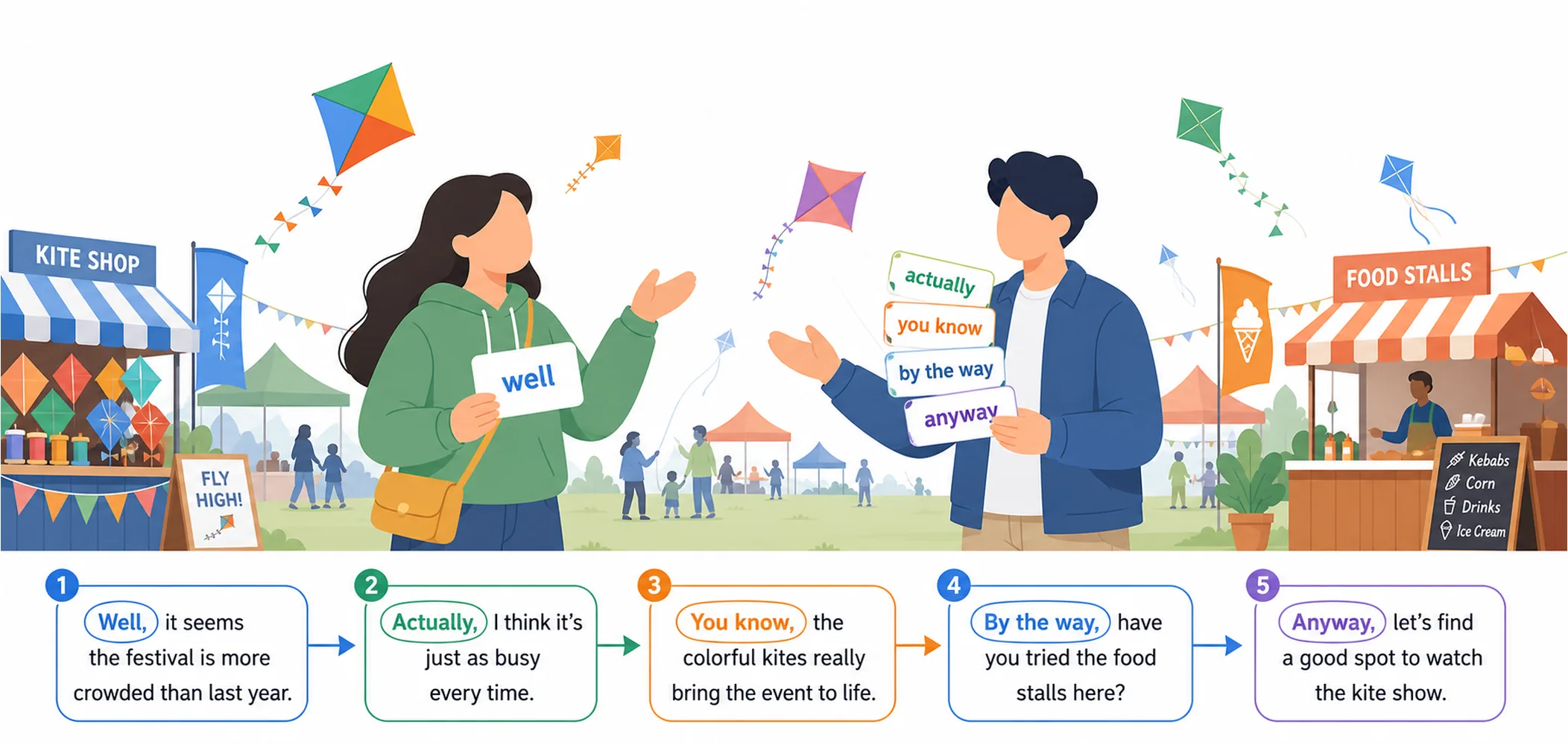
What Are Discourse Markers?
Discourse markers are words or phrases that connect ideas in conversation. They help organize what we say and make spoken English flow more naturally. Unlike formal written conjunctions like "however" or "therefore," discourse markers are often shorter, more casual, and used at the beginning of sentences or utterances. Common examples include "so," "well," "I mean," and "you know." They signal relationships between ideas—addition, contrast, explanation, or conclusion—while also helping speakers think and maintain listener attention.
Types of Discourse Markers
```html
Discourse markers fall into several categories. Understanding these types helps you recognize how native speakers naturally structure conversation.
| Category | Function | Examples |
|---|---|---|
| Connective markers | Link ideas together | so, and, because |
| Reformulative markers | Clarify or rephrase content | I mean, that is, in other words |
| Checking markers | Confirm shared understanding with the listener | you know, innit, right? |
| Temporal markers | Show sequence and time relationships | then, next, after that |
| Focusing markers | Draw attention to what follows | well, actually, basically |
```
Why Discourse Markers Matter in Speaking
In spoken English, discourse markers do much more than connect sentences. They make you sound natural and confident by filling pauses, buying thinking time, and showing politeness or engagement. They also help listeners follow your thoughts and prepare them for what comes next. Overusing them can make speech sound repetitive or unprepared, while using them appropriately shows fluency and communication skill. Learning to use discourse markers correctly is essential for sounding like a native speaker in casual conversation.
Discourse Markers at a Glance
| Function | Marker | Example | When / How to Use |
|---|---|---|---|
| Adding | and also | "It's cheap, and also really convenient." | Adds a related point; slightly more emphatic than plain and |
| what's more | "What's more, you get free delivery." | Adds a stronger or more surprising extra point | |
| on top of that | "On top of that, the staff were rude." | Piles on an additional (often negative) point | |
| not only that | "Not only that, she speaks three languages." | Signals something even more impressive is coming | |
| plus | "Plus, it saves time." | Informal; quick way to add another reason or fact | |
| Contrasting | but | "I liked it, but it was too long." | Most common spoken contrast; used mid-sentence or at start of a new turn |
| however | "However, the price is still high." | Slightly more formal; used at the start of a new sentence or clause | |
| even so | "Even so, I'd recommend it." | Concedes a point but maintains a contrasting position | |
| then again | "Then again, maybe I'm wrong." | Casual; reconsiders what was just said | |
| mind you | "Mind you, it did cost a lot." | Informal British English; adds a qualifying contrast | |
| Clarifying | I mean | "It was fine — I mean, not great, but fine." | Very common; repairs or restates what was just said |
| in other words | "In other words, it failed." | Reformulates a point more simply or directly | |
| that is (to say) | "It's free — that is, for members." | Adds precision or a qualification to a statement | |
| what I mean is | "What I mean is, it's complicated." | Used when clarifying after sensing confusion or misunderstanding | |
| basically | "Basically, we ran out of money." | Informal; simplifies or gets to the core point quickly | |
| Sequencing | first (of all) | "First of all, let me explain the problem." | Opens a list or sequence of points |
| then / after that | "Then we went to the station." | Moves the narrative or list to the next step | |
| next | "Next, add the eggs." | Common in instructions or step-by-step explanations | |
| finally / lastly | "Finally, save the file." | Signals the last item in a sequence | |
| to start with | "To start with, I wasn't sure." | Informal alternative to first; often implies a change happened later | |
| Checking Understanding | you know? | "It was overwhelming, you know?" | Invites the listener to confirm shared understanding or empathy |
| right? | "You see what I mean, right?" | Quick check that the listener is following or agrees | |
| don't you think? | "That's unfair, don't you think?" | Seeks the listener's opinion or validation of a statement | |
| if you know what I mean | "She was a bit much, if you know what I mean." | Assumes shared context or unspoken understanding between speaker and listener | |
| okay? | "We'll meet at five, okay?" | Confirms agreement or understanding; often marks the end of an instruction |
Examples





What to Remember
- Discourse markers connect ideas in conversation and make spoken English flow more naturally than formal written conjunctions.
- Common discourse markers like "so," "well," "I mean," and "you know" are casual and typically appear at utterance beginnings.
- Discourse markers signal relationships between ideas: addition, contrast, explanation, or conclusion, helping listeners follow your thoughts clearly.
- Unlike formal conjunctions, discourse markers are shorter, more conversational, and function to organize speech rather than grammar structure.
- Avoid overusing discourse markers; excessive use can make speech sound unclear, so use them purposefully to enhance clarity.