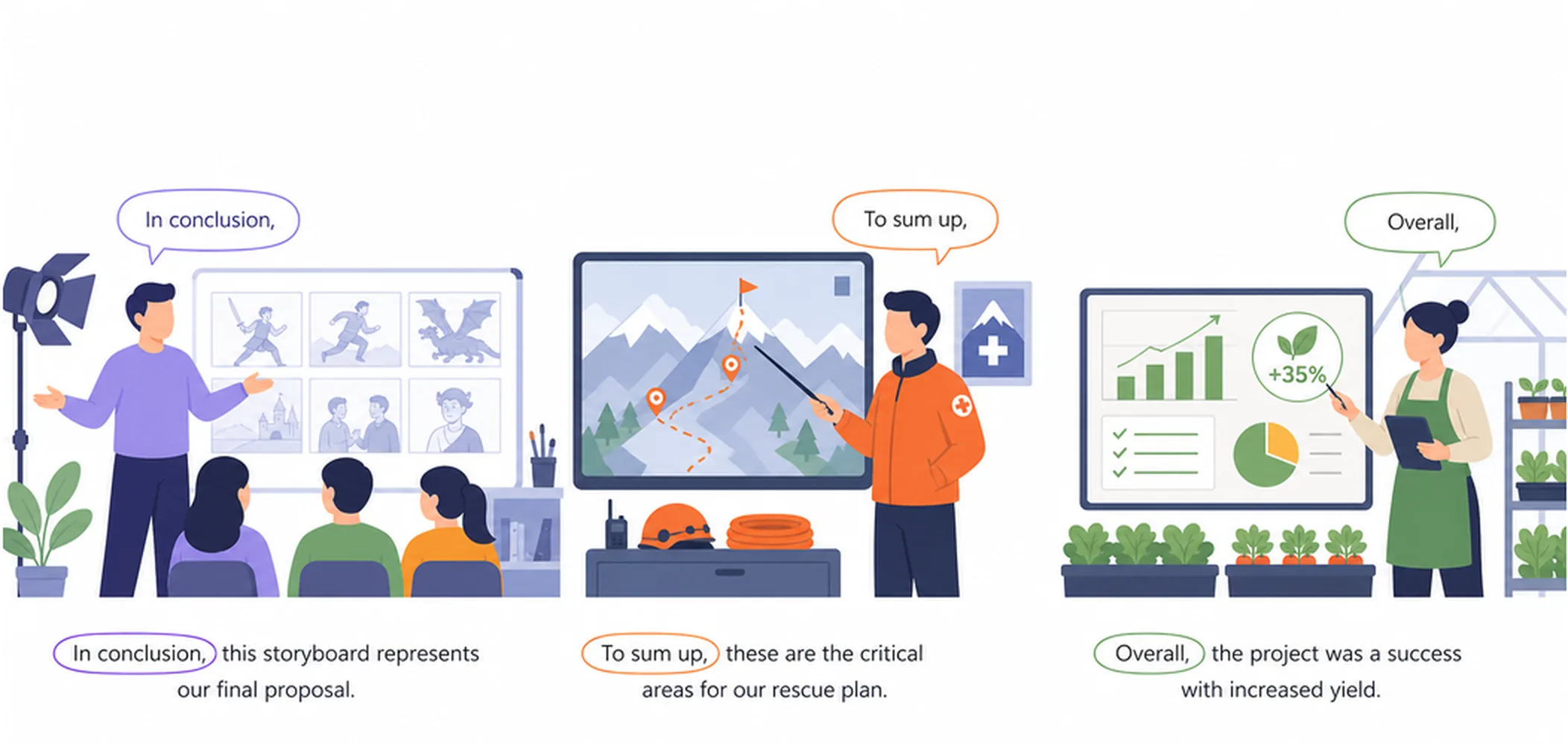
What Are Discourse Markers for Summarising?
Discourse markers are linking words or phrases that help organize your ideas and guide the reader through your text. Summarising discourse markers are special connectors that signal you are about to present a conclusion, final point, or overview of what came before. They make your writing clearer and more professional by showing that you are bringing different ideas together into one main point. These markers are essential in essays, presentations, reports, and academic writing at the B2 level and beyond.
Common Discourse Markers for Summarising
The most frequently used summarising markers include: 'in summary', 'in conclusion', 'to summarise', 'in short', 'ultimately', 'to sum up', 'in brief', and 'all in all'. Each of these phrases introduces a concluding statement that brings together the main ideas from your previous sentences or paragraphs. Some markers are more formal (such as 'in conclusion' and 'ultimately') and work well in academic or professional contexts. Others, like 'in short' and 'to sum up', are slightly less formal but still appropriate for most written communication. Understanding when and where to use each marker will improve the flow and readability of your writing.
Position and Function in Sentences
Summarising discourse markers typically appear at the beginning of a sentence, followed by a comma. They prepare the reader for a concluding idea that connects to everything mentioned before. For example, you might write three sentences explaining different points, then use 'in summary,' to introduce a single sentence that ties those points together. The marker should be followed by the main summarising statement. In longer texts, these markers often introduce the final paragraph or the last part of a section. Remember that the idea after the marker should be a genuine summary or conclusion—not a completely new thought.
Summarising Discourse Markers at a Glance
| Marker | Formality | Typical Context | Example | Usage Note |
|---|---|---|---|---|
| In conclusion | Formal | Essays, reports, speeches | In conclusion, the evidence strongly supports renewable energy. | Opens the final paragraph; signals a wrap-up of all main points. Avoid in casual writing. |
| To summarise | Neutral–Formal | Academic writing, presentations, meetings | To summarise, three key factors drive inflation. | Can appear mid-text as well as at the end. Slightly less final than "In conclusion". |
| To sum up | Neutral–Informal | Speeches, presentations, semi-formal writing | To sum up, the project was a success. | More conversational than "To summarise". Good for spoken summaries. |
| In summary | Formal | Reports, academic essays, business writing | In summary, costs exceeded the budget by 15%. | Interchangeable with "In conclusion" but feels slightly more neutral and less rhetorical. |
| Overall | Neutral | Essays, data analysis, reviews | Overall, the results were positive. | Concise and versatile. Works well when drawing a general conclusion from data or evidence. |
| On the whole | Neutral–Formal | Essays, evaluations, opinion writing | On the whole, the policy has been effective. | Implies a balanced judgment; acknowledges exceptions while stating a general trend. |
| All in all | Informal–Neutral | Spoken English, informal essays, blogs | All in all, it was a great conference. | Warm and conversational. Avoid in formal academic writing; better for personal or creative pieces. |
| In brief | Formal–Neutral | Business writing, executive summaries, reports | In brief, the merger reduced operating costs. | Signals a condensed restatement. Best when word count is limited; implies brevity is intentional. |
| In short | Neutral | General writing, journalism, everyday use | In short, we need more funding. | Very common and flexible. Often used to cut through detail and state the core message directly. |
| To conclude | Formal | Academic essays, formal speeches | To conclude, both approaches have merit. | Close synonym of "In conclusion". Often followed by an evaluative or decisive statement. |
| Ultimately | Formal–Neutral | Academic essays, arguments, editorial writing | Ultimately, individual choices shape society. | Emphasises the most fundamental conclusion after considering all factors. Adds rhetorical weight. |
| In a nutshell | Informal | Spoken English, blogs, casual writing | In a nutshell, the app saves you time. | Idiomatic; means "in the fewest possible words". Avoid in academic or professional formal writing. |
Examples






What to Remember
- Summarising discourse markers signal conclusions and overviews, helping readers understand how ideas connect together.
- Use markers like "in summary," "in conclusion," and "to sum up" to introduce final points.
- Place summarising markers at the beginning of sentences or clauses to clearly signal a summary coming.
- These markers work best in formal writing like essays, reports, and presentations at B2 level.
- Avoid overusing summarising markers; use them strategically to emphasize main ideas, not in every paragraph.