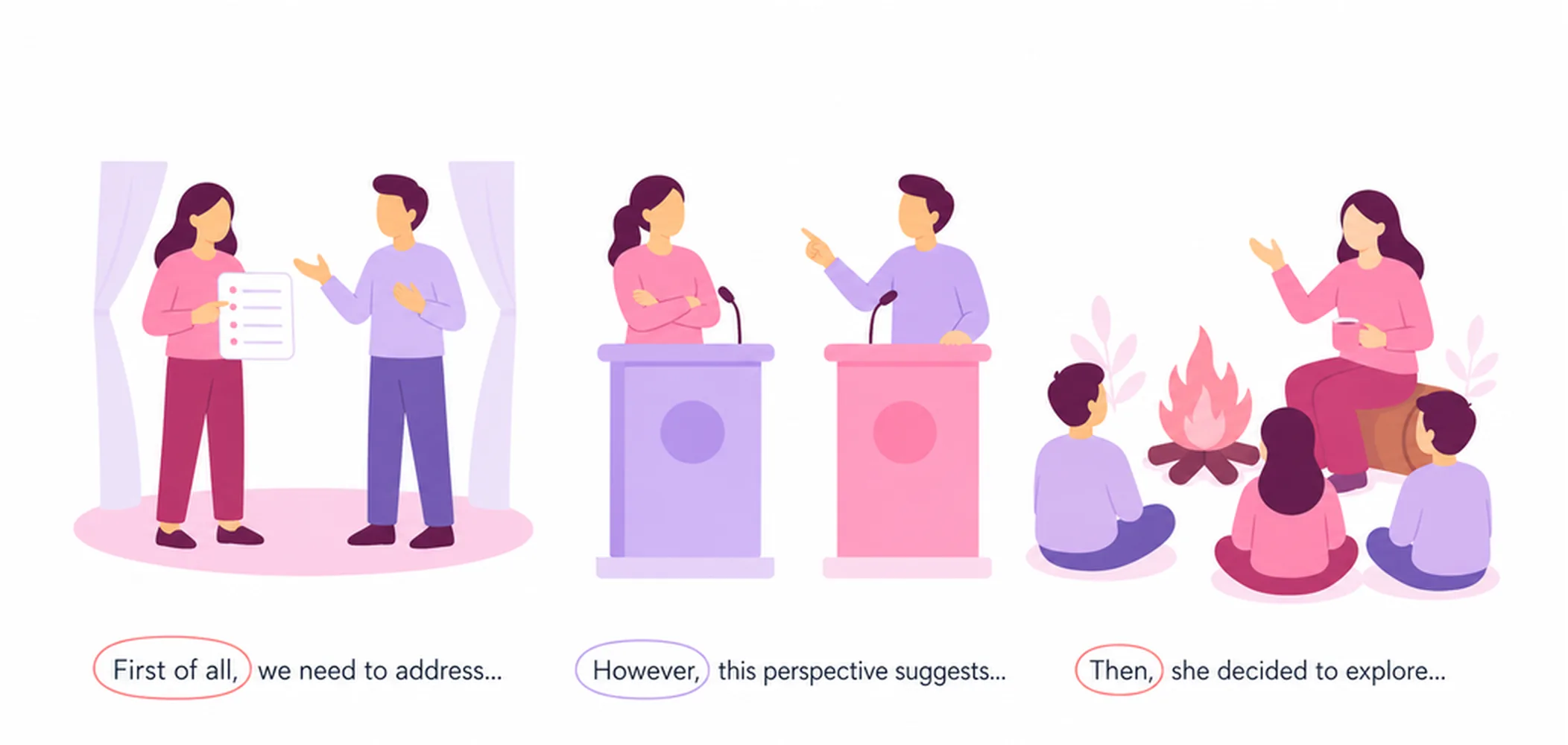
What Are Discourse Markers?
Discourse markers are words and phrases that connect ideas, sentences, and paragraphs together. They show relationships between thoughts and help your writing or speech flow smoothly. Think of them as bridges between your ideas. They don't add new information themselves—instead, they organize the information you already have. Common examples include 'however', 'therefore', 'in addition', and 'on the other hand'. These markers signal to your reader or listener how to understand what comes next.
Why Discourse Markers Matter
Without discourse markers, your writing sounds choppy and disorganized. Each sentence feels separate, like unconnected facts. With them, your ideas connect logically and your message becomes clearer. Discourse markers also show the writer's perspective and attitude. For example, 'unfortunately' shows disappointment, while 'importantly' shows that something deserves attention. They help you express complex relationships between ideas—contrast, cause and effect, addition, conclusion, and clarification. Mastering discourse markers is essential for advanced writing and speaking.
Main Types of Discourse Markers
```html
| Category | Function | Examples |
|---|---|---|
| Additive | Introduce extra information | furthermore, additionally, in addition |
| Contrastive | Show opposing ideas | however, on the other hand, yet |
| Causal | Show cause and effect | therefore, consequently, as a result |
| Sequential | Organize information in order | firstly, meanwhile, finally |
| Clarification | Explain or rephrase | in other words, that is to say, namely |
Each type helps your audience understand how different ideas relate to each other.
```
Discourse Markers by Type: A Quick Reference
| Feature | Additive | Contrastive | Causal | Sequential | Clarification |
|---|---|---|---|---|---|
| Function | Adds extra information or a related idea to what has already been said | Shows a contrast, opposition, or unexpected result between two ideas | Shows a cause-and-effect relationship or explains why something happened | Orders information chronologically or logically, showing steps in a process | Rephrases, explains, or makes an earlier statement easier to understand |
| When to Use | When building on a point, listing advantages, or expanding an argument | When comparing two opposing ideas, introducing a counterargument, or showing a surprising turn | When explaining reasons, results, or logical consequences of an action or event | When describing a process, giving instructions, or narrating events in order | When a term or idea may be misunderstood, or when you want to expand on a vague statement |
| Positive Example | "She is a skilled writer. Furthermore, she has years of editing experience." | "He studied all night. However, he still struggled with the exam." | "It rained heavily. As a result, the match was cancelled." | "First, preheat the oven. Then, mix the ingredients." | "The project was delayed. In other words, we missed the deadline." |
| Negative Example | "The report is incomplete. Moreover, several charts are missing." (Adds a further problem) | "The food was cheap. Nevertheless, it tasted terrible." (Concedes but still contrasts) | "She skipped breakfast. Consequently, she felt weak by noon." (Negative outcome caused) | "Next, avoid touching the hot surface." (Sequential warning step) | "He was not cooperative. That is to say, he refused every suggestion." (Clarifying a criticism) |
| Key Signal Words | also, furthermore, moreover, in addition, besides, as well as, additionally, too | however, but, although, yet, on the other hand, nevertheless, despite, even though, whereas | because, since, therefore, thus, as a result, consequently, due to, so, hence, for this reason | first, second, then, next, after that, finally, subsequently, meanwhile, before, lastly | in other words, that is to say, to clarify, to put it simply, what I mean is, namely, i.e. |
| Typical Position in Sentence | Usually at the start of a new sentence or clause; rarely mid-sentence | At the start of a contrasting clause or sentence; sometimes mid-sentence with commas | Can appear at the start of a result clause or embedded within a sentence | Typically at the very beginning of each step or time-ordered clause | Usually at the start of the clarifying sentence, followed by a comma |
| Common Mistakes | Overusing "also" repeatedly instead of varying with "moreover" or "furthermore" | Confusing "although" (used mid-sentence) with "however" (used to start a new sentence) | Using "because" and "therefore" in the same sentence to express the same link (redundant) | Using too many sequential markers, making writing sound mechanical or list-like | Using clarification markers when the original statement was already clear, creating wordiness |
| Register / Formality | "Furthermore" / "moreover" = formal; "also" / "too" = neutral or informal | "However" / "nevertheless" = formal; "but" / "yet" = neutral or informal | "Therefore" / "consequently" = formal; "so" / "because" = neutral or informal | "Subsequently" = formal; "then" / "next" = neutral or informal | "That is to say" = formal; "I mean" / "basically" = informal |
Examples






What to Remember
- Discourse markers connect ideas and sentences to improve the flow and coherence of your writing.
- They show relationships between thoughts but do not add new semantic information themselves.
- Common discourse markers include however, therefore, in addition, on the other hand, and moreover.
- Place discourse markers at the beginning of clauses or sentences to signal relationships clearly.
- Using too many discourse markers in short succession can make writing feel awkward and repetitive.