What Are Discourse Markers for Adding Information?
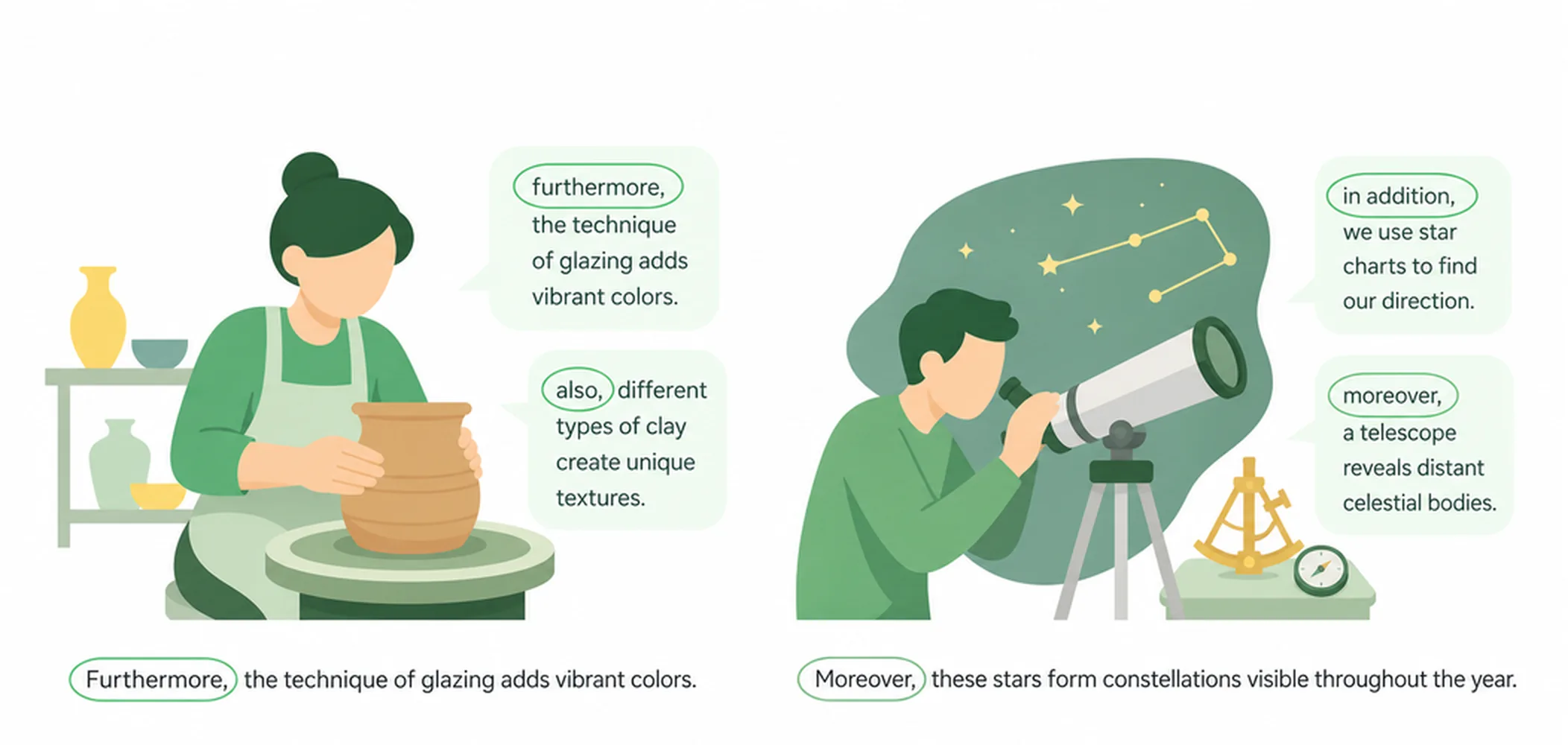
Discourse markers are connecting words or phrases that help you add related ideas smoothly. When you use discourse markers for adding information, you signal to your reader that you are introducing something new but related to what came before. This makes your writing more cohesive and helps you develop arguments, lists, and explanations clearly. Common markers include moreover, furthermore, in addition, besides, additionally, and also. These words show that you are building on an idea, not changing direction.
Why Use These Markers?
Using discourse markers for adding information improves readability and demonstrates control over advanced English. Without them, your sentences feel disconnected: "The project was completed on time. The budget was under control." With markers, the relationship is clear: "The project was completed on time. Moreover, the budget was under control." Markers also help you emphasize importance by signalling which ideas are equally significant or build on one another.
Formality and Usage Differences
Different markers suit different contexts. Furthermore and moreover are formal and academic, making them ideal for essays and professional writing. Also and besides are more neutral and appear in both formal and informal contexts. In addition and additionally are formal but slightly less heavy than furthermore. Choose based on your context: use formal markers in academic or professional documents, and neutral markers in everyday communication. Notice punctuation: most markers require a comma after them when they open a sentence.
Discourse Markers for Adding Information: Comparison Table
| Category | Moreover | Furthermore | In Addition | Besides | Additionally | Also |
|---|---|---|---|---|---|---|
| Formality Level | Formal / Academic | Formal / Academic | Neutral / Semi-formal | Informal / Conversational | Neutral / Semi-formal | Informal / Neutral |
| Typical Position in Sentence | Sentence-initial (beginning of a new sentence or clause) | Sentence-initial (beginning of a new sentence or clause) | Sentence-initial; occasionally mid-sentence | Sentence-initial or mid-sentence; can precede a noun phrase | Sentence-initial; occasionally mid-sentence | Flexible: sentence-initial, mid-sentence, or before a verb |
| Punctuation Requirements | Followed by a comma when sentence-initial: Moreover, … | Followed by a comma when sentence-initial: Furthermore, … | Followed by a comma when sentence-initial: In addition, … | Comma after sentence-initial use: Besides, …; no comma when followed directly by a noun phrase: Besides this… | Followed by a comma when sentence-initial: Additionally, … | Comma optional when sentence-initial: Also, …; no comma in mid-sentence use: She also said… |
| Specific Nuance | Introduces a point that is stronger or more significant than the previous one; implies escalation or reinforcement of an argument | Adds information that extends or develops the previous point further; closely linked to it; suggests continuation of the same line of reasoning | Simply adds an extra, separate point to a list; neutral and does not imply a hierarchy of importance between points | Adds information that often carries a tone of "anyway" or "what's more"; can suggest that the new point is an obvious or clinching additional reason | Adds an extra point in a list or sequence; straightforward and neutral; common in reports and instructional writing | Simple, lightweight addition of related information; the least emphatic of all; can feel cumulative when used in a series |
| Example Sentence | The proposal is cost-effective. Moreover, it has already been tested successfully in two pilot regions. | The study used a large sample size. Furthermore, participants were selected using rigorous random sampling. | The course covers grammar and vocabulary. In addition, students practise listening and speaking skills. | I don't want to go out tonight. Besides, it's raining heavily. | Please back up your files before installing the update. Additionally, ensure your device is fully charged. | She speaks French and Spanish. She also has a working knowledge of Italian. |
| Best Used In | Academic essays, research papers, formal reports | Academic writing, formal arguments, dissertations | General writing, emails, presentations, everyday formal texts | Spoken language, informal writing, persuasive everyday texts | Reports, instructions, business writing, neutral essays | Spoken language, informal writing, lists, casual emails |
| Common Mistake to Avoid | Do not use in casual conversation; sounds overly stiff outside formal contexts | Avoid using to introduce a completely unrelated point; the ideas must be logically connected | Do not write In addition to and then follow it with a full clause (use In addition to + noun/gerund instead) | Avoid in formal academic writing; it can sound dismissive or colloquial | Do not confuse with in addition; while similar, additionally is a single adverb and cannot be followed by to + noun | Avoid overusing; repeating also many times in one paragraph makes writing feel monotonous and underdeveloped |
| Key Difference Summary: All six markers add information, but they differ in formality and emphasis. Moreover and furthermore are the most formal and carry the strongest sense of building or escalating an argument — moreover escalates importance while furthermore extends the same line of thought. In addition and additionally are neutral connectors that simply list extra points without implying weight or hierarchy. Besides is the most conversational and often suggests an obvious or clinching extra reason. Also is the lightest and most flexible, suited to everyday writing and speech where a simple, low-key addition is all that is needed. | ||||||
Examples






What to Remember
- Use discourse markers like moreover, furthermore, and additionally to connect related ideas smoothly in writing.
- Place discourse markers at the beginning of a clause or sentence to signal new information clearly.
- Remember that discourse markers for adding information show continuation, not contrast or cause-and-effect relationships.
- Use commas after introductory discourse markers to separate them from the main clause they introduce.
- Avoid overusing the same marker repeatedly; vary between moreover, furthermore, in addition, besides, and also for better cohesion.