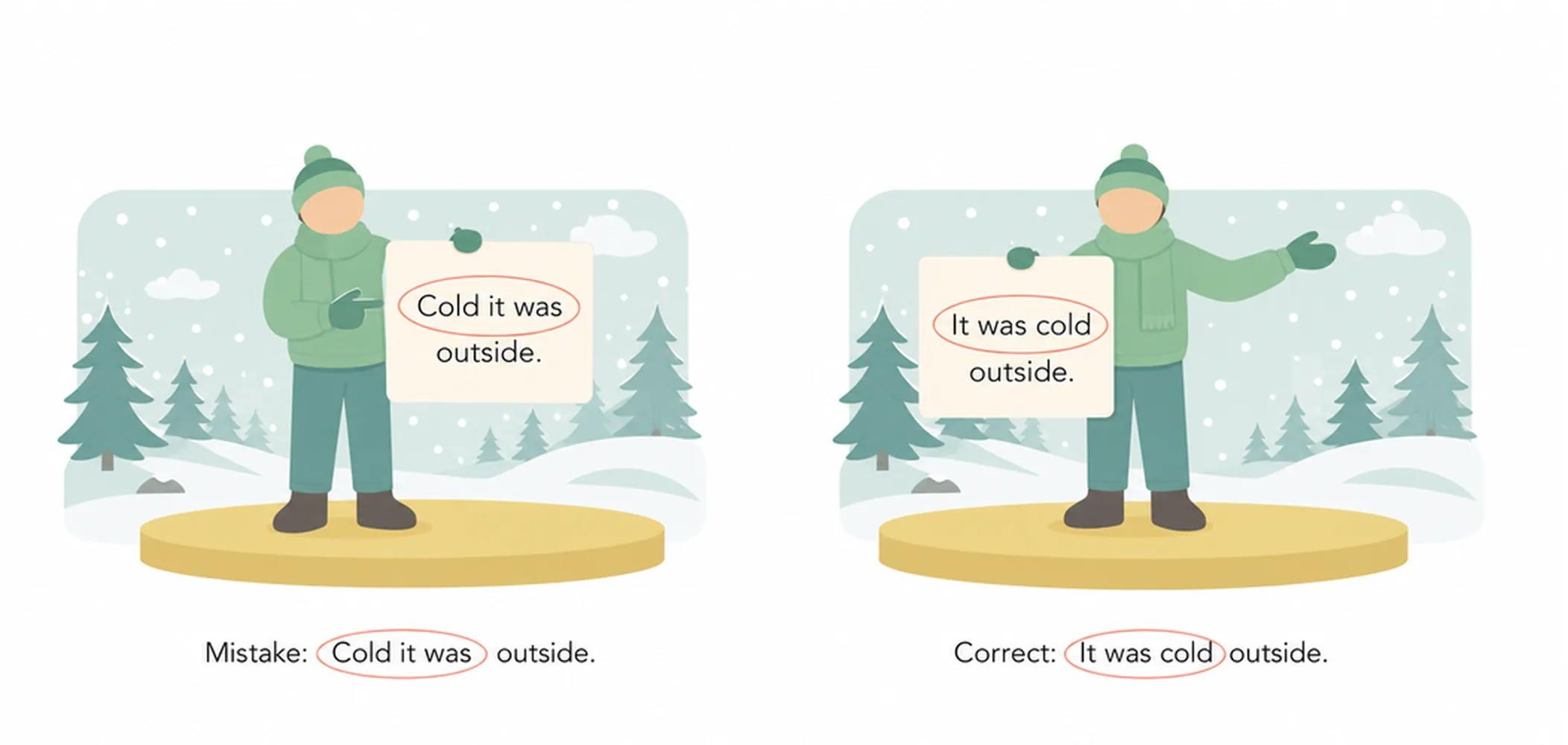
Why Fronting Mistakes Happen
Fronting—moving a constituent to the beginning of a clause for emphasis or narrative effect—is a sophisticated grammatical tool. C1 learners often misuse it because it requires precise knowledge of inversion rules, subject-auxiliary agreement, and register-appropriate contexts. Mistakes typically occur when learners either fail to invert the subject and auxiliary (when required), over-apply inversion (when it's not grammatical), or confuse fronting with topicalization. Understanding the subtle rules governing fronting will refine your advanced writing and speech.
Common Fronting Mistakes
Below are the most frequent errors advanced learners make with fronting and topicalization, with explanations and corrections.
Fronting vs. Topicalization — Key Differences at a Glance
| Dimension | Fronting | Topicalization |
|---|---|---|
| Definition | Moving a non-subject element (adverb, complement, object, or adjunct) to the very beginning of the clause, typically triggering subject–auxiliary inversion. | Moving a topic element (usually an object or prepositional phrase) to the front of the clause without triggering inversion; the normal subject–verb order is kept. |
| Inversion Requirement | Required when a negative adverbial or certain adverbials of place/direction are fronted (e.g., "Never have I seen…"). Inversion is the key grammatical marker that distinguishes fronting from simple topicalization. | Not required. The subject and verb remain in their canonical order after the fronted topic. Applying inversion here is a common — and serious — grammatical error. |
| Register | Predominantly formal, literary, or rhetorical. Common in written English, speeches, and advanced academic prose. Sounds stilted or archaic in casual conversation. | Found in both formal and informal registers. Frequently used in spoken English to shift discourse focus or contrast a topic with something previously mentioned. |
| Positive Example | "Rarely does she miss a deadline." The negative adverb "Rarely" is fronted → subject–auxiliary inversion ("does she") is obligatory. |
"That book, I have already read." The object "That book" is topicalized → the subject "I" still comes directly before the verb with no inversion. |
| Negative Example | "Never I have seen such courage." ✗ Incorrect: fronting "Never" demands inversion; the subject must not appear before the auxiliary. |
"That book have I already read." ✗ Incorrect: topicalization does not trigger inversion; inserting inversion here confuses topicalization with fronting. |
| Question Example | "Under no circumstances should you sign the contract." A fronted negative prepositional phrase forces auxiliary "should" before subject "you." |
"The contract, you should read carefully." The topic "The contract" is placed first for emphasis; the subject–verb order ("you should") stays intact — no inversion. |
| Key Signal Words / Triggers | Negative adverbials: never, rarely, seldom, hardly, no sooner, not only, under no circumstances, only then. Directional/locative adverbs: here, there, down, up, out (with intransitive verbs). | Definite noun phrases, pronouns, or prepositional phrases that represent already-introduced or contrastive topics. Often accompanied by a comma pause in writing or a prosodic break in speech. |
| 🔑 Key Difference: The single most commonly confused distinction is inversion. Fronting (especially with negative adverbials) obligatorily triggers subject–auxiliary inversion, making the sentence feel formal and emphatic. Topicalization moves an element to the front purely for discourse focus but never triggers inversion — the subject–verb order remains unchanged. Applying inversion to a topicalized sentence, or omitting it from a fronted negative adverbial, are the two core errors the article warns against. | ||
Examples

Seldom have I encountered such compelling evidence in an academic paper.
Fronted negative adverbial + subject-auxiliary inversion · Written register

So profoundly did the novel affect her worldview that she changed her career path.
Emphatic fronting with subject-verb inversion · Literary/formal

Only by accepting failure can we truly understand success.
Fronted prepositional phrase triggering inversion · Rhetorical

Under no circumstances will the committee accept incomplete applications.
Negative fronted phrase + modal inversion · Formal/institutional
When to use it
Academic Writing
Fronting emphasizes key findings or limitations. Use inverted structures to add sophistication and focus.
"Rarely does the data suggest a linear correlation; indeed, patterns emerge only under specific conditions."
Formal Speech
Fronting creates rhetorical impact in presentations or arguments. It signals emphasis and formality.
"Only by adopting this framework can we address systemic inequality."
Narrative & Literature
Fronting adds dramatic effect and shifts narrative focus. Common in fiction and storytelling.
"Little did he know that his decision would alter the course of history."
Legal & Institutional Contexts
Fronting with negative phrases establishes rules and restrictions with formal authority.
"Under no circumstances shall modifications be made without written consent."
Signal words
Seldom
Rarely
Never
Scarcely
Barely
Little
Only
Not only...but also
So
Such
Under no circumstances
In no way
At no point
Common Mistakes
✕
Wrong
Only rarely I see such dedication in young professionals.
✓
Correct
Only rarely do I see such dedication in young professionals.
Fronted adverbials of frequency (only rarely, seldom, never) require subject-auxiliary inversion. Missing 'do' creates grammatical error.
✕
Wrong
Rarely such commitment has been shown by the team.
✓
Correct
Rarely has such commitment been shown by the team.
When fronting an adverbial with a perfect/passive verb, invert the subject and auxiliary verb form (has, have, had, etc.). 'Has been' is required here.
✕
Wrong
So important this decision is that we must reconsider.
✓
Correct
So important is this decision that we must reconsider.
Fronted adjectives in 'so/such...that' constructions require subject-verb inversion. The copula 'is' must precede the subject.
✕
Wrong
Nowhere in the document mentioned are the limitations.
✓
Correct
Nowhere in the document are the limitations mentioned.
Invert only the auxiliary and subject; don't place the past participle before them. Correct order: auxiliary + subject + past participle.
✕
Wrong
Little did he realize the consequences he will face.
✓
Correct
Little did he realize the consequences he would face.
Fronting with 'little did' (negative fronting) uses past tense; the consequent clause must use conditional (would), not simple future.
✕
Wrong
To solve this problem, the team decided many strategies were needed.
✓
Correct
To solve this problem, many strategies were needed by the team.
Fronted infinitives don't trigger inversion—this is topicalization, not negative/emphatic fronting. Subject-verb order remains normal.
✕
Wrong
Not only did he complete the project, but he also organized very well the final presentation.
✓
Correct
Not only did he complete the project, but he also organized the final presentation very well.
Fronting 'not only' requires inversion in the first clause, but the second clause (with 'but also') should have normal word order. Adverbs follow the object.
KEY TAKEAWAYS
What to Remember
- Invert the subject and auxiliary verb after fronted negative or restrictive adverbials (Never have I seen this before).
- Topicalization moves known information to the front without requiring subject-auxiliary inversion (This book, I really enjoyed it).
- Only invert when fronting negatives, inversive adverbials, or conditionals; fronting other elements rarely requires inversion.
- Register matters: fronting is formal and emphatic, so avoid overusing it in casual or neutral contexts.
- Don't confuse fronting (emphasis/effect) with topicalization (shifting known information); they follow different inversion rules.