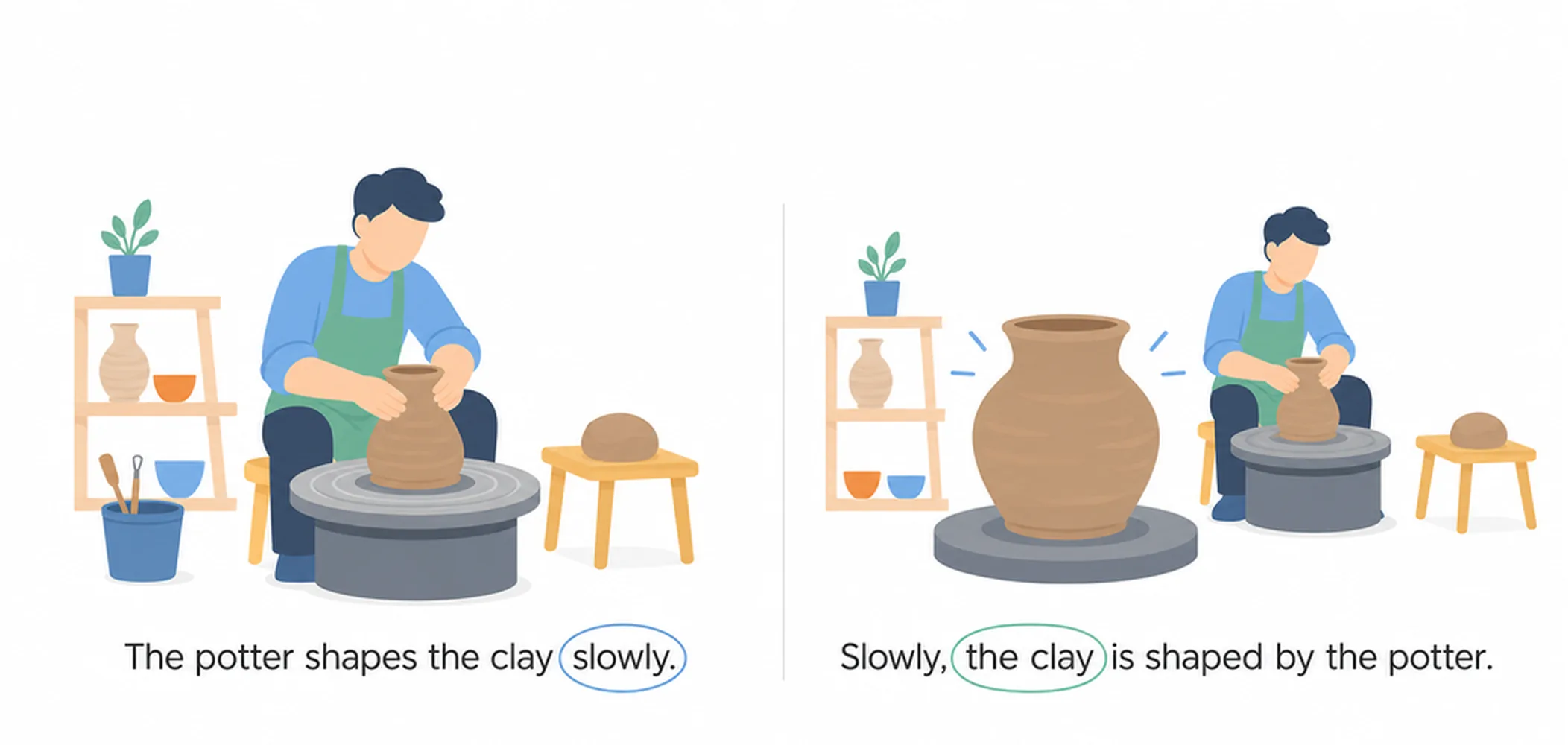
What are Fronting Complements?
Fronting complements is an advanced syntactic technique where the direct or indirect object, or a prepositional phrase functioning as a complement, is moved from its canonical position (after the verb) to the beginning of the sentence. This inversion serves pragmatic purposes: it allows the speaker or writer to emphasise a particular element, establish a new topic, create contrastive focus, or produce a marked stylistic effect. Unlike topicalization of subjects or adjuncts, which occurs naturally in English, fronting complements requires deliberate movement of core arguments and often triggers subject-auxiliary inversion in negative or emphatic contexts.
Forms and Structural Patterns
Fronting complements can involve several grammatical elements. Direct objects: 'This argument I cannot accept' (cf. canonical 'I cannot accept this argument'). Indirect objects and prepositional complements: 'To whom did you give the letter?' Predicative complements: 'A fool he was not' (archaic/literary). The fronted element maintains its grammatical relationship to the verb but gains prominence through its initial position. Often, fronting complements co-occurs with subject-auxiliary inversion, especially in questions, emphatic statements, or literary registers. The fronted complement is typically marked by stress and intonation in speech, and by its marked syntactic position in writing.
Pragmatic Functions and Register
Fronting complements operates across multiple registers with distinct communicative effects. In formal or literary English, it conveys emphasis, rhetorical force, or emotional intensity: 'This I will never forget.' In interrogative contexts, it is obligatory in standard English: 'Which book did you recommend?' In conversational English, fronting complements can signal topicality, contrast, or focus: 'That house I wouldn't buy—it's too old.' Be aware that excessive fronting, particularly of objects without clear pragmatic motivation, risks appearing archaic, overly formal, or affected in contemporary English. The register and context determine acceptability and naturalness.
Fronted vs. Canonical Word Order
| Feature | Canonical Structure (Standard Word Order) | Fronted Direct Object (Object Topicalisation) | Fronted Indirect Object (Recipient Topicalisation) | Fronted Prepositional Complement (PP Fronting) | Fronted Predicative Complement (Predicate Topicalisation) |
|---|---|---|---|---|---|
| Form |
Subject + Verb + Complement (SVC / SVO / SVOO order) |
Direct Object + Subject + Verb (OSV order; no subject–auxiliary inversion) |
Indirect Object + Subject + Verb + Direct Object (IO fronted before subject; DO remains post-verb) |
Prepositional Phrase + Subject + Verb (PP moved to clause-initial position) |
Predicative Complement + Subject + Copula (Adjective/NP complement precedes subject and verb) |
| When to Use | Neutral, everyday communication; no special emphasis required; new or equally weighted information | To mark the direct object as the topic or contrast it with something previously mentioned; add emphasis or literary effect | To highlight who receives something, especially when the recipient is the discourse topic or in contrast with another recipient | To foreground location, direction, manner, or circumstance; common in formal, literary, and descriptive writing | To dramatically emphasise a quality or state; common in literary prose, exclamations, and rhetorical contexts |
| Positive Example |
She reads novels every evening. They gave the award to Maria. He is very talented. |
Novels, she reads every evening. (Emphasis: it is novels, specifically, that she reads) |
Maria, they gave the award to. (Focus shifts to the recipient, Maria) |
Into the dark forest, the traveller walked slowly. (Location foregrounded for atmosphere) |
Very talented, he certainly is. (The quality is emphatically confirmed) |
| Negative Example |
She doesn't read poetry. They didn't give the prize to him. He is not careless. |
Poetry, she does not read. (Negation applies to the verb; fronted object is unchanged) |
Him, they did not give the prize to. (Recipient is topicalised; negation stays with auxiliary) |
Into the forest, she would not venture. (Negation with modal; PP still fronted) |
Careless, he is not. (Emphatic denial of the quality; copula negated) |
| Question Example |
What does she read? To whom did they give the award? How talented is he? |
That book — did she actually read it? (Tag/echo question; object fronted for clarification) |
Her colleague, did they give the award to? (Spoken/informal clarification question with IO fronted) |
Into which forest did she venture? (Wh-question with PP fronted; subject–auxiliary inversion required) |
How talented is he, really? (Wh-exclamative/question; predicative complement fronted) |
| Key Signal Words / Markers | No special markers; neutral intonation; default information flow (given → new) | Pause or comma after fronted NP; resumptive pronoun optional in speech ("That book, she loved it"); contrastive stress on DO | Comma or prosodic break after IO; stranded preposition often retained at end of clause ("…gave the prize to"); contrastive context words like but, however, instead | Prepositions: in, on, under, through, across, along, into, from, beside, beyond; subject–auxiliary inversion common in formal/literary style | Copular verbs: be, seem, appear, remain, become; emphatic auxiliaries: is, was, were, certainly, indeed, truly; exclamatory words: What, How |
| Register & Frequency | All registers; most frequent in everyday speech and informal writing; unmarked and stylistically neutral | Informal speech and literary writing; marks contrast or shared context ("That one I like; the other I don't"); less common in formal prose | Relatively rare; mainly in spoken discourse or written dialogue; can sound archaic or overly formal without strong discourse motivation | Formal, literary, and journalistic writing; very common in descriptive fiction; sometimes used in formal speech for rhetorical effect | Literary, rhetorical, and emphatic speech; exclamatory sentences; characterised by heightened emotional or dramatic tone |
| Subject–Auxiliary Inversion? | Only in direct questions |
No — subject precedes verb as normal (This distinguishes it from wh-movement) |
No — subject still precedes verb (No inversion triggered by IO fronting alone) |
Often Yes — especially in literary/formal style "Into the room walked the detective." (Locative inversion is a distinct construction) |
Sometimes Yes — with copula "Happy he is not." / "A genius she is." (Copula may or may not invert depending on register) |
| Information-Structure Role | Topic = subject; focus = end of sentence (rheme); follows the given–new principle naturally | Fronted DO becomes the topic; signals "as for X…"; creates contrast with alternatives; old or shared information moves to front | Fronted IO signals the recipient is the most salient participant; useful when multiple recipients are being contrasted ("To John we gave the trophy; to Mary, the medal.") | Fronted PP frames the scene or circumstance before introducing the main action; sets spatiotemporal or manner context; creates a "scene-setting" effect | Fronted predicative complement singles out a quality for strong affirmation or denial; creates an exclamatory or contrastive proposition about the subject's properties |
| Key Difference: All fronting constructions move a non-subject complement to the beginning of the clause to create topicalisation, emphasis, or contrast — but they differ in what is moved and whether inversion occurs. Canonical structures follow neutral Subject–Verb–Complement order with no special discourse marking. Direct object fronting (OSV) highlights a specific object without inversion and is driven by contrast or shared context. Indirect object fronting spotlights the recipient and is rare without strong discourse motivation. Prepositional complement fronting foregrounds circumstantial or locative information and frequently triggers subject–auxiliary inversion in formal registers, producing a distinctly literary or journalistic tone. Predicative complement fronting places an adjective or noun phrase before the subject and copula to deliver a dramatically emphatic or contrastive assertion about the subject's state or quality. Across all types, fronting shifts the sentence's topic from the subject to the moved element, redistributes informational weight, and elevates the register from neutral to marked or stylistically heightened. | |||||
Examples






What to Remember
- Fronting complements moves direct or indirect objects and prepositional phrases to sentence-initial position for emphasis.
- This syntactic inversion is marked and intentional, unlike natural subject topicalization, requiring careful pragmatic justification.
- Fronted complements create contrastive focus, establish new topics, or produce deliberate stylistic effects in writing.
- The complement must return to its original position structurally; only its discourse position changes fundamentally.
- Common mistake: overusing fronting complements in formal writing risks sounding artificial or disrupting natural information flow.