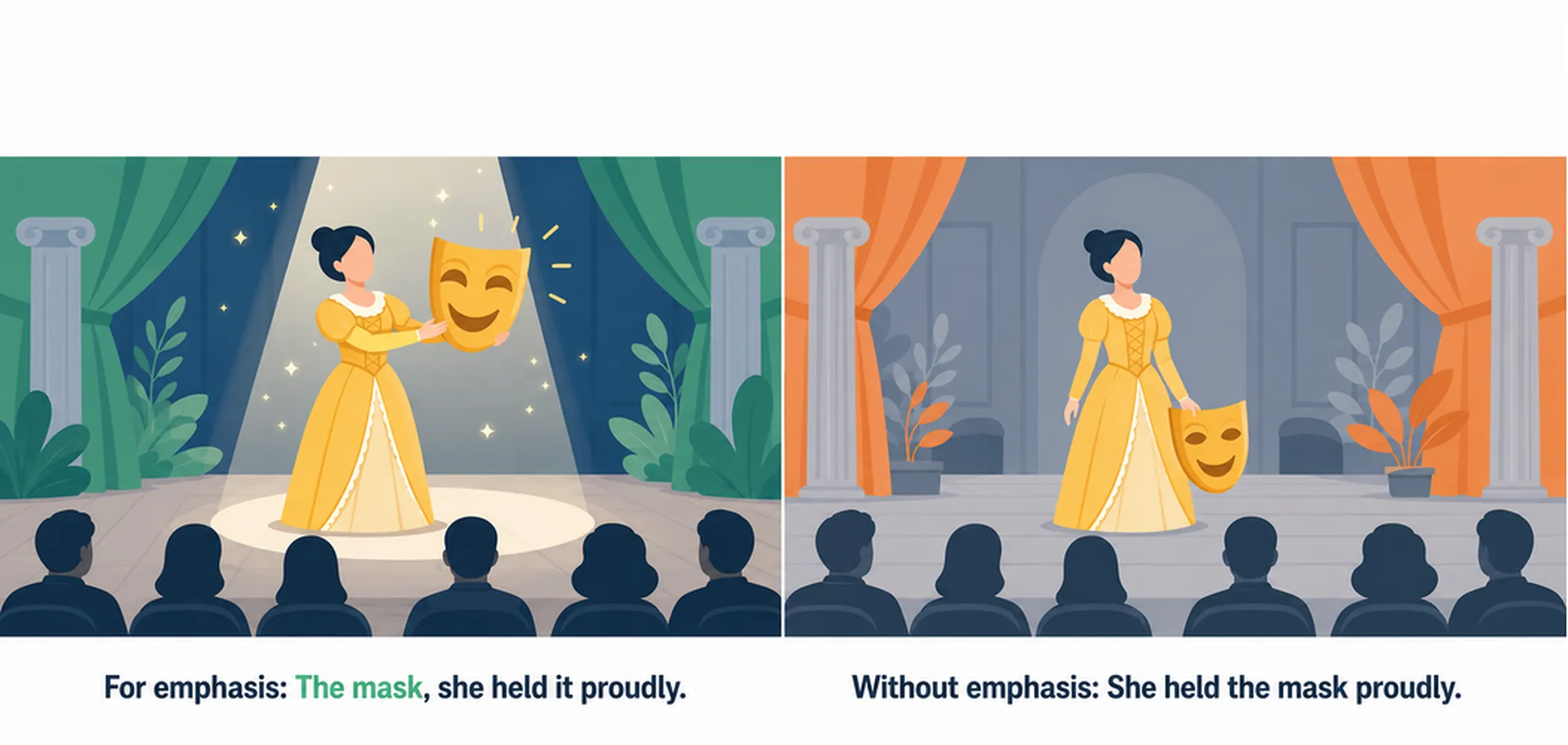
What is Object Fronting?
Object fronting is an advanced syntactic technique where the direct or indirect object of a sentence is moved from its canonical position (after the verb) to the beginning of the clause. This inversion serves primarily rhetorical purposes: it creates emphasis, establishes discourse focus, and often signals emotional intensity or argument strength. Unlike stylistically neutral word order, fronting is a marked construction that demands reader or listener attention. It is common in formal writing, rhetorical speech, and literary contexts where the writer wishes to prioritize certain information or create a particular affective tone.
Functions and Effects of Object Fronting
Object fronting achieves several communicative goals. First, it establishes the fronted object as the discourse topic or theme—the entity around which the rest of the clause revolves. Second, it creates emphasis and focus, making the object more prominent than it would be in standard word order. Third, it can express emotional force: fronting often conveys surprise, indignation, or strong conviction. Fourth, it facilitates cohesion by linking the fronted object back to previously mentioned referents, thus anchoring the sentence within the broader discourse context. The fronted object, whether direct (what/whom) or indirect (to/for whom), becomes the interpretive lens through which the predicate is understood.
Constraints and Grammatical Considerations
Not all objects can be freely fronted; linguistic constraints apply. Direct objects are more readily fronted than indirect objects or prepositional objects. Fronting works best with definite, specific, or highly topical referents—pronouns and known entities are ideal. Fronting of indefinite or generic objects is less common and typically requires strong pragmatic motivation. Additionally, fronting must preserve the grammatical integrity of the clause: the verb's subcategorization frame remains intact, and any necessary prepositions or particles accompany the fronted element. In questions and conditionals, fronting interacts with other structural operations, requiring careful attention to clause ordering and complementizer placement.
Fronted vs. Unfronted: Side-by-Side Comparison
| Aspect | Standard Word Order (Object in Normal Position) | Fronted Object (Object Moved to Front of Clause) |
|---|---|---|
| Form | Subject + Verb + Object (e.g., I love this film.) |
Object + Subject + Verb (e.g., This film, I love.) |
| When to Use | Used in everyday, neutral statements where no particular element requires special emphasis. The information flows in a predictable, unmarked sequence. | Used to highlight or contrast a specific object, to indicate a topic shift, to create a dramatic or literary effect, or to show that the object — not something else — is what is being referred to. |
| Positive Example | She read every single book on the shelf. | Every single book on the shelf, she read. |
| Negative Example | He didn't touch the money. | The money, he didn't touch. |
| Question Example | Did you finish the report? | The report — did you finish it? (A pronoun often resumes the fronted object in questions.) |
| Key Signal Words / Markers | No special markers needed; the standard SVO order itself signals neutral meaning. | A comma or dash often separates the fronted object from the rest of the clause. Spoken English uses a pause and rising intonation on the fronted element. |
| Focus & Emphasis | Emphasis falls naturally on the end of the sentence (end-focus principle). The object receives only ordinary stress. | Emphasis shifts dramatically to the fronted object. It becomes the topic and the most salient piece of information, often implying contrast with something else. |
| Register & Style | Suitable for all registers — formal, informal, spoken, and written. The default choice in most contexts. | More common in literary, rhetorical, or emphatic speech. Can sound stilted if overused in casual conversation, but is very effective in formal writing and speeches. |
| Key Difference: In standard word order, the object sits quietly after the verb and receives no special prominence. When fronted, the object is pulled to the very beginning of the clause, immediately signalling to the listener or reader that this — and not something else — is what is being talked about. Fronting is a powerful rhetorical device that creates contrast, suspense, and emphasis, but it marks a deliberate departure from neutral grammar and should be used purposefully. | ||
Examples






What to Remember
- Object fronting moves the direct or indirect object to the sentence beginning for emphasis and rhetorical effect.
- Fronting creates a marked construction that demands reader attention and signals emotional intensity or argumentative strength.
- The fronted object must be followed by the verb and remaining clause elements in correct order.
- Fronting is common in formal writing but sounds unnatural in casual speech without proper discourse context.
- Avoid fronting merely for style variation; use it intentionally when you need to establish focus or emphasis.