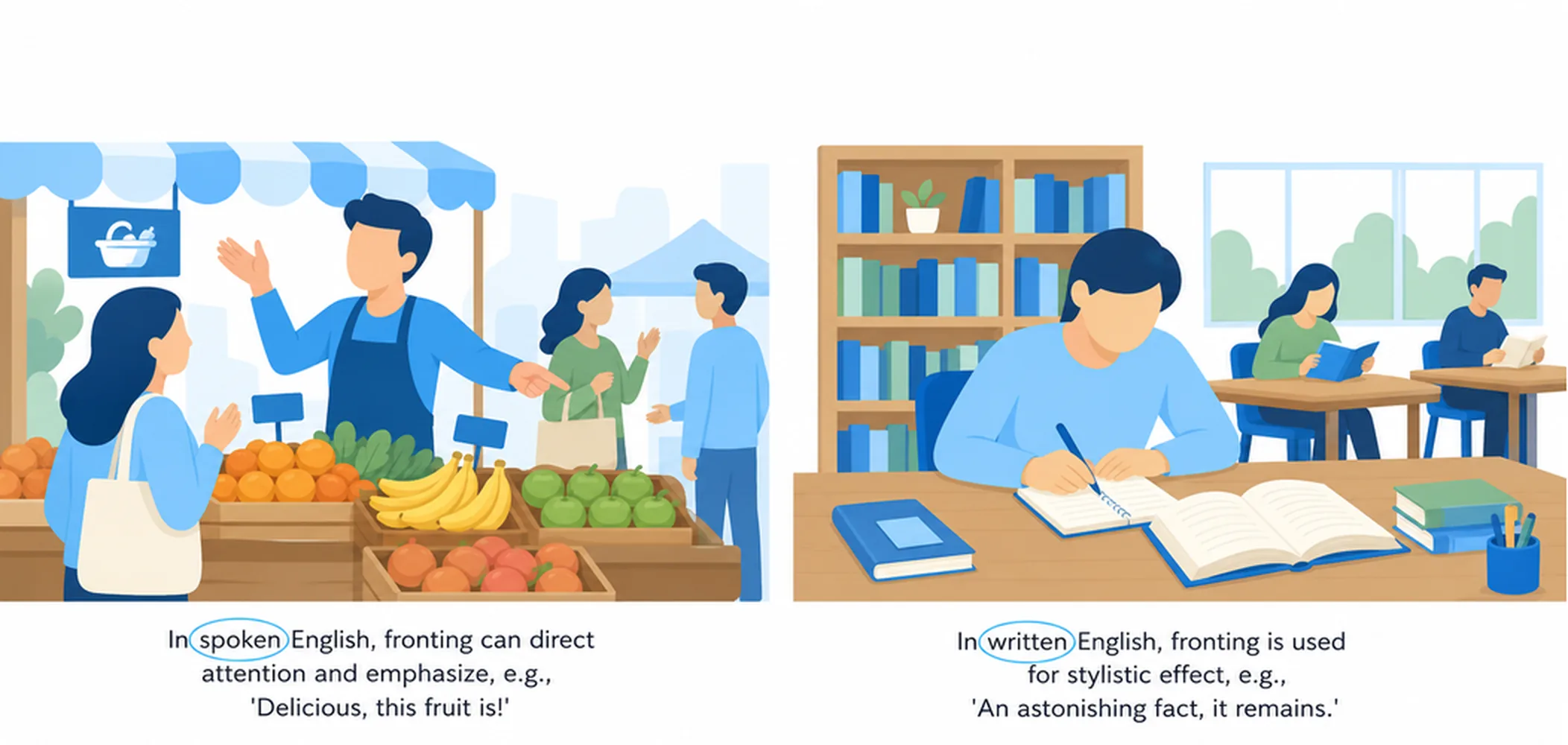
Fronting in Spoken vs Written English
Fronting—moving an element to the beginning of a clause for emphasis or thematic focus—occurs in both spoken and written English, but with markedly different motivations and frequencies. In spoken English, fronting typically emerges from real-time processing demands and interpersonal dynamics: speakers front information to signal emotional salience, to grab attention, or to clarify given information before developing a point. In written English, fronting functions as a deliberate stylistic and rhetorical device, creating cohesion, managing information flow, and establishing formal register. Understanding when and why these patterns diverge is essential for achieving register-appropriate and sophisticated expression at the C1 level.
Fronting in Spoken Discourse
In spontaneous speech, fronting serves immediate communicative purposes. Speakers front objects, adjectives, or entire predicates to prioritize what they consider most newsworthy or emotionally salient. This fronting often occurs without major syntactic restructuring and is frequently accompanied by prosodic cues (stress, intonation) and hesitation markers. Fronting in speech also helps the speaker organize ongoing thought and repair communication breakdowns. The motivation is typically local and interactive—responding to the conversational moment—rather than global textual architecture.
Fronting in Formal Written Discourse
Written fronting is more deliberate and architecturally motivated. Writers front constituents to establish cohesion across sentences, to create parallel structures across paragraphs, or to signal a shift in perspective or argument. Fronting in academic or literary writing often involves complex noun phrases or predicates, and it always serves a function within the broader text structure. The effect is more formal, controlled, and semantically weighted. Fronting here signals sophistication and reader awareness; it assumes the reader can process non-canonical word order as a stylistic choice rather than a processing necessity.
Spoken vs Written Fronting: Side-by-Side Comparison
| Dimension | Spoken Fronting | Written Fronting |
|---|---|---|
| Form | Often informal and fragmentary; fronted elements may appear loosely attached, sometimes as left-dislocated topics followed by a resumptive pronoun (e.g., "That book, I loved it"). | Typically more grammatically complete and carefully constructed; fronting follows conventional syntactic rules without resumptive pronouns (e.g., "That book I loved"). |
| Motivation | Driven by real-time processing demands; speakers front elements to manage turn-taking, signal relevance quickly, or maintain conversational flow under time pressure. | Driven by deliberate rhetorical and stylistic choices; writers front elements to create emphasis, vary sentence rhythm, guide reader attention, or achieve a particular literary effect. |
| Frequency | High frequency in casual conversation; occurs spontaneously and often unnoticed by both speaker and listener. Left-dislocation and topicalisation are especially common. | Lower frequency overall; used selectively for maximum impact. Overuse in writing can seem contrived or awkward, so writers deploy it sparingly. |
| Syntactic Complexity | Tends toward simpler constructions; subject-verb inversion after fronted adverbials may be avoided. Anacoluthon (broken-off constructions) is tolerated (e.g., "Her — I really don't know what to think"). | Can handle more complex fronted structures; subject-verb inversion after negative or restrictive adverbials is expected and grammatically obligatory (e.g., "Never had she seen such chaos"). |
| Prosodic Support | Heavily supported by prosody; stress, intonation, and pausing reinforce the fronted element and signal its discourse importance to the listener without additional verbal marking. | No prosodic support available; the writer must rely entirely on word order, punctuation (commas, dashes), and syntactic positioning to signal prominence to the reader. |
| Typical Elements Fronted | Topics already mentioned in discourse; objects of shared knowledge; time and place adverbials; evaluative comments (e.g., "Brilliant, that idea was"). | Negative adverbials ("Never", "Rarely", "Not only"); prepositional phrases; predicative adjectives; direct objects for contrast or emphasis; participial phrases. |
| Register | Most common in informal, colloquial, and conversational registers; also appears in spontaneous speech in interviews, debates, and lectures. | Most common in formal, literary, journalistic, and academic registers; signals sophistication and deliberate stylistic control. |
| Discourse Function | Primarily used to establish or re-establish topics, manage turn transitions, signal contrast, and maintain coherence in fast-moving interactive discourse. | Primarily used to create thematic cohesion, build suspense, foreground contrasts, link back to prior sentences, and control the information flow across longer text spans. |
| Effect on Audience | Listeners process fronted elements as immediate cues for attention and relevance; the effect is largely subconscious and aids real-time comprehension. | Readers notice fronting as a marked, deliberate choice; it creates a sense of formality, drama, or sophistication and can slow reading pace to emphasise key ideas. |
| Positive Example | "That curry — I could eat it every day." (topic-comment structure with resumptive pronoun) | "Only through sustained effort can true mastery be achieved." (fronted adverbial with inversion) |
| Negative / Restrictive Example | "Not once did he — well, he never apologised, let me put it that way." (repair typical of speech) | "Not once did he offer an apology." (clean inversion, no repair needed) |
| Key Signal Words / Structures | Topic-comment constructions; left-dislocation with "it" or pronoun copy; "As for…", "Speaking of…"; rising intonation on fronted element. | "Never", "Rarely", "Not only…but also", "Scarcely", "Hardly", "Only then", "So + adjective", participial openers. |
| Key Difference: Spoken fronting is a spontaneous, prosodically supported discourse management tool driven by the real-time demands of interaction — it is frequent, informal, and often structurally looser, relying on intonation and stress to convey prominence. Written fronting, by contrast, is a carefully chosen, context-free rhetorical device that must achieve all its emphasis through word order and punctuation alone; it tends to appear in formal or literary contexts, demands full syntactic well-formedness (including obligatory subject-verb inversion after negative adverbials), and is used sparingly to guide reader attention, create stylistic impact, and build thematic cohesion across longer stretches of text. | ||
Examples






What to Remember
- Fronting moves sentence elements to the beginning for emphasis or thematic focus.
- Spoken English uses fronting reactively for emotional impact, attention-grabbing, or clarifying information quickly.
- Written English employs fronting deliberately as a stylistic choice for sophisticated composition.
- Fronting frequencies differ significantly between spoken and written contexts due to different purposes.
- Both registers can front objects, adverbials, or predicates, but motivations and effects vary.