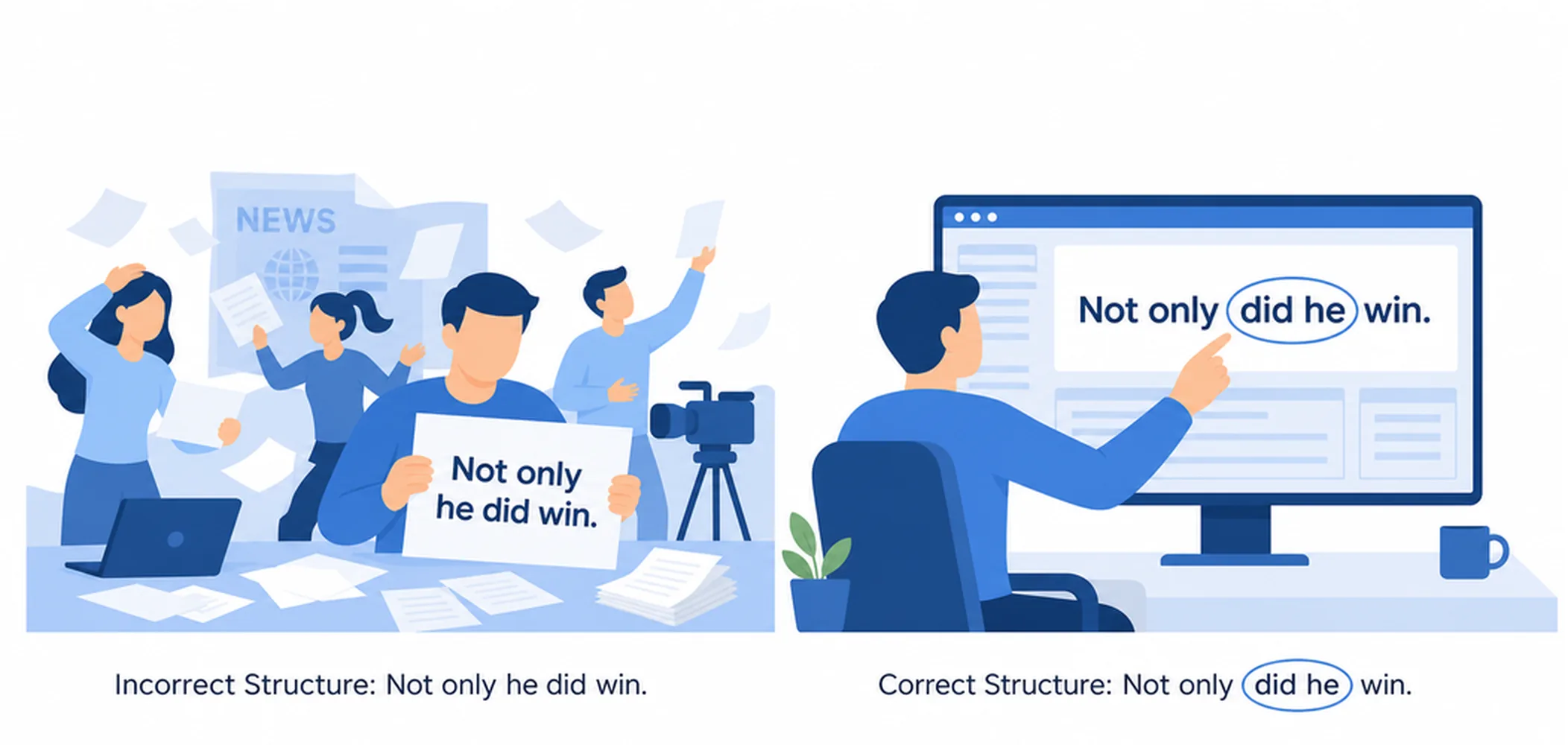
What is Fronting After Negative Adverbials?
Fronting after negative adverbials is an advanced syntactic pattern in English where placing a negative or semi-negative adverbial at the beginning of a clause triggers subject-verb inversion. This construction mimics the inversion found in questions and emphatic statements. When adverbials such as 'never', 'rarely', 'not only', 'under no circumstances', or 'little did' appear in sentence-initial position, the auxiliary verb moves before the subject. This pattern is characteristic of formal, literary, or emphatic English and is rarely used in casual speech.
Why Does Inversion Occur?
The inversion happens because negative and semi-negative adverbials are inherently emphatic and carry topicalized weight. By fronting them, the speaker or writer emphasizes the negation and creates a marked, formal register. The auxiliary verb (or main verb 'be') must invert with the subject to maintain the grammatical structure. Without this inversion, the sentence would feel incomplete or ungrammatical. This rule applies consistently across a range of negative adverbials: 'never before', 'not since', 'barely', 'scarcely', 'hardly', 'seldom', and longer phrases like 'not for a moment' or 'on no account'.
Register and Stylistic Use
Fronting after negative adverbials is predominantly formal and literary. It appears frequently in academic prose, published fiction, legal documents, and persuasive writing. In everyday conversation, speakers rarely use this construction; instead, they employ standard word order with emphasis conveyed through intonation or stress. Understanding when and how to deploy this pattern is essential for C1 learners aiming to produce sophisticated written English or recognize it in high-register texts. Overuse can sound artificial or pretentious, so strategic deployment enhances rather than dominates your writing.
Negative Adverbials That Trigger Inversion
| Adverbial | Meaning | Formality | Structure After Fronting | Example |
|---|---|---|---|---|
| Never | At no time | Formal / literary | Auxiliary + subject + main verb | Never have I seen such chaos. |
| Rarely / Seldom | Not often; almost never | Formal / literary | Auxiliary + subject + main verb | Rarely does she complain. |
| Hardly / Scarcely / Barely | Almost not; only just | Formal / literary | Auxiliary + subject + main verb; often followed by when/before | Hardly had he sat down when the alarm rang. |
| No sooner | Immediately after | Formal / literary | Auxiliary + subject + main verb; followed by than | No sooner had she left than it started raining. |
| Not only | In addition to; not just | Formal | Auxiliary + subject + main verb; paired with but (also) | Not only did he lie, but he also stole. |
| Not until / Not till | Only at/after a specific time | Formal | Auxiliary + subject + main verb in the main clause | Not until midnight did they arrive. |
| Not once | Never even a single time | Formal / emphatic | Auxiliary + subject + main verb | Not once did he apologise. |
| Under no circumstances | In no situation whatsoever | Very formal / official | Auxiliary + subject + main verb | Under no circumstances should you open this door. |
| In no way | Not at all; by no means | Formal | Auxiliary + subject + main verb | In no way does this affect our decision. |
| On no account | For no reason; absolutely not | Very formal | Auxiliary + subject + main verb | On no account must you leave early. |
| At no time | Never; not at any point | Formal / official | Auxiliary + subject + main verb | At no time was the public informed. |
| Nowhere | In/to no place | Formal / literary | Auxiliary + subject + main verb | Nowhere else can you find such beauty. |
| Little | Hardly; not much (semi-negative) | Formal / literary | Auxiliary + subject + main verb | Little did she know what lay ahead. |
| Only when / Only if / Only by | Restricted condition or means | Formal | Inversion in the main clause only; subordinate clause keeps normal order | Only when he left did she relax. |
| Only after / Only then | Following a prior event or moment | Formal | Inversion in the main clause only; subordinate clause keeps normal order | Only after he arrived did she feel comfortable. |
Examples






What to Remember
- Negative adverbials at sentence start (never, rarely, seldom) trigger subject-verb inversion.
- Inversion occurs with the auxiliary verb, which moves before the subject.
- Common negative adverbials triggering inversion include: never, rarely, little, under no circumstances, not only.
- This pattern is formal and emphatic; avoid it in casual, everyday speech.
- Remember: inversion happens only when the negative adverbial is fronted, not mid-sentence.