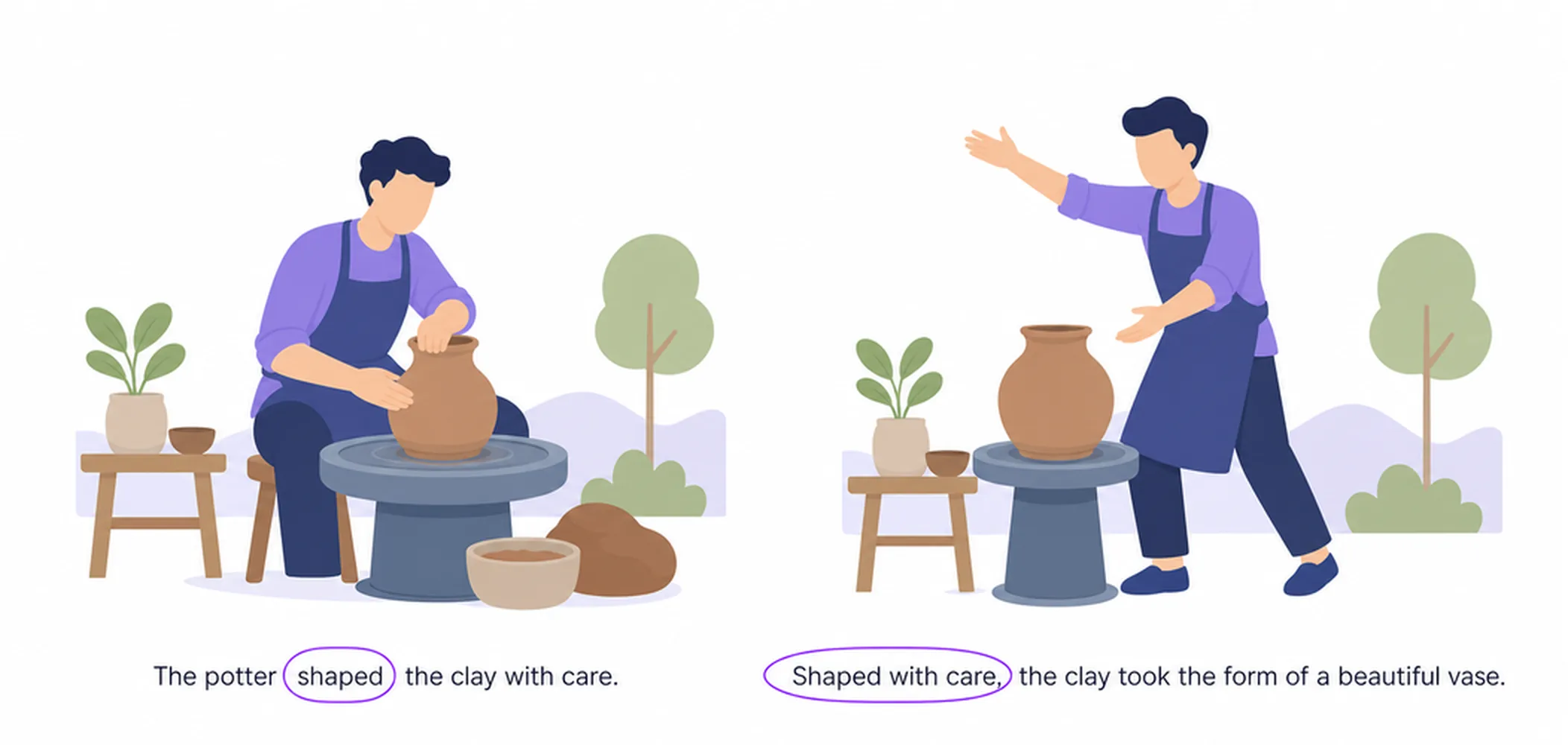
What is Fronting with Participles?
Fronting is a syntactic strategy that moves a constituent from its canonical position to the beginning of a clause for emphasis, focus, or stylistic effect. When combined with participles—either present (-ing) or past (-ed) forms functioning as reduced relative clauses or adverbial modifiers—this creates a sophisticated rhetorical device common in formal writing, journalism, and literary contexts. Rather than placing the participial phrase in its default position (mid-sentence or clause-final), fronting brings it forward to create immediacy, tension, or dramatic impact. This technique is particularly valued in C1-level academic and creative writing for its ability to manipulate information structure and reader attention.
Structures and Functions of Fronted Participles
Fronted participles typically take two primary forms. Present participles (verb + -ing) fronted at the sentence start function as adverbial modifiers or reduced relative clauses: 'Having exhausted all options, the committee decided to postpone the vote.' Past participles (verb + -ed) similarly appear at the front, often implying a passive sense or completion: 'Faced with mounting criticism, the politician issued a statement.' Both forms create a subordinate clause that precedes and modifies the main clause. The fronted participle phrase must share the same logical subject as the main clause's subject; failure to observe this produces a dangling participle, a common error at all levels. Fronting works especially well with participles already marked for aspect or voice, as these forms naturally signal temporal or causal relationships to the reader.
Rhetorical and Stylistic Effects
Fronting with participles serves multiple communicative purposes. It can establish temporal sequence ('Arriving late, she missed the opening remarks'), spatial setting ('Perched atop the cliff, the lighthouse commanded views for miles'), or causal relationship ('Knowing the risks, he proceeded anyway'). In journalistic and academic writing, fronting draws attention to circumstances or background information deemed significant before the main event or statement. Literary writers employ this technique to create suspense, emphasize character action, or manipulate narrative perspective. The fronted participle also allows writers to avoid repetitive subject pronouns and compress information—compare 'Having considered the proposal carefully, Maria rejected it' with 'Maria considered the proposal carefully and rejected it.' At the C1 level, control of this structure demonstrates syntactic sophistication and awareness of how sentence structure shapes meaning and reader engagement.
Fronted vs. Non-Fronted Participial Phrases
| Category | Fronted Participial Construction | Standard Non-Fronted Equivalent |
|---|---|---|
| Form | Participial phrase (present -ing or past -ed/-en) placed at the beginning of the sentence, before the subject and main verb. Pattern: [Participial Phrase], [Subject] + [Main Verb] + [Rest of Clause] |
Subject appears first, followed by the main verb, with any participial or adverbial phrase placed after the main clause. Pattern: [Subject] + [Main Verb] + [Object/Complement] + [Participial/Adverbial Phrase] |
| When to Use |
|
|
| Positive Example | Present participle (fronted): "Smiling broadly, she accepted the award." Past participle (fronted): "Exhausted by the long journey, the travellers finally rested." Perfect participle (fronted): "Having finished the report, he switched off his computer." |
Present participle (standard): "She accepted the award, smiling broadly." Past participle (standard): "The travellers finally rested, exhausted by the long journey." Perfect participle (standard): "He switched off his computer, having finished the report." |
| Negative Example | Present participle (fronted): "Not knowing the answer, he remained silent." Past participle (fronted): "Unimpressed by the performance, the critics left early." Perfect participle (fronted): "Not having received a reply, she sent a second message." |
Present participle (standard): "He remained silent, not knowing the answer." Past participle (standard): "The critics left early, unimpressed by the performance." Perfect participle (standard): "She sent a second message, not having received a reply." |
| Question Example | Indirect question (fronted): "Standing at the window, did she notice anything unusual?" Rhetorical/narrative question (fronted): "Faced with such evidence, could anyone doubt the verdict?" Note: In questions, the subject follows the fronted participial phrase, and the auxiliary verb then follows the subject. This maintains grammatical accuracy while preserving the fronting effect. These constructions are more common in literary or rhetorical contexts than in everyday speech. |
Indirect question (standard): "Did she notice anything unusual while standing at the window?" Rhetorical/narrative question (standard): "Could anyone doubt the verdict when faced with such evidence?" Note: Standard word order is the default in most question forms, especially in spoken English. The subject and auxiliary verb follow conventional interrogative patterns. |
| Key Signal Words | Opening position signals: Words ending in -ing or -ed/-en at the very start of a sentence Common fronted forms: Having (done), Being (done), Knowing, Seeing, Feeling, Driven, Surrounded, Convinced, Encouraged, Alarmed, Inspired, Exhausted, Determined, Faced (with), Given (that) A comma always follows the fronted participial phrase before the main clause. |
Subject-first signals: Pronoun or noun appears first: He, She, They, The man, The team Common linking devices in standard position: while, when, after, because, since, as, although, though, once, until, before The participial phrase may follow the main clause with or without a comma, or be replaced entirely by a subordinate clause using a conjunction. |
| Emphasis & Focus | The circumstance, condition, or background action receives primary emphasis. The reader processes the participial context before learning who acted or what happened. This creates anticipation and foregrounds the manner, cause, or timing of the main event. | The subject and the main action receive primary emphasis. Any participial detail is perceived as supplementary or secondary information. The sentence feels more direct, with the agent and event clearly at the front. |
| Stylistic Effect | Creates a formal, literary, or elevated register. Adds rhythm and variety to prose. Can generate suspense or drama by withholding the subject until after the participial phrase. Risk: dangling participles if the implied subject of the participle does not match the grammatical subject of the main clause. | Creates a neutral, conversational, or informal register. The sentence feels natural and easy to follow. Lower risk of grammatical ambiguity since the subject is immediately clear. Preferred in spoken English and informal writing. |
| Key Difference: The core distinction between fronted and non-fronted participial constructions lies in information order and emphasis. When a participial phrase is fronted, the writer deliberately places background circumstances, causes, or manner before the main event, giving those details greater prominence and creating a more formal or dramatic effect. In contrast, the standard construction keeps the subject and main action first, treating participial details as supplementary. Both constructions express the same propositional content, but they differ significantly in focus, register, rhythm, and perceived importance of each element. Writers must also be vigilant about dangling participles in fronted constructions — the implied subject of the fronted phrase must always match the grammatical subject of the main clause, or the sentence becomes ambiguous or incorrect (e.g., incorrect: "Running down the street, the keys were dropped." vs. correct: "Running down the street, she dropped the keys."). | ||
Examples






What to Remember
- Fronting moves a participial phrase to the clause beginning for emphasis, focus, or stylistic effect.
- Present participles (-ing) and past participles (-ed) can both be fronted as reduced relative clauses.
- The fronted participle must clearly modify the main clause subject to avoid dangling modifiers.
- Fronting is primarily used in formal writing, journalism, and literary contexts for sophisticated expression.
- Ensure the participial phrase appears immediately before its subject to maintain grammatical clarity and correctness.