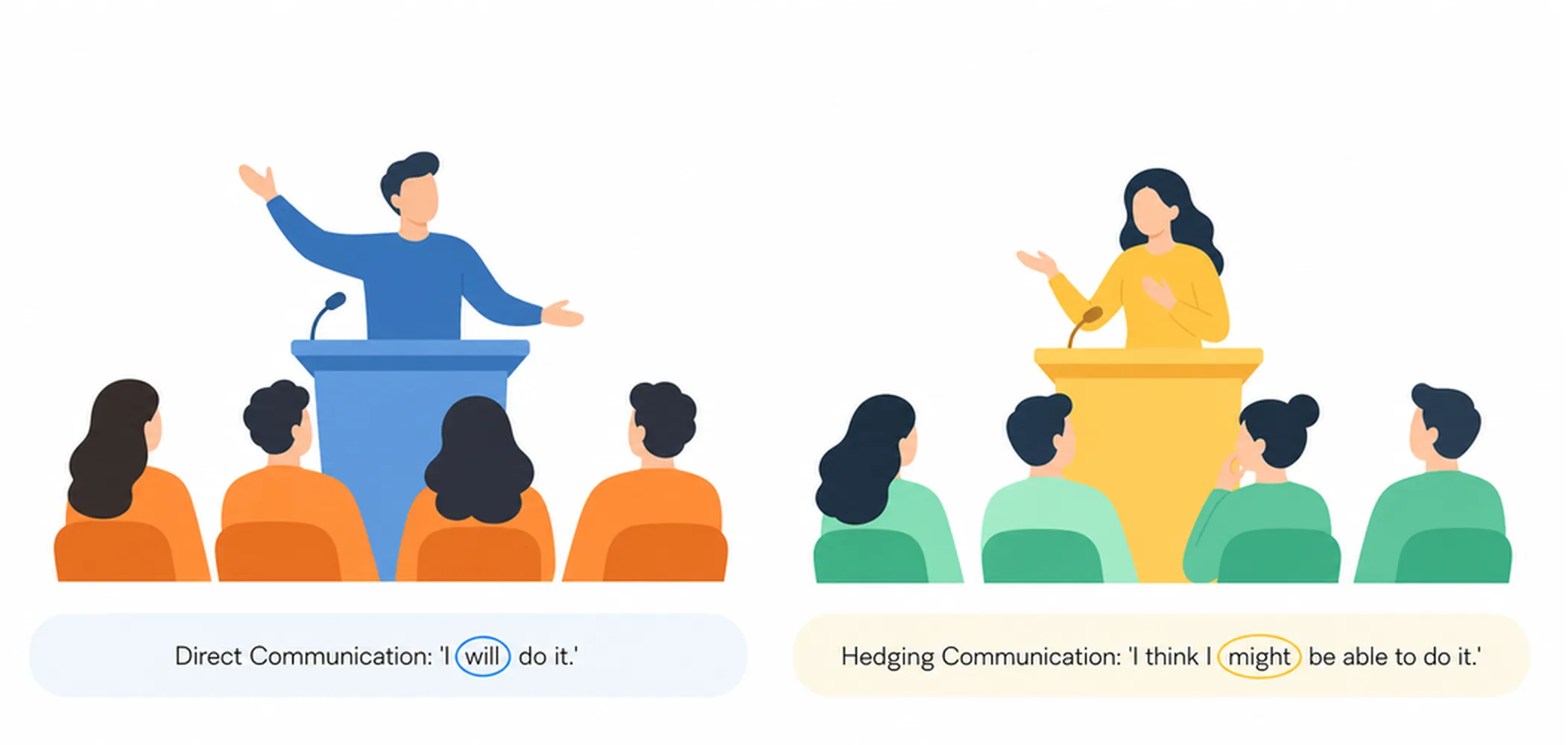
What is Hedging?
Hedging refers to the linguistic strategies speakers use to express uncertainty, limit the scope of their claims, or soften the directness of their statements. Rather than making absolute declarations, hedging allows speakers to qualify their assertions with degrees of probability, personal distance, or tentativity. In professional, academic, and interpersonal contexts, hedging demonstrates intellectual honesty, politeness, and awareness of complexity. Native speakers employ hedging constantly in spontaneous speech to avoid overgeneralisation and maintain credibility.
Functions of Hedging in Speech
Hedging serves multiple pragmatic functions. It allows speakers to mitigate potential disagreement ("I tend to think that..."), express epistemological uncertainty ("It seems to me..."), acknowledge alternative viewpoints ("In a sense..."), and manage interpersonal dynamics by appearing less imposing. In academic discourse, hedging conveys appropriate caution about research findings. In everyday conversation, it softens criticism or disagreement, making communication more diplomatic. Understanding when and how to hedge is essential for achieving fluency that reflects authentic native-speaker patterns.
Key Categories of Hedging Devices
Hedging employs four primary mechanisms: modal auxiliaries (might, may, could), epistemic adverbials (arguably, perhaps, relatively), epistemic verbs (seem, appear, suggest), and clausal hedges (In my view, sort of, I would say). These devices work synergistically; a single utterance may contain multiple hedges to calibrate the strength of a claim. The choice of hedging device depends on the degree of uncertainty, the relationship between interlocutors, and the register. Advanced speakers adjust their hedging density to match context—formal presentations require more explicit hedges, while intimate conversation permits greater directness paired with subtle hedging.
Hedging Devices in Spoken English
```html
| Category | Common Spoken Examples | Degree of Uncertainty | Typical Use in Speech | Learner Note |
|---|---|---|---|---|
| Modal Auxiliaries |
might, may, could, should, must, would
"That might be the answer.""She could be right." "It may take a while." |
Low → High
might / could = low certaintymay = moderate should / must = high certainty |
Speculating about facts, outcomes, or situations; softening direct assertions | Might is the most common hedge in casual speech. Avoid may in very informal registers — it can sound formal. |
| Epistemic Adverbials |
probably, possibly, perhaps, maybe, apparently, presumably, roughly, sort of, kind of
"She's probably busy.""Maybe we should wait." "It's roughly two miles." |
Very Low → Moderate-High
possibly / perhaps / maybe = lowprobably / presumably = moderate-high sort of / kind of = vague approximation |
Qualifying claims, approximating quantities, signalling inference from evidence | Sort of / kind of are extremely frequent in informal speech. Apparently marks information from a third-party source. |
| Epistemic Verbs |
think, believe, suppose, guess, reckon, seem, appear, understand, assume, feel
"I think it starts at six.""I suppose we could try." "It seems a bit complicated." |
Low → Moderate
guess / suppose = very tentativethink / believe / reckon = moderate personal opinion seem / appear = observed but uncertain |
Expressing personal opinions, distancing speaker from a claim, softening disagreement | I think is the single most common hedge in spoken English. First-person forms (I think/feel) are more personal; third-person forms (it seems/appears) are more impersonal and formal. |
| Clausal Hedges |
as far as I know, if I'm not mistaken, if I remember correctly, I'm not sure but, something like, in a way, more or less, to some extent
"As far as I know, the office is closed.""It's more or less finished." "To some extent I agree." |
Low → Moderate
Limits the scope of a claim rather than grading certainty — signals the speaker acknowledges their knowledge may be incomplete
|
Restricting or qualifying the extent of a claim; protecting face; signalling incomplete knowledge | These phrases add politeness and intellectual honesty. Use them when recalling facts you are not fully confident about or when partially agreeing or disagreeing. |
```
Examples






What to Remember
- Hedging softens claims and expresses uncertainty rather than making absolute, definitive statements.
- Use modal verbs like "might," "could," and "may" to express probability and tentativity.
- Adverbs such as "perhaps," "arguably," and "relatively" qualify statements and limit their scope.
- Phrases like "sort of," "kind of," and "I'd say" create personal distance from assertions.
- Avoid hedging in contexts requiring clarity, such as instructions, warnings, or formal declarations.