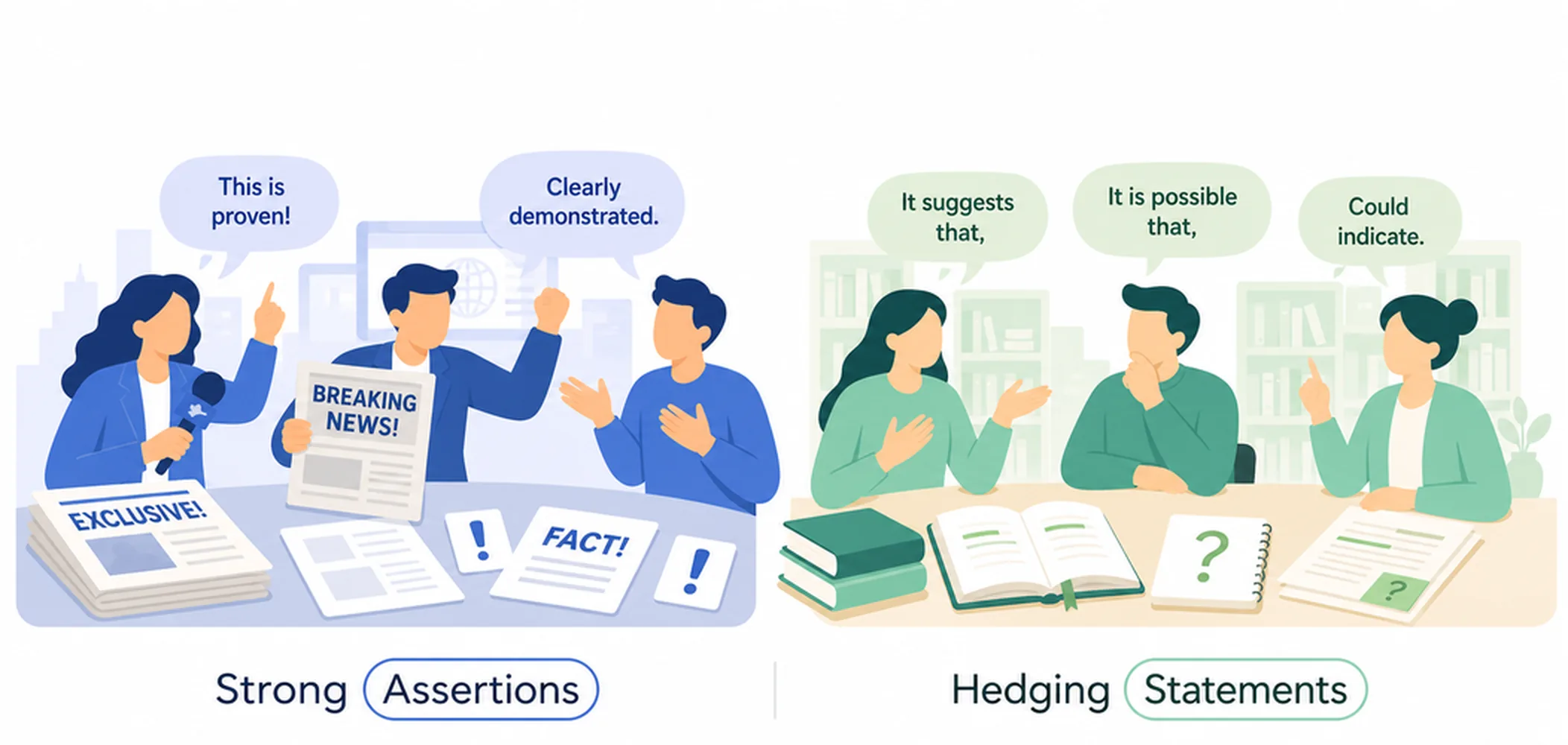
Grammar C1 Hedging Language

Hedging in academic writing

Hedging in academic writing

What is Hedging in Academic Writing?

Hedging refers to the strategic use of cautious or non-committal language to qualify statements, express uncertainty, or avoid making absolute claims. In academic discourse, hedging serves a crucial communicative function: it signals intellectual honesty, acknowledges the limitations of research, and reflects the provisional nature of knowledge. Rather than weakening arguments, effective hedging strengthens credibility by demonstrating awareness of nuance, counterarguments, and the complexity of academic inquiry. This is particularly valued in disciplines where certainty is rare and methodological limitations are inherent.

Key Functions of Hedging

Hedging serves multiple purposes in academic writing. First, it manages the writer's certainty, allowing them to present evidence-based claims without overstating confidence. Second, it protects the writer from overgeneralization by narrowing the scope of claims. Third, it demonstrates rhetorical awareness and reader engagement by acknowledging alternative viewpoints. Fourth, it mitigates the force of potentially contentious statements, which is essential in persuasive academic writing. Finally, hedging can soften criticism or disagreement with existing scholarship, maintaining collegial tone while still advancing counter-arguments.

Balancing Clarity and Caution

While hedging is essential, excessive use can render arguments unclear and unconvincing. The challenge is calibrating hedging to the level of certainty your evidence warrants. Strong evidence warrants minimal hedging; tentative findings demand more cautious language. Context matters: conclusions sections typically employ more definite language than introductions or discussions of limitations. Genre also influences expectations: review articles tolerate broader claims than empirical reports. Skilled academic writers deploy hedging strategically and intentionally, choosing precise qualifiers rather than vague intensifiers, thereby maintaining both intellectual integrity and argumentative force.

Hedging Language: Key Words and Phrases by Category

Category Examples Function Sample Sentence Note
Modal Verbs may, might, could, would, should Express possibility or uncertainty about a claim "This could suggest a link between diet and disease." may/might = lower certainty; would = conditional
Adverbs possibly, probably, perhaps, arguably, generally, typically, largely, apparently Qualify the degree of confidence or scope of a statement "This is arguably the most significant factor." Place before the main verb or adjective; probably > possibly in certainty
Verbs suggest, indicate, appear, seem, tend, assume, propose, imply Soften the directness of a claim or attribute it tentatively "The data suggest that stress affects performance." Prefer suggest over prove; avoid overusing seem
Nouns possibility, tendency, assumption, indication, likelihood, evidence Introduce uncertainty through nominal constructions "There is a possibility that results were affected by bias." Often used with there is a… or the… that… structures
Adjectives possible, probable, likely, uncertain, limited, apparent Modify nouns or follow linking verbs to limit a claim "A possible explanation is a lack of funding." Used attributively (a likely cause) or predicatively (it is likely that)
Phrases & Clauses it seems that, it is possible that, it could be argued that, to some extent, in many cases, according to Frame entire sentences with caution or attribute claims to a source "It could be argued that remote work increases productivity." According to X shifts responsibility to the source; useful for attribution
Approximators approximately, around, about, roughly, often, frequently, in some cases Limit the precision or universality of numerical or frequency claims "Approximately 60% of participants reported improvement." Avoids over-claiming exact figures; essential in results sections

Examples

The data suggest that climate variability may have influenced agricultural productivity in the nineteenth century.
Hedged interpretation of findings · Appropriate epistemic caution
It could be argued that the protagonist's motivations are somewhat ambiguous, which might explain the text's enduring appeal.
Literary analysis · Acknowledging alternative interpretations
Our findings appear to contradict the conventional wisdom, though further research would be needed to confirm this preliminary observation.
Positioning a counter-argument · Acknowledging methodological limitations
The correlation between socioeconomic status and academic achievement is arguably one of the most robust findings in educational research.
Hedging a strong claim · Inviting discussion while asserting significance
We tentatively propose that this mechanism operates through both direct and indirect pathways, though the relative contributions remain somewhat uncertain.
Hypothesis presentation · Acknowledging incomplete understanding
While one might argue that these results validate the hypothesis, alternative explanations cannot be entirely ruled out.
Conceding a point while maintaining critical distance · Sophisticated hedging
When to use it
Presenting Research Findings
Use hedging when reporting empirical results to acknowledge limitations of your methodology, sample size, or analytical approach.
"The results tentatively suggest a positive correlation, though the small sample size warrants cautious interpretation."
Interpreting Literature
Employ hedging in textual analysis to show awareness that interpretations are contested and multiple readings are possible.
"One could argue that the narrator's unreliability invites the reader to question the events portrayed."
Engaging with Opposing Views
Use hedging to acknowledge competing theories or criticisms while positioning your own argument diplomatically.
"While previous studies have claimed universality, the evidence would appear to support a more nuanced, context-dependent model."
Drawing Conclusions
Hedge concluding statements to indicate scope limitations and signal avenues for future research.
"These preliminary findings may offer a useful framework for investigating similar phenomena in other domains."
Proposing Theoretical Mechanisms
Use cautious language when speculating about mechanisms or causal pathways not directly tested in your study.
"We tentatively propose that this effect operates through reduced cognitive load, though direct evidence for this pathway is limited."
Narrowing Claim Scope
Employ hedging to qualify overly broad generalizations and signal that claims apply to specific contexts.
"These patterns appear particularly pronounced in post-industrial economies, suggesting a context-dependent phenomenon."
Signal words
may might could suggest appear seem tend to relatively arguably somewhat to some extent in part tentatively preliminary provisional would seem it is possible that one might argue fairly rather arguably perhaps in a sense so to speak
Common Mistakes
Wrong
The study proves that social media causes depression in teenagers.
Correct
The study provides evidence that social media may contribute to depressive symptoms in some adolescents.
Avoid absolute language ('proves') without hedging; use 'may' or 'appears to' for correlational or limited evidence.
Wrong
This research is absolutely groundbreaking and will revolutionize the field forever.
Correct
This research may represent a significant contribution that could influence future theoretical development in the field.
Excessive hyperbole and certainty undermine credibility; use measured, hedged language to maintain academic tone.
Wrong
The author clearly intended to criticize capitalism throughout the novel.
Correct
The novel could be read as offering a critique of capitalist ideology, though authorial intention remains ambiguous.
In literary analysis, acknowledge interpretive plurality; 'could be read as' and 'arguably' are more appropriate than 'clearly'.
Wrong
There are no alternative explanations for this phenomenon.
Correct
Current evidence does not obviously support alternative explanations, though further investigation may reveal additional mechanisms.
Avoid absoluteness; use 'does not appear to', 'may not', or 'would seem to' to remain open to future evidence.
Wrong
Our findings are kind of interesting and suggest maybe that the theory might be somewhat correct perhaps.
Correct
Our findings support the hypothesis, though additional confirmation across different populations would strengthen these preliminary conclusions.
Excessive vague hedging ('kind of', 'maybe', 'somewhat', 'perhaps') sounds unconfident; use precise qualifiers instead.
Wrong
It is possible that one could argue that perhaps this might suggest that the data could indicate a trend.
Correct
The data suggest an emerging trend warranting further investigation.
Avoid hedge stacking; one or two precise qualifiers are more effective than multiple weak ones that obscure meaning.
KEY TAKEAWAYS

What to Remember

  • Use modal verbs like "may," "might," "could," and "tend to" to express possibility rather than certainty.
  • Employ adverbs such as "arguably," "seemingly," "relatively," and "somewhat" to qualify claims without absolute commitment.
  • Include phrases like "it could be argued that" or "evidence suggests" to soften direct statements appropriately.
  • Avoid over-hedging, which weakens your argument; balance caution with confident assertion of your own findings.
  • Hedge research limitations and interpretations, but remain direct when stating established facts or your methodology.
← Previous
Hedging with phrases (it seems that, it appears that)
Next →
Hedging in spoken English