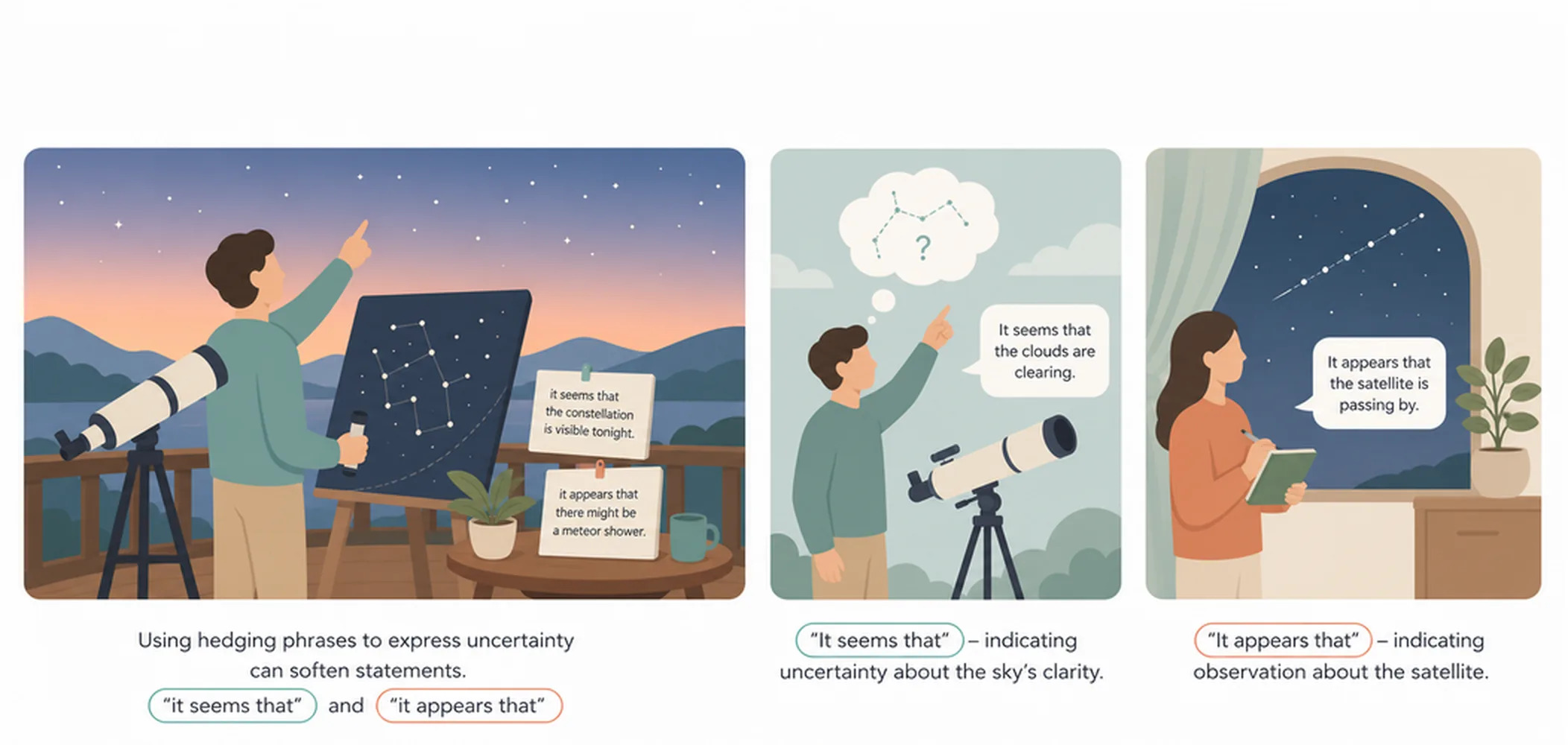
What is Hedging Language?
Hedging is a sophisticated communication strategy that allows speakers and writers to express ideas with appropriate degrees of certainty, doubt, or caution. Rather than making absolute statements, hedging phrases soften claims, making them more tentative, diplomatic, or academically rigorous. Phrases such as 'it seems that', 'it appears that', 'it would seem', and 'it could be argued that' are essential tools for nuanced expression, particularly in academic, professional, and formal contexts where overconfidence or categorical statements may be inappropriate or unconvincing.
Core Hedging Phrases and Their Functions
The most common hedging structures use impersonal constructions beginning with 'it', followed by a verb expressing appearance, likelihood, or possibility. 'It seems that' and 'it appears that' are among the most frequently used, suggesting observation-based uncertainty without committing to absolute truth. 'It would seem that' conveys stronger hedging through the conditional mood, implying tentative reasoning. 'It could be argued that' introduces subjective interpretation, useful when presenting contested viewpoints. These structures differ subtly: 'seems' emphasises subjective perception, 'appears' suggests visual or observable evidence, while 'could be argued' explicitly acknowledges the interpretive nature of a claim. The choice between them depends on the source of your uncertainty—perception, evidence, or interpretation.
Strategic Use in Academic and Professional Discourse
Hedging serves multiple rhetorical purposes: it demonstrates intellectual honesty by avoiding overstatement, builds credibility by acknowledging complexity, and protects claims against contradiction. In academic writing, hedging is essential for discussing theories, interpretations, and research findings that may be contested or provisional. In professional communication, it enables diplomatic expression of disagreement, suggestions, or criticism without appearing presumptuous. Overuse, however, can undermine confidence and clarity; effective hedging balances caution with conviction, using these phrases strategically rather than reflexively in every sentence.
Comparing Core Hedging Phrases
| Dimension | It seems that | It appears that | It would seem that | It could be argued that |
|---|---|---|---|---|
| Form | Introductory it + present simple verb + that-clause | Introductory it + present simple verb + that-clause | Introductory it + modal (would) + base verb + that-clause | Introductory it + modal (could) + passive verb + that-clause |
| Degree of Certainty | Moderate; the speaker has a reasonable but unconfirmed impression | Slightly higher than "seems"; implies observable or verifiable evidence | Lower than "seems"; the conditional modal adds extra tentativeness | Low; openly signals a debatable or contested claim rather than a fact |
| Source of Evidence | General impression, intuition, or informal observation | Observable data, research findings, or factual evidence | Indirect, limited, or inconclusive evidence; often used when evidence is mixed | Logical reasoning or a particular perspective; not necessarily the speaker's own view |
| Typical Context | Everyday conversation, informal writing, casual academic commentary | Formal academic writing, reports, journalism, scientific discussion | Formal or cautious academic writing; situations requiring diplomatic hedging | Essays, debates, critical analysis; presenting one possible viewpoint among several |
| Tone | Neutral to conversational; polite and non-assertive | Formal and objective; slightly more authoritative than "seems" | Very tentative, deferential, and formally cautious | Analytical and distanced; acknowledges subjectivity openly |
| Positive Example | "It seems that students perform better when given immediate feedback." | "It appears that the new policy has reduced waiting times significantly." | "It would seem that further research is needed before any conclusions can be drawn." | "It could be argued that social media has had a largely negative effect on democracy." |
| Negative Example | "It seems that the intervention has not produced the expected results." | "It appears that the data does not support the original hypothesis." | "It would seem that the current approach is not achieving its intended goals." | "It could be argued that the benefits of the scheme do not outweigh its costs." |
| Question Example | "Does it seem that the situation is improving over time?" | "Does it appear that the treatment group showed greater improvement?" | "Would it seem that the two variables are related based on these findings?" | "Could it be argued that traditional methods remain more effective in this context?" |
| Key Signal Words | seems, suggests, indicates (informally) | appears, suggests, indicates (formally), evidence shows | would seem, might suggest, could indicate, tentatively | could be argued, one might contend, some would say, arguably |
| Register | Informal to semi-formal | Semi-formal to formal | Formal to very formal | Formal academic and argumentative |
| Speaker's Commitment | Moderate personal commitment; speaker leans toward the claim | Moderate-to-high commitment; grounds claim in observable reality | Low commitment; speaker deliberately distances themselves from the claim | Minimal personal commitment; claim is attributed to a general viewpoint or debate |
| Key Difference: All four phrases are hedging devices used to avoid making overly strong or absolute claims, but they differ significantly in formality, certainty, and speaker involvement. "It seems that" is the most neutral and widely used, suitable for everyday and semi-academic contexts. "It appears that" is more formal and evidence-driven, implying observable support for the claim. "It would seem that" is the most tentative of the three, using the conditional modal "would" to signal maximum caution and is best reserved for highly formal or diplomatically sensitive writing. "It could be argued that" stands apart from the others because it does not present the writer's personal observation but instead introduces a debatable position, making it the preferred choice in argumentative essays and critical analysis where multiple perspectives are acknowledged. | ||||
Examples






What to Remember
- Use hedging phrases like "it seems that" and "it appears that" to soften absolute claims diplomatically.
- Hedging language is especially important in academic and professional writing to express appropriate levels of certainty.
- These phrases make statements tentative rather than definitive, allowing you to present ideas cautiously or diplomatically.
- Place hedging phrases at the beginning of sentences followed by a that-clause for standard formal structure.
- Overusing hedging can weaken your argument, so use these phrases strategically only when genuine uncertainty exists.