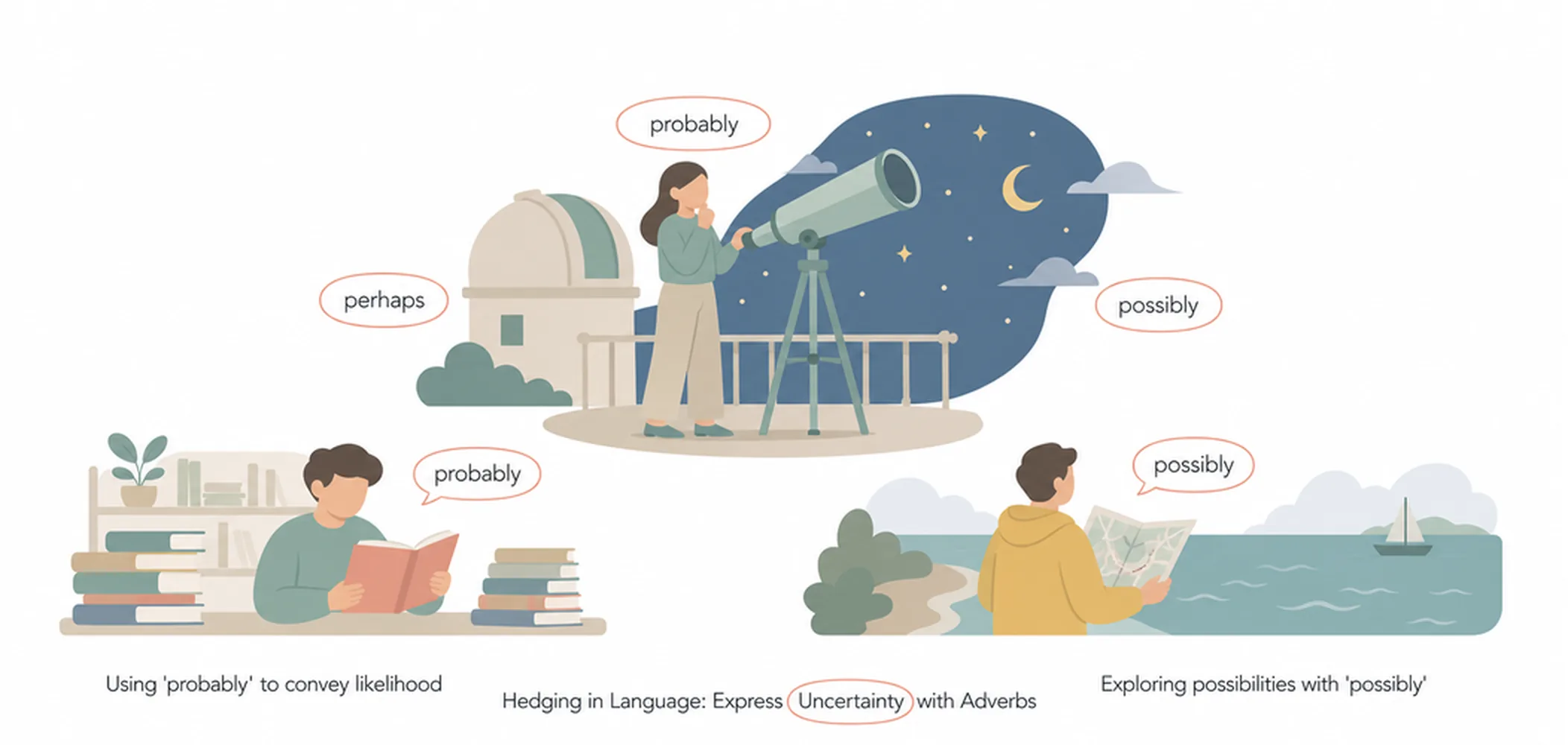
What is Hedging and Why It Matters
Hedging is a linguistic strategy used to express uncertainty, qualification, or tentativeness about a statement. Rather than making absolute claims, hedging adverbs allow speakers and writers to soften their assertions, making them more measured and precise. This is particularly valuable in academic discourse, professional communication, and situations where you want to avoid overstatement. Hedging demonstrates intellectual honesty—it acknowledges that not all claims can be made with complete certainty, which is a hallmark of sophisticated English use.
Common Hedging Adverbs and Their Nuances
The three primary hedging adverbs—probably, possibly, and perhaps—convey different degrees of likelihood. Probably suggests a high degree of confidence (70–90% certainty), indicating that something is more likely than not. Possibly expresses lower certainty (30–50%), suggesting that something could happen but is far from guaranteed. Perhaps occupies middle ground (40–60%), offering a gentle, conversational way to express uncertainty without committing strongly to either likelihood. Beyond these three, adverbs like arguably, conceivably, seemingly, and allegedly provide additional ways to hedge claims, each carrying distinct pragmatic implications for how your statement will be received.
Positioning and Register Considerations
Hedging adverbs can appear at the sentence initial position, mid-sentence after the auxiliary verb, or even in final position, with each placement carrying subtle differences in emphasis and formality. Initial placement (Perhaps the government should reconsider) is more conversational, while mid-sentence positioning (The government should, arguably, reconsider) integrates the hedge more seamlessly into formal academic writing. Be aware that excessive hedging can undermine your credibility—use these adverbs strategically to qualify genuine uncertainties rather than to avoid commitment on matters where you should take a clear stance. The register varies too: possibly and probably are neutral, perhaps is slightly more conversational, while arguably and conceivably are more academic.
Probably vs. Possibly vs. Perhaps: Side-by-Side Comparison
| Dimension | Probably | Possibly | Perhaps |
|---|---|---|---|
| Certainty Level | High probability (~70–90% confident). The speaker believes something is likely true or will likely happen. | Low-to-moderate possibility (~30–50% confident). The speaker admits something could happen but is genuinely unsure. | Moderate possibility (~40–60% confident). Slightly more tentative than probably but often interchangeable with maybe; conveys polite uncertainty. |
| Typical Register | Neutral to informal. Common in everyday speech, journalism, and casual writing. | Neutral to slightly formal. Used in academic writing, legal contexts, and careful spoken English. | Slightly formal to literary. More common in British English, formal essays, polite suggestions, and written prose. |
| Grammatical Position | Usually placed before the main verb or after the auxiliary verb (will probably go, probably is). Rarely at the start of a clause in informal use. | Flexible: can appear at the start, middle, or end of a clause (Possibly he left. He possibly left. He left, possibly.). | Very flexible: frequently appears at the start of a clause or sentence (Perhaps she forgot.) but also mid-sentence (She has perhaps forgotten.). |
| Typical Context of Use | Predictions, expectations, informed guesses, and warnings where the speaker has good reason to believe something. | Open possibilities, cautious speculation, acknowledging one of several options, or softening a strong claim in academic or professional writing. | Polite suggestions, diplomatic softening, literary or reflective writing, and expressing a tentative idea or recommendation. |
| Positive Example | "She will probably arrive by noon — her train leaves at ten." | "He could possibly finish the project on time, but it depends on the team." | "Perhaps we should reconsider our approach before the meeting." |
| Negative Example | "He will probably not accept the offer given his current contract." | "The drug possibly does not work for all patients in this age group." | "Perhaps it is not the best moment to raise that question." |
| Question / Suggestion Example | "Are you probably going to need more time?" (less natural in direct questions; more common in indirect speech: "I wondered if he would probably need more time.") | "Could you possibly send me the report by Friday?" (very common in polite requests) | "Perhaps you could explain your reasoning?" (softens a direct question or request) |
| Key Signal Words / Collocations | most probably, quite probably, very probably; often pairs with will, would, is | quite possibly, very possibly, could possibly; common in could you possibly… requests | perhaps the best, perhaps not, perhaps even; often used with might, could, should for extra softening |
| Key Difference: Choose probably when you are reasonably confident something is true or likely (~70–90%) and want to sound direct but not absolute. Choose possibly when you want to flag a genuine open question or low-odds chance (~30–50%), or when making a very polite request (Could you possibly…?). Choose perhaps when you want a slightly formal or literary tone, are making a polite suggestion, or are softening a request or recommendation — its certainty level sits between the other two, but its primary function is often politeness and diplomacy rather than a precise probability claim. In short: probably = likely; possibly = maybe (genuine doubt); perhaps = maybe (polite or reflective). | |||
Examples






What to Remember
- Use hedging adverbs like probably, possibly, and perhaps to express uncertainty rather than making absolute statements.
- Position hedging adverbs before main verbs or at the sentence start to qualify your entire claim.
- Choose probably for high likelihood, possibly for lower likelihood, and perhaps for polite suggestion or consideration.
- Hedging adverbs are essential in academic writing to demonstrate intellectual honesty and avoid overstatement of claims.
- Avoid overusing hedging language; excessive qualification weakens your argument and signals lack of confidence in your position.