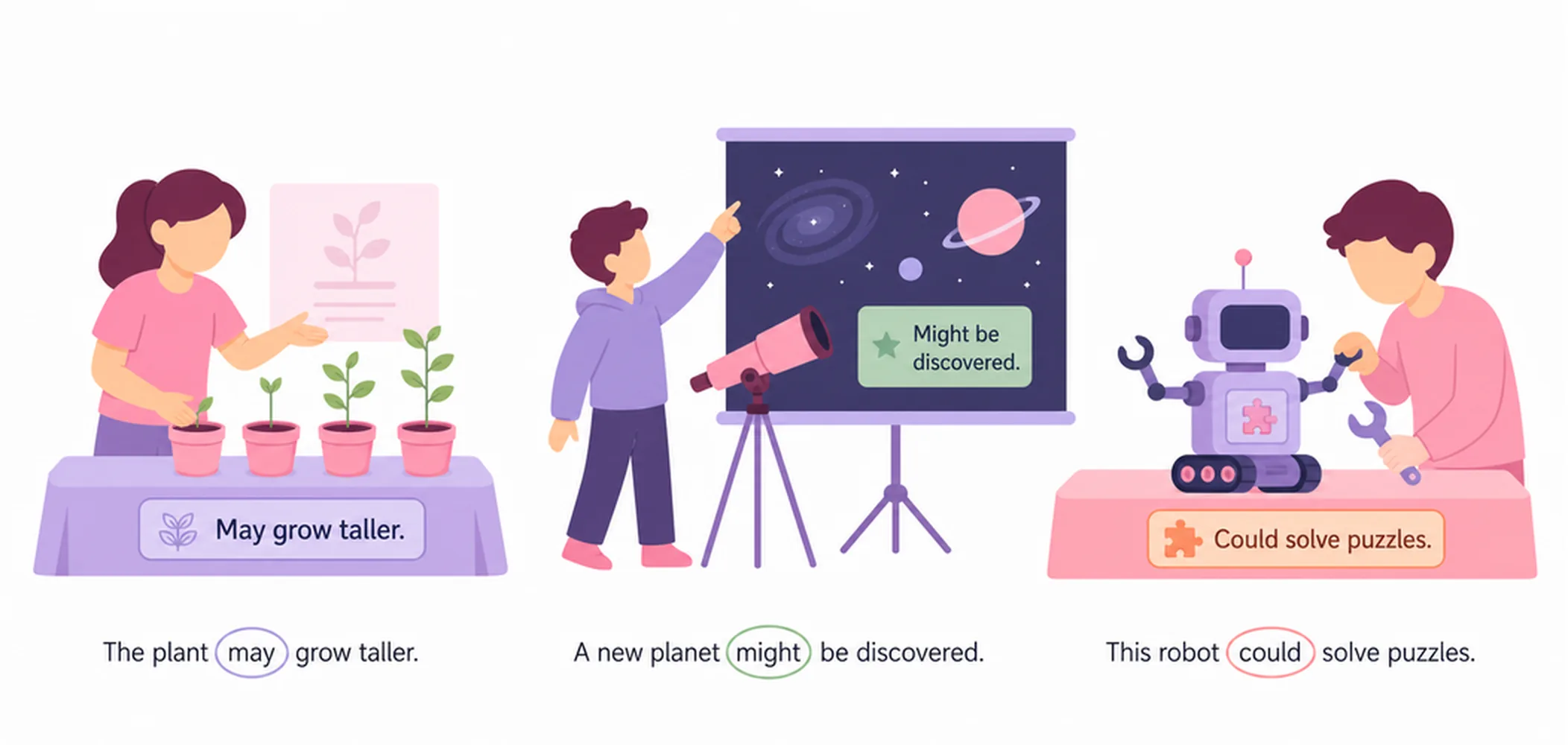
What is Hedging and Why It Matters
Hedging is a linguistic strategy used to soften assertions, express uncertainty, or avoid absolute claims. Rather than stating something definitively, hedged language introduces doubt, possibility, or qualification. This is particularly valuable in academic discourse, professional communication, and diplomatic contexts where precision and nuance are essential. Modal verbs like may, might, and could are primary hedging devices that signal the speaker's level of confidence about a proposition without dismissing it entirely.
The Spectrum of Certainty: May, Might, and Could
Although these three modals share overlapping functions, they occupy slightly different positions on the certainty spectrum. May expresses a genuine possibility with relatively higher likelihood—the speaker acknowledges the claim as plausible and worth considering. Might introduces greater uncertainty and is often used when the speaker is more doubtful or when conditions are less favourable for the claim to be true. Could, in hedging contexts, suggests possibility but often carries a more hypothetical or conditional tone. In contemporary British English, may and might are increasingly used interchangeably in hedging, though traditionally might signals greater tentativeness. All three are indispensable in academic writing, policy documents, and professional recommendations where certainty cannot be guaranteed.
Functions of Hedging in Context
Hedging serves multiple pragmatic functions beyond mere expression of uncertainty. In academic contexts, it allows researchers to present findings responsibly without overstating claims. In business communication, it enables professionals to propose ideas tentatively, inviting discussion rather than imposing conclusions. In interpersonal contexts, hedging can soften criticism, protect face, and facilitate negotiation. Strategic use of may, might, and could demonstrates intellectual humility, acknowledges competing perspectives, and invites collaborative thinking. Overuse, however, can undermine credibility and appear evasive; the key lies in calibrating hedging language to match the context, audience, and purpose.
May vs Might vs Could: A Side-by-Side Comparison
| Dimension | May | Might | Could |
|---|---|---|---|
| Form | may + base verb (invariable; no -s, -ed, or -ing) | might + base verb (invariable; past form of "may" but used independently) | could + base verb (invariable; past form of "can" but used independently) |
| Degree of Certainty | ~50% certainty — a genuine, reasonably likely possibility; the speaker considers it a real option | ~30–40% certainty — a more remote or tentative possibility; the speaker is less confident than with may | ~20–40% certainty — a theoretical or conditional possibility; often implies the outcome depends on circumstances |
| Formality Level | Neutral to formal — common in academic writing, official reports, and polite speech | Neutral — slightly more informal than may; widely used in everyday conversation and casual writing | Neutral to informal — very common in spoken English; also used in formal writing for conditional scenarios |
| When to Use | Use when the possibility is real and present-tense; also for granting or requesting permission in formal contexts | Use when speculating about something less probable, hypothetical, or in reported speech (shifting from may) | Use when suggesting one of several options, expressing conditional possibility, or softening a suggestion or criticism |
| Typical Context | Academic hedging ("results may indicate…"), weather forecasts, formal permissions, policy documents | Casual speculation, reported speech, low-confidence predictions, tentative suggestions in conversation | Brainstorming options, conditional statements, polite requests, gentle advice, theoretical reasoning |
| Positive Example | "The treatment may reduce symptoms within two weeks." | "He might come to the party, but I'm not sure." | "We could try a different approach if this one fails." |
| Negative Example | "This policy may not be sufficient to address the issue." | "She might not agree with your proposal." | "That couldn't be the right answer — let's reconsider." |
| Question Example | "May this be a sign of a deeper problem?" (formal; also used for permission: "May I proceed?") | "Might there be another explanation we haven't considered?" (formal speculation) | "Could this be the cause of the delay?" (common, natural-sounding hedge) |
| Key Signal Words / Phrases Often Paired With | possibly, perhaps, under certain conditions, in some cases, it is possible that | perhaps, I suppose, I'm not sure, it's unlikely but, even so, theoretically | potentially, one option is, if…then, alternatively, conceivably, it is conceivable that |
| Interchangeability | Often interchangeable with might in everyday use, but carries more confidence; not interchangeable when expressing permission | Often interchangeable with may, but subtly weaker; preferred in reported speech ("She said it might work") | Interchangeable with may/might for possibility, but adds a nuance of contingency or option; not interchangeable for formal permission |
| Register / Style Advice | Prefer in academic papers, formal emails, and reports to hedge claims professionally | Good for everyday hedging; use when you want to sound tentative without sounding evasive | Ideal for presenting alternatives, softening directives, or making requests feel less imposing |
| Key Difference Summary | |||
| The three modals form a spectrum of decreasing certainty: may signals the highest confidence in a possibility (~50%) and suits formal, academic hedging; might signals a more remote or tentative possibility (~30–40%) and is natural in everyday speculation; could signals a theoretical or conditional possibility (~20–40%) and excels at presenting options or softening claims. Crucially, only may (and sometimes could) carries a permission meaning — might does not. In most hedging contexts the three overlap, but choosing deliberately among them lets a writer or speaker calibrate exactly how confident or cautious they wish to appear. | |||
Examples






What to Remember
- Use may, might, or could to introduce uncertainty without committing to absolute claims.
- May suggests slightly higher likelihood than might; both soften assertions effectively in formal contexts.
- Could indicates possibility but less certainty than may; avoid it for unlikely scenarios.
- Hedging modal verbs work best in academic writing, professional reports, and diplomatic communication.
- Overusing hedging weakens arguments; reserve these modals for genuine uncertainty, not excessive caution.