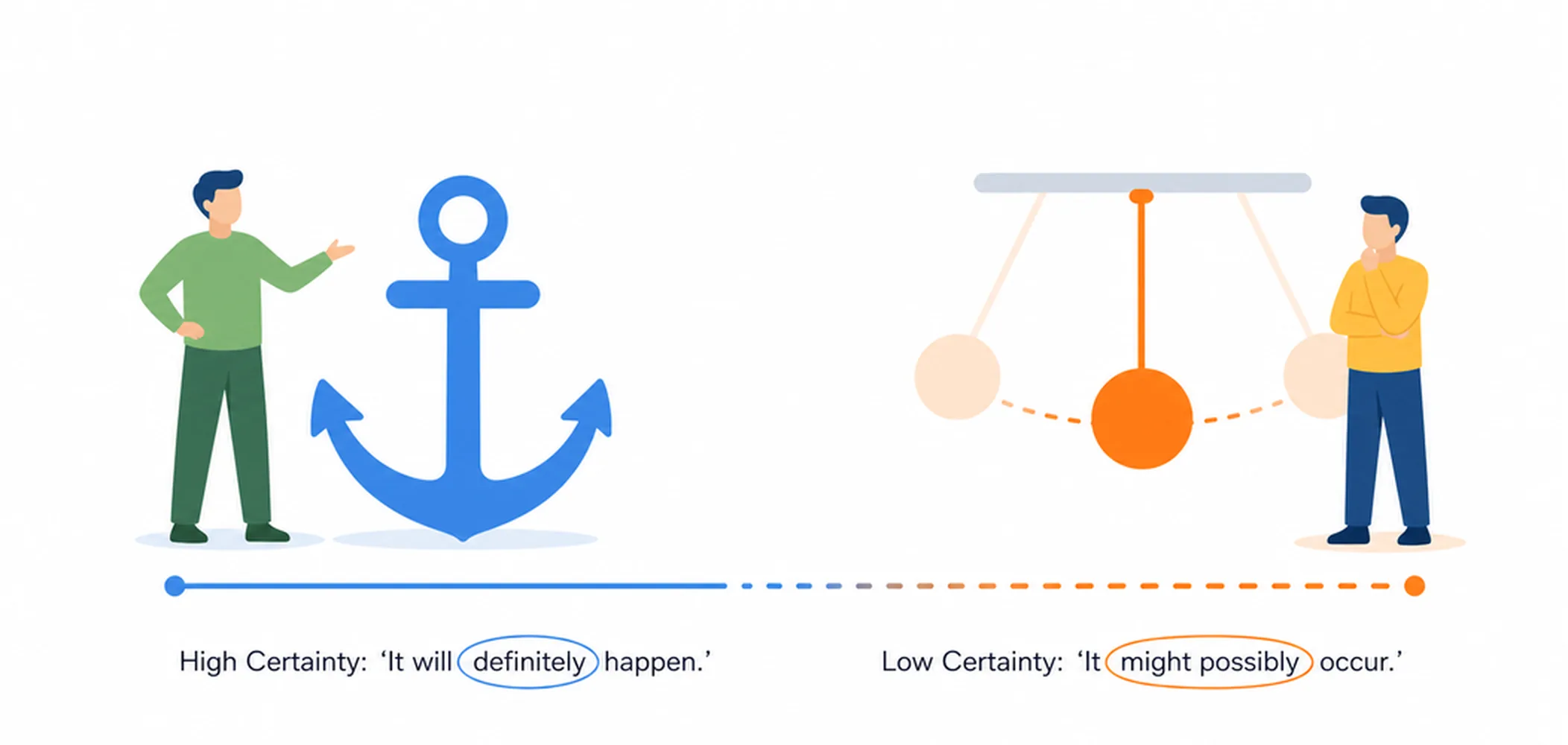
What is Hedging Language?
Hedging language is a set of linguistic devices used to soften, qualify, or express uncertainty about a statement. Rather than making absolute claims, hedging allows speakers and writers to present ideas with appropriate caution, acknowledging limitations, alternative viewpoints, or degrees of probability. In academic, professional, and formal contexts, hedging demonstrates intellectual honesty and prevents overstatement. It signals that the speaker is not claiming certainty where it doesn't exist—a hallmark of credible, nuanced communication at the C1 level and above.
Key Characteristics of Hedging
Hedging operates along a spectrum of certainty. It employs several grammatical tools: modal verbs (may, might, could), adverbial hedges (perhaps, arguably, seemingly), epistemic phrases (it could be argued that, there is evidence to suggest), and cautious verb phrases (tend to, appear to). The choice of hedging device reflects the speaker's level of confidence and the context's formality. Effective hedging is neither excessive (which undermines credibility) nor insufficient (which risks oversimplification). Mastering hedging is crucial for academic writing, research presentations, and professional discourse where precision and intellectual humility are valued.
The Certainty Scale
| Certainty Level | Hedging Expression | Form / Type | Example Sentence | Note |
|---|---|---|---|---|
| 🔴 Lowest | it is conceivable that | Impersonal it-clause | It is conceivable that the drug reduces inflammation. | Signals a bare logical possibility; writer is very non-committal |
| it is possible that | Impersonal it-clause | It is possible that other factors are involved. | Slightly more common than "conceivable"; still very low certainty | |
| might / could / may | Modal verb | This might explain the observed variation. | Might = lowest modal; could ≈ might; may slightly stronger; all express possibility | |
| possibly / perhaps / conceivably | Adverb (stance) | Possibly, the sample size was too small. | Often paired with a modal for extra distance: could possibly | |
| would appear / would seem | Modal + lexical verb | The results would appear to support the hypothesis. | Tentative but based on visible evidence; common in academic writing | |
| appears / seems (to) | Lexical verb | The data seem to indicate a downward trend. | Slightly more confident than "would appear"; evidence-based inference | |
| suggest / indicate / imply | Reporting / lexical verb | The findings suggest a causal relationship. | Subject is usually the data/findings, not the writer; very frequent in research articles | |
| probably / likely | Adverb / adjective | This is probably due to increased enzyme activity. | Implies probability >50%; stronger hedge than "possibly" | |
| should / ought to | Modal verb (epistemic) | The temperature should stabilise within 24 hours. | Epistemic should = logical expectation; distinguish from deontic (obligation) use | |
| is likely to / is expected to | Adjective/verb phrase | The effect is likely to increase with dosage. | Strong probability; common in predictions and forecasts | |
| will | Modal verb | Higher doses will produce stronger effects. | Near-certain prediction; use carefully — implies strong evidence or established fact | |
| is certain to / must | Adjective phrase / modal | The reaction must involve an intermediate compound. | Logical necessity or very high confidence; rare in cautious academic prose | |
| 🟢 Highest | it is clear / it is evident / clearly | Impersonal it-clause / adverb | Clearly, the correlation is significant. | No hedge — asserts certainty; use only when data fully supports the claim |
Examples






What to Remember
- Hedging language softens absolute claims by expressing uncertainty, qualification, or alternative possibilities in statements.
- Use modal verbs like might, could, may, and seem to indicate possibility rather than certainty.
- Adverbs such as arguably, perhaps, relatively, and somewhat reduce the strength of claims appropriately.
- In academic writing, hedging demonstrates intellectual honesty and prevents overstatement of findings or conclusions.
- Avoid excessive hedging in contexts requiring clear assertion; balance caution with appropriate confidence levels.