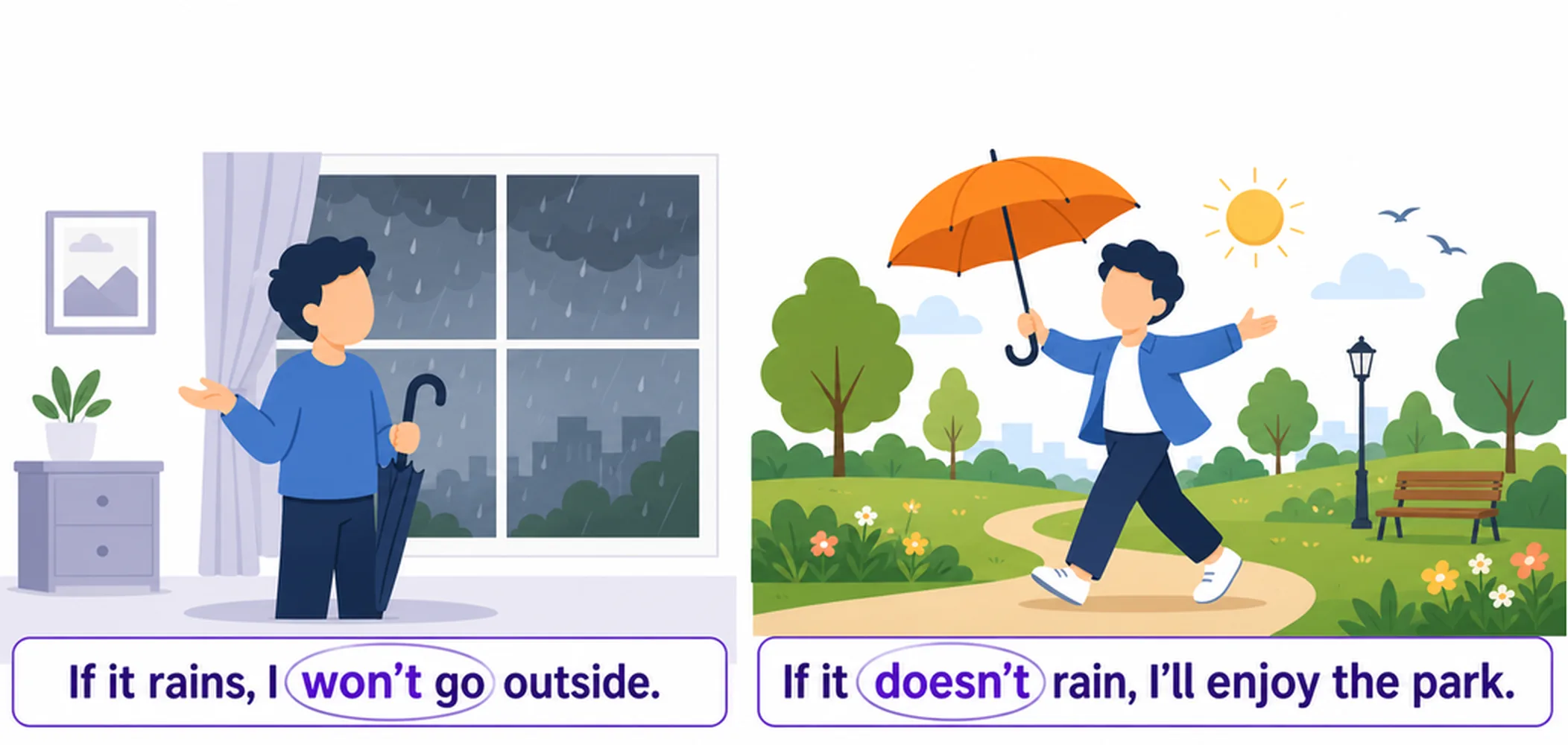
Introduction to Negative First Conditionals
The negative first conditional describes what will NOT happen if a condition is not met. It uses the same time frame as the positive form—a real, possible situation in the future. To make a first conditional negative, you add 'not' to the main verb in the result clause. The structure is straightforward and very useful for expressing consequences that you want to avoid.
Signal Words and Phrases
Certain words and phrases often appear with negative first conditionals. They help express the conditional and negative meanings clearly.
Pro Tip: Using 'Unless' as an Alternative
You can often replace 'if + negative' with 'unless' to make the sentence more concise. For example: 'If you don't study, you won't pass' becomes 'Unless you study, you won't pass.' Both mean the same thing, but 'unless' is more direct and commonly used in spoken English.
Negative First Conditional Formula
The negative first conditional describes situations where something will not happen if a condition is not met. The negative marker can appear in the if-clause, the result clause, or both.
In the if-clause, use do not / does not + infinitive verb. In the result clause, use will not / won't + infinitive verb.
| Structure | Example |
|---|---|
| If + subject + do/does not + verb (infinitive) + ..., + subject + will + verb (infinitive) + ... | If you do not study, you will fail the exam. |
| Structure | Example |
|---|---|
| Subject + will not / won't + verb (infinitive) + ... + if + subject + verb (present simple) + ... | You will not pass if you do not study. |
| Structure | Example |
|---|---|
| If + subject + do/does not + verb + ..., + subject + will not / won't + verb + ... | If you do not arrive on time, we will not wait for you. |
• In the if-clause, use the present simple tense with the negative form: do not (I, you, we, they) or does not (he, she, it).
• In the result clause, use will not or the contraction won't followed by the base infinitive.
• The structure depends on which clause contains the negation—place the negative marker in whichever part of the sentence expresses the negative condition or consequence.
What to Remember
- The negative first conditional describes what will NOT happen if a condition is not met.
- Use 'if' + present simple in the condition clause, then will not/won't + verb in the result clause.
- Add 'not' to the main verb in the result clause to make it negative.
- The time frame is the same as positive first conditional—a real, possible future situation.
- Common mistake: don't use 'will not' in the if-clause; only use it in the result clause.