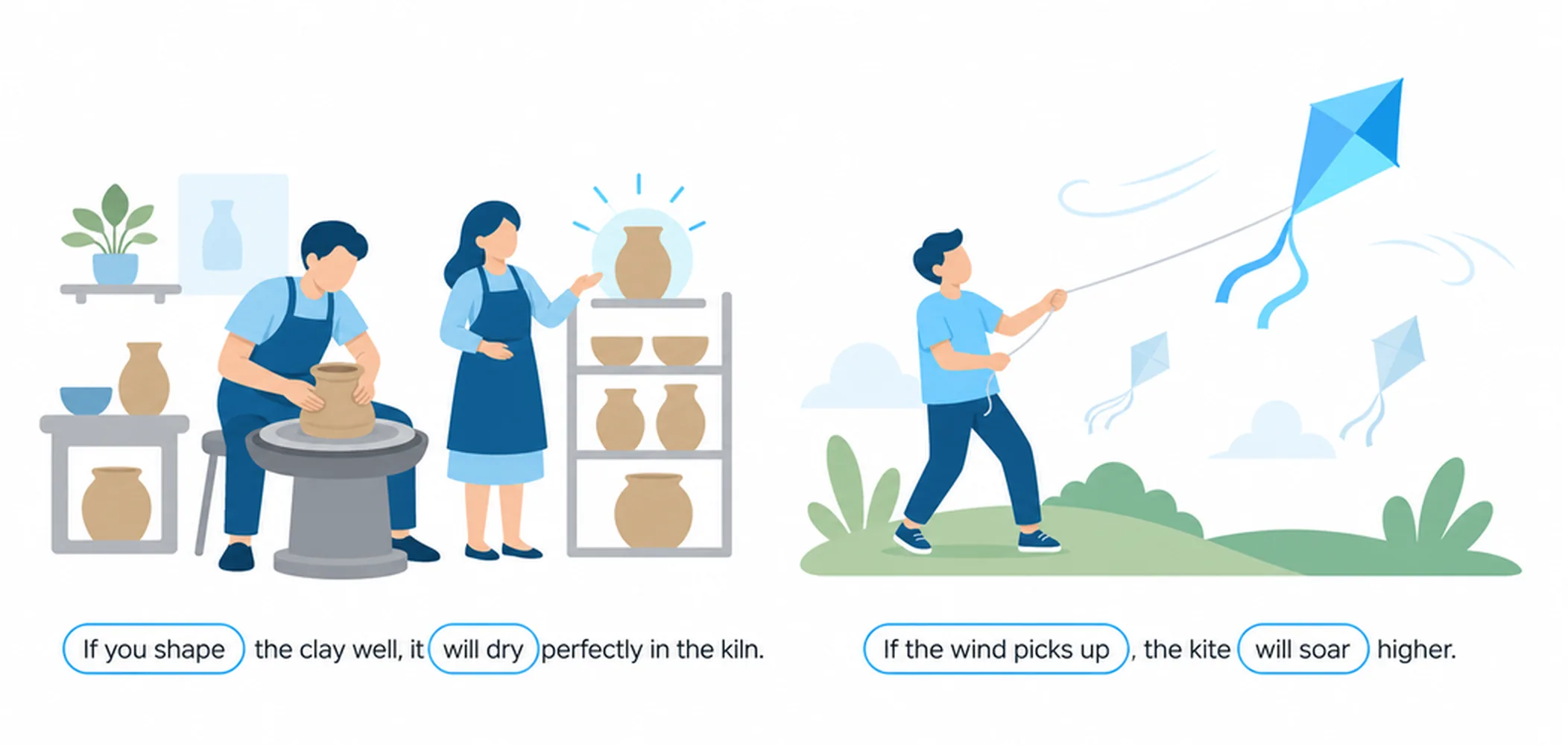
What is the First Conditional?
The first conditional is used to talk about situations that are possible or likely to happen in the future. It describes what happens if a certain condition is met. We use it when we believe there is a real chance that the condition will become true. For example, if you study hard, you will pass the exam. The condition is possible because you can control whether you study or not.
Form and Structure
The first conditional uses the present simple tense in the if-clause and the future simple (will + base verb) in the main clause. The pattern is: If + present simple, will + base verb. You can also use other modals instead of will, such as can, may, or might, to show different levels of certainty. The if-clause can come at the beginning or end of the sentence, and the meaning stays the same.
Real Situations vs. Possible Situations
Both real and possible situations use the first conditional because both are likely or probable. A real situation is something that actually happens (If you touch the hot stove, it burns). A possible situation is something that might happen in the future (If you miss your bus, you will be late for work). The difference is small—both conditions can realistically occur. The first conditional is perfect for predictions, warnings, and promises about probable futures.
Real vs. Possible Situations: Side-by-Side Comparison
Both real and possible situations in the first conditional use identical grammatical structure: If + present simple, will + base verb. The distinction between them is not grammatical but rather semantic and attitudinal — it reflects the speaker's degree of certainty about whether the condition will be met.
| Aspect | Real Situations | Possible Situations |
|---|---|---|
| When to Use | Use when the condition is based on something that is already happening, a known fact, a scheduled event, or a very likely outcome in the near future. | Use when the condition is uncertain, hypothetical, or depends on a future decision or action that has not yet been made or taken. |
| Speaker's Certainty | High — the speaker believes the condition is very likely or almost certain to occur. | Moderate — the speaker considers the condition genuinely possible but not guaranteed. |
| Positive Example | "If the train arrives on time, we will catch our connection." The train is expected; this is a real, planned situation. | "If it rains tomorrow, we will cancel the picnic." Rain is possible but not certain; the outcome depends on a future event. |
| Negative Example | "If she doesn't submit the report today, the manager will not approve it." The deadline is a real, current constraint. | "If you don't study harder, you won't pass the exam." Passing or failing depends on a possible future change in behaviour. |
| Question Example | "If the store opens early, will you go before work?" The store's opening is a real, verifiable possibility. | "If you get the job offer, will you move to another city?" The job offer is uncertain and speculative. |
| Signal Words | today, tonight, this morning, already, on time, soon, as planned, definitely, certainly | maybe, perhaps, tomorrow, next week, possibly, one day, sometime, by chance, ever |
| Speaker's Attitude | The speaker is confident the condition will be met and is simply describing a predictable consequence. | The speaker acknowledges uncertainty and is exploring what might happen under a given scenario. |
Examples





What to Remember
- Use the first conditional to describe possible or likely future situations based on a real condition.
- The if-clause uses present simple tense; the main clause uses will + base verb (future simple).
- The condition must be realistic and possible—something that could actually happen or be controlled.
- You can reverse the sentence order: "You will pass if you study hard" or "If you study hard, you will pass."
- Common mistake: never use will in the if-clause; use present simple instead.