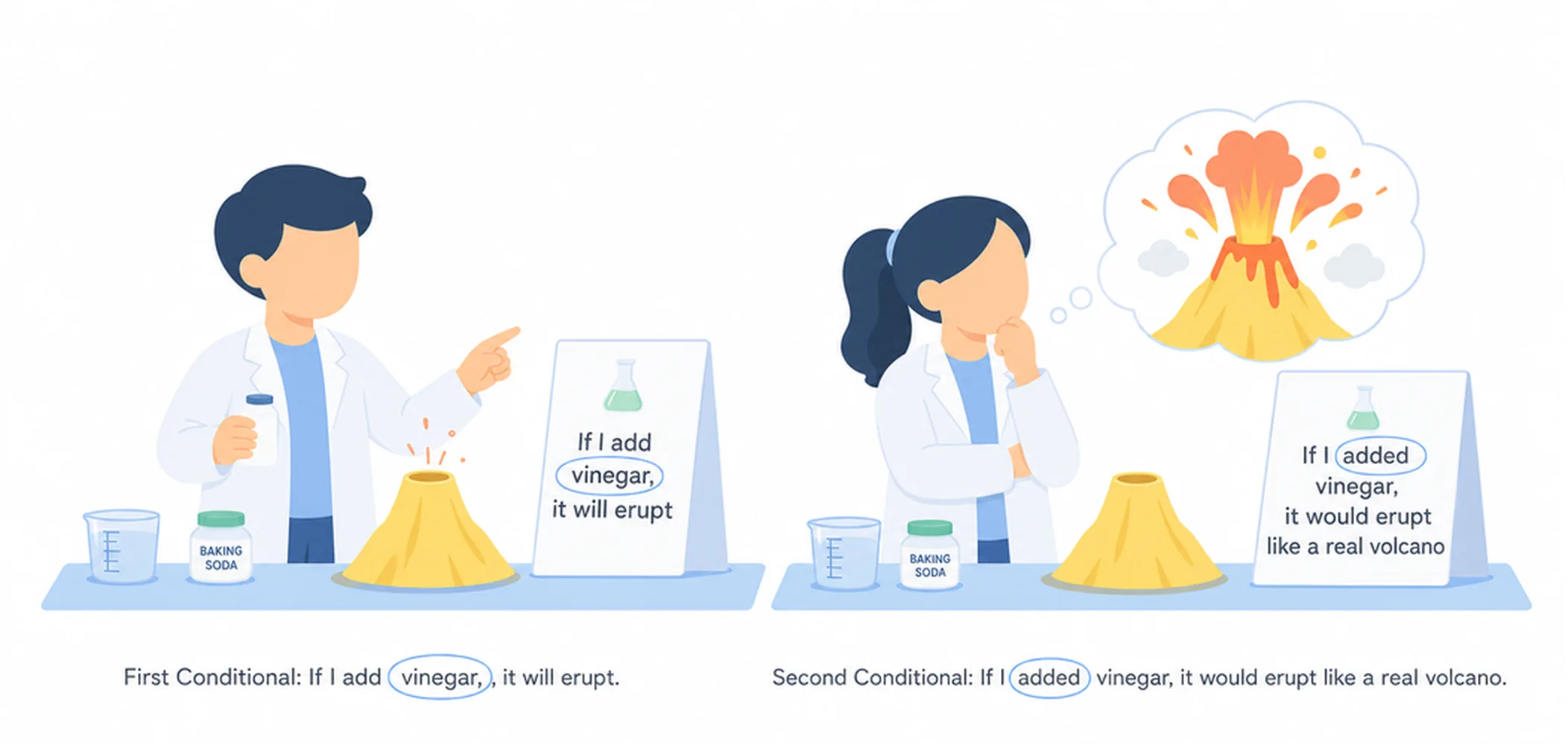
First Conditional vs Second Conditional
Both first and second conditionals talk about situations that might happen, but they describe very different possibilities. The first conditional (if + present simple, will + base verb) describes real, possible situations that could happen in the future. The second conditional (if + past simple, would + base verb) describes imaginary, unlikely, or impossible situations. Understanding when to use each one is essential for expressing yourself accurately in English.
Key Differences
The first conditional is about reality: something is genuinely possible. The second conditional is about imagination: something is unlikely or will probably not happen. First conditional sounds realistic and optimistic; second conditional sounds more doubtful and less probable. Think of first conditional as 'this could really happen' and second conditional as 'this probably won't happen, but let's imagine it did.'
First Conditional vs Second Conditional: Side-by-Side Comparison
| Aspect | First Conditional | Second Conditional |
|---|---|---|
| Form | If + present simple, will + base verb | If + past simple, would + base verb |
| When to use | To talk about real, likely, or possible situations in the present or future. The condition is realistic and could genuinely happen. | To talk about unreal, imaginary, or unlikely situations in the present or future. The condition is hypothetical or contrary to fact. |
| Likelihood | High — the speaker believes the condition is possible or probable. | Low or zero — the speaker considers the condition unlikely, impossible, or purely imaginary. |
| Positive example | If it rains tomorrow, I will take an umbrella. | If it rained every day, I would move to another city. |
| Negative example | If she doesn't hurry, she will miss the bus. | If he didn't work so hard, he wouldn't be so stressed. |
| Question example | Will you call me if you need help? | Would you travel the world if you had more money? |
| Key signal words | if, when, unless, as long as, provided that + will / won't / can / may | if, imagine, suppose, what if + would / wouldn't / could / might |
| Key Difference: The core distinction is one of reality vs. imagination. The first conditional uses the present simple and will to describe situations the speaker genuinely expects could occur. The second conditional uses the past simple and would to signal a mental shift into a hypothetical world — the past tense is not about past time but about distance from reality. A quick test: if you can replace if with "and this is quite possible", use the first conditional; if you need "but this is just a dream or very unlikely", use the second. | ||
Examples






What to Remember
- Use first conditional for real, possible situations: if + present simple + will + base verb.
- First conditional describes future events that are likely to happen in reality.
- Don't confuse first conditional with second conditional, which is for imaginary situations.
- First conditional uses present simple in the if-clause, never past tense.
- Second conditional describes unlikely or impossible situations with if + past simple + would.