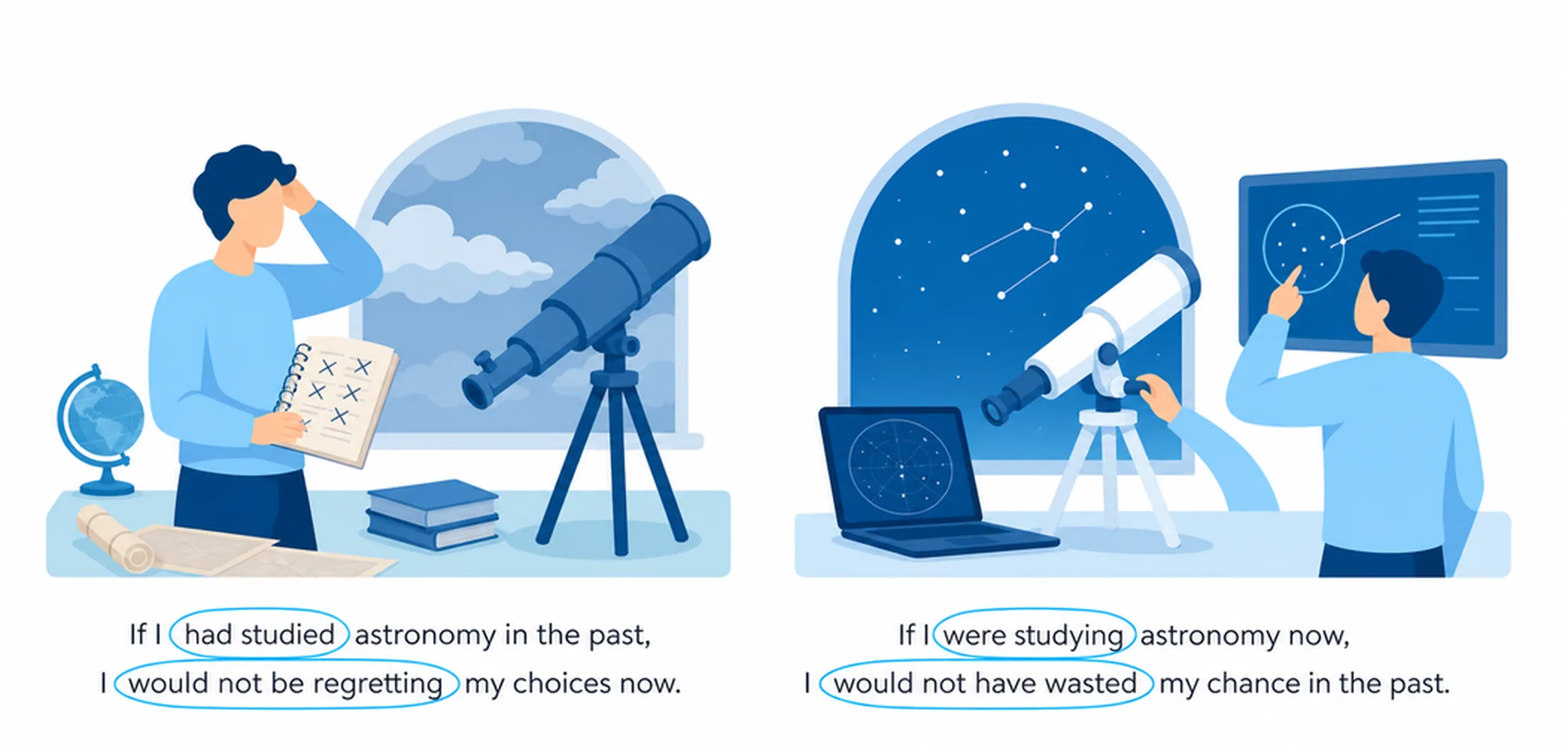
Understanding Negative Mixed Conditionals
Mixed conditionals blend past and present timeframes to express hypothetical situations with unrealistic outcomes. Negative mixed conditionals negate either the condition or the consequence, allowing you to express what wouldn't be the case if circumstances were different. Mastering the negative forms requires precision with auxiliary negation and careful tense sequencing across two temporal planes.
Positive vs. Negative Mixed Conditionals
| Aspect | Type 1 Mixed Conditional Past condition → Present result |
Type 2 Mixed Conditional Present condition → Past result |
|---|---|---|
| Form |
Positive: If + past perfect, would + bare infinitive Negative: If + had not + past participle, would not + bare infinitive (negation can appear in either or both clauses) |
Positive: If + past simple, would have + past participle Negative: If + did not + bare infinitive, would not have + past participle (negation can appear in either or both clauses) |
| When to use | Use when a past event (real or imagined) has a direct effect on a present situation. The negative form emphasises what did NOT happen in the past and how that absence still affects now. | Use when a present state or characteristic (real or imagined) would have changed a past outcome. The negative form highlights how the absence of a present quality would have altered a past event. |
| Positive example |
"If she had studied medicine, she would be a doctor now."
She didn't study medicine → she is not a doctor now.
|
"If he were more careful, he would not have crashed the car."
He is careless by nature → he crashed the car in the past.
|
| Negative example |
"If she had not studied medicine, she would not be a doctor now."
She did study medicine → she is a doctor now. The negative reverses the implied reality.
|
"If he were not so careless, he would not have crashed the car."
He is careless → he crashed. Negating the condition reverses the imagined scenario.
|
| Mixed negation (one clause negative, one positive) |
"If she had not dropped out of school, she would be earning more now."
Negative if-clause + positive result clause.
"If she had studied harder, she would not be struggling now."
Positive if-clause + negative result clause.
|
"If he were not so stubborn, he would have accepted the offer."
Negative if-clause + positive result clause.
"If he were braver, he would not have run away."
Positive if-clause + negative result clause.
|
| Question example |
"Would she be a doctor now if she had not changed her major?"
Invert subject and 'would' in the result clause; the if-clause stays the same.
|
"Would he have crashed the car if he were not so careless?"
Same inversion rule applies; the if-clause remains unchanged.
|
| Contraction forms |
had not → hadn't would not → wouldn't "If she hadn't moved abroad, she wouldn't be fluent in French now." |
were not → weren't would not have → wouldn't have "If he weren't so shy, he wouldn't have missed that opportunity." |
| Key signal words |
If-clause: if … had (not), had … (not) [inversion], unless, but for Result clause: now, today, at the moment, still, currently, by this point |
If-clause: if … were (not), if … didn't, unless, were … [inversion] Result clause: yesterday, last week, at that time, back then, already, then |
| Common errors |
"If she hadn't studied, she wouldn't have been a doctor now."
Error: Using 'would have been' instead of 'would be' breaks the present-result meaning.
|
"If he hadn't been so careless, he wouldn't have crashed."
Error: Using past perfect in the if-clause turns it into a Type 3 conditional, removing the present-state meaning.
|
| Key Difference: The core distinction between the two types lies in the direction of time across the clauses. In Type 1 Mixed Conditionals (past → present), negation in the if-clause reverses an implied past action and consequently flips the present reality described in the result clause — both clauses shift together. In Type 2 Mixed Conditionals (present → past), negation in the if-clause reverses an implied permanent trait or present state, which in turn reverses a past outcome — the present characteristic is the root cause. The key test: ask yourself "Is the condition about what happened in the past, or about what kind of person or thing exists now?" If the former, use Type 1; if the latter, use Type 2. Negating either type does not change which tenses are used — it only reverses the implied real-world scenario being contrasted. | ||
Formula
✖ Negative
If
+
Subject
+
hadn't + past participle
+
(past condition negated)
+
Subject
+
wouldn't + be + verb-ing / wouldn't + present infinitive
+
(present consequence)
If she hadn't missed the deadline, she wouldn't be struggling with the project now.
? Question
If
+
Subject
+
hadn't + past participle
+
wouldn't
+
Subject
+
be + verb-ing?
If you hadn't accepted the job offer, wouldn't you be regretting your current position now?
Examples

If I hadn't ignored the warning signs, I wouldn't be in this difficult situation today.
Past condition negated → present consequence · Mixed Type 3–2

If the company didn't have poor leadership, it wouldn't have lost so many talented employees last year.
Present condition negated → past consequence · Mixed Type 2–3

If she hadn't chosen to study abroad, wouldn't she be working in a completely different field by now?
Question form · Past condition negated, present consequence

If he didn't suffer from chronic anxiety, he wouldn't have turned down the promotion last month.
Habitual/ongoing condition negated → past consequence

They wouldn't be struggling now if they hadn't rejected sound financial advice a year ago.
Inverted word order · Consequence before condition
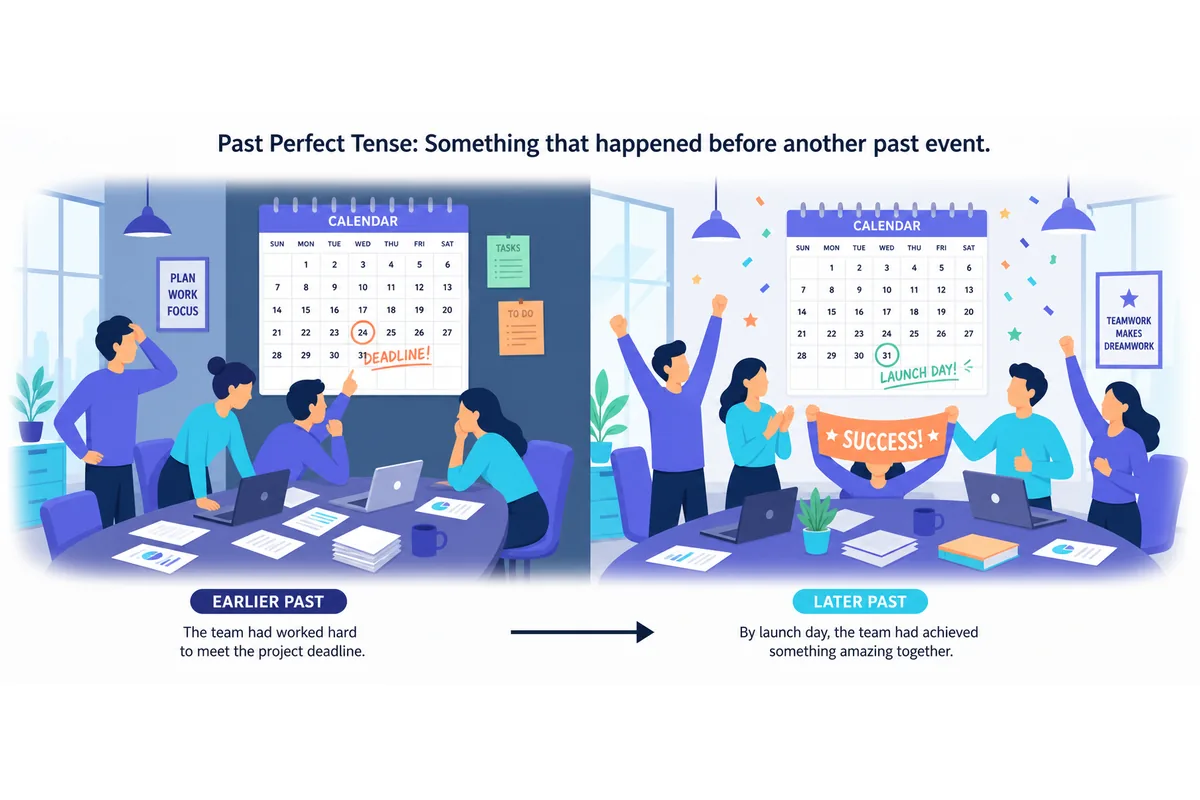
If the project hadn't been delayed, wouldn't the team be celebrating a successful launch right now?
Passive voice · Question form · Mixed conditional
When to use it
Explaining Present Regret
Express how a past action is causing your present situation or feeling.
"If I hadn't procrastinated last semester, I wouldn't be struggling to graduate on time."
Analyzing Consequences
Discuss why someone is in a current state, linking it to past decisions or circumstances.
"If she hadn't ignored the early symptoms, she wouldn't be undergoing extensive treatment now."
Hypothetical Questions
Pose speculative questions about how the present would differ if the past had been different.
"If they hadn't relocated to a smaller office, wouldn't they have better employee retention today?"
Logical Argumentation
Build arguments in essays or debates by showing causality across time frames.
"If the policy hadn't been introduced in 2015, the economy wouldn't be performing as well as it is."
Signal words
if
hadn't
wouldn't be
wouldn't have
didn't
now
today
currently
as it is
in the past
back then
Common Mistakes
✕
Wrong
If I hadn't made that mistake, I wouldn't have been more confident today.
✓
Correct
If I hadn't made that mistake, I would be more confident today.
Avoid double past tense in present-time consequence; use simple present or present continuous without 'have'.
✕
Wrong
If he didn't arrive late yesterday, he wouldn't miss the meeting now.
✓
Correct
If he hadn't arrived late yesterday, he wouldn't be missing the meeting now.
Use past perfect for a negated past condition; simple past is used only for habitual/ongoing negated conditions.
KEY TAKEAWAYS
What to Remember
- Mixed conditionals connect past conditions with present consequences or vice versa, mixing conditional structures across different timeframes.
- Negate the condition or consequence separately; avoid double negation unless expressing specific logical emphasis intentionally.
- Use past perfect in past-focused clauses and present conditional in present-focused clauses to maintain temporal accuracy.
- Common mistake: don't mix tense patterns inconsistently; maintain clear past-present alignment even when negating either clause.
- Negative auxiliary placement determines meaning; position "wouldn't," "hadn't," or "wouldn't have" precisely to negate the correct element.