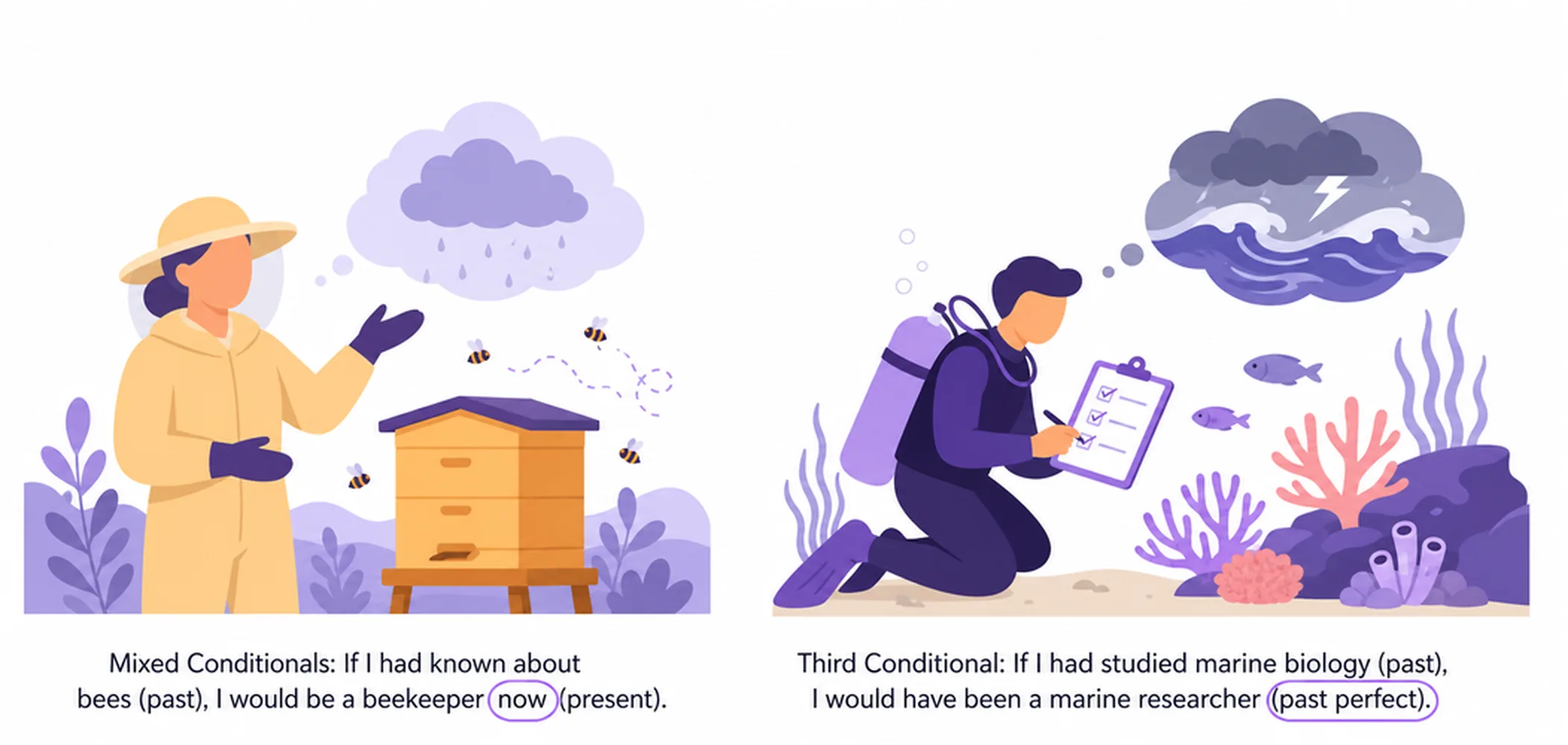
Key Difference: Time Reference
Third conditionals and mixed conditionals both discuss hypothetical past situations, but they diverge fundamentally in what they examine. Third conditionals maintain temporal consistency—a past condition produces a past consequence. Mixed conditionals, conversely, violate chronological boundaries: they explore how a past condition would affect a present state, or how a present condition would have altered a past outcome. Understanding this distinction is essential for C1 learners who need precision in expressing complex, temporally layered hypotheses.
Structural and Functional Breakdown
Third conditional: If + past perfect → would have + past participle. Both clauses anchor to the past; the consequence never materialised because the condition didn't occur. Example: 'If I had studied harder, I would have passed the exam.' Mixed conditional: typically divides into two subtypes. Type A reverses the logic: If + past perfect → would + base verb (past action → present state). Type B inverts: If + past simple → would have + past participle (present condition → past consequence). The mixed structure reflects real-world reasoning where temporal boundaries blur.
When Temporal Logic Matters
In professional, academic, and reflective discourse, distinguishing these forms prevents ambiguity. The key difference lies in whether the condition and consequence refer to the same time period or span different points in time.
| Conditional Type | Time Reference | Example |
|---|---|---|
| Mixed Conditional | Past condition + present consequence | If World War II had ended differently, Europe would be unrecognisable today. |
| Third Conditional | Both past condition and past consequence | If Germany had invested more heavily in diplomacy, war could have been avoidable in the 1930s. |
A historian might use the third conditional to speculate purely on past alternatives: "If the Allies had delayed their invasion, the war might have lasted longer." A therapist might employ mixed conditionals to explore how past decisions shape present circumstances: "If you had set boundaries earlier in your childhood, you might find relationships easier now." The temporal distinction—whether both clauses reference the past, or one clause reaches into the present—determines which form is grammatically and logically appropriate.
Mixed Conditionals vs Third Conditional: Side-by-Side Comparison
| Dimension | Third Conditional | Mixed Conditional |
|---|---|---|
| Form | If + past perfect (had + past participle) → would have + past participle | Most common type: If + past perfect (had + past participle) → would + base verb Reverse type: If + past simple / were → would have + past participle |
| Time Reference | Both the condition and the result refer to the past. The entire hypothetical situation is set in the past. | The condition and the result refer to different time frames — typically a past condition with a present result, or a present/permanent condition with a past result. |
| When to Use | Use when imagining how a past situation could have turned out differently. Often expresses regret, criticism, or speculation about completed events. | Use when a past event still has consequences now (past → present), or when a permanent personal trait would have changed a past outcome (present → past). Bridges two time zones. |
| Positive Example | If she had studied harder, she would have passed the exam. (She didn't study → she didn't pass — both in the past.) |
If she had studied medicine, she would be a doctor now. (She didn't study medicine in the past → she is not a doctor today — past condition, present result.) |
| Negative Example | If he hadn't missed the flight, he wouldn't have arrived late. (He missed the flight → he arrived late — both past.) |
If he hadn't moved abroad, he wouldn't be living in Paris now. (He moved abroad in the past → he is living in Paris now — past action, present state.) |
| Question Example | Would you have taken the job if they had offered it to you? (Speculating about a past decision and its past outcome.) |
Would you be fluent in Spanish now if you had kept practising? (Past action — or lack of it — affecting a present ability.) |
| Key Signal Words / Clues | yesterday, last year, that day, at that time, back then, in 1990 — time expressions anchoring both clauses firmly in the past. | now, today, still, currently, at the moment (in the result clause) — or permanent characteristics like be, be lazy, be a doctor — signal a cross-time relationship. |
| 🔑 Key Difference: The third conditional keeps both the imagined cause and its imagined effect entirely in the past — it revisits a single, completed moment and wonders "what if?". The mixed conditional deliberately crosses time boundaries: a past event can shape the present reality ("If I had taken that job, I would be rich now"), or a present/permanent characteristic can be projected back to explain a past outcome ("If I weren't so shy, I would have spoken to her"). The key question to ask yourself is: Are both the condition and the result in the same time frame? If yes → third conditional. If they belong to different time frames → mixed conditional. | ||
Examples






What to Remember
- Third conditionals show past condition + past result; mixed conditionals break temporal consistency.
- Mixed conditionals can reverse time: past condition affecting present state, or vice versa.
- Use past perfect for the condition; present perfect or simple present for present result.
- Use past perfect for the condition; would have + past participle for past result.
- Common mistake: confusing mixed conditionals with third conditionals by maintaining temporal order throughout.