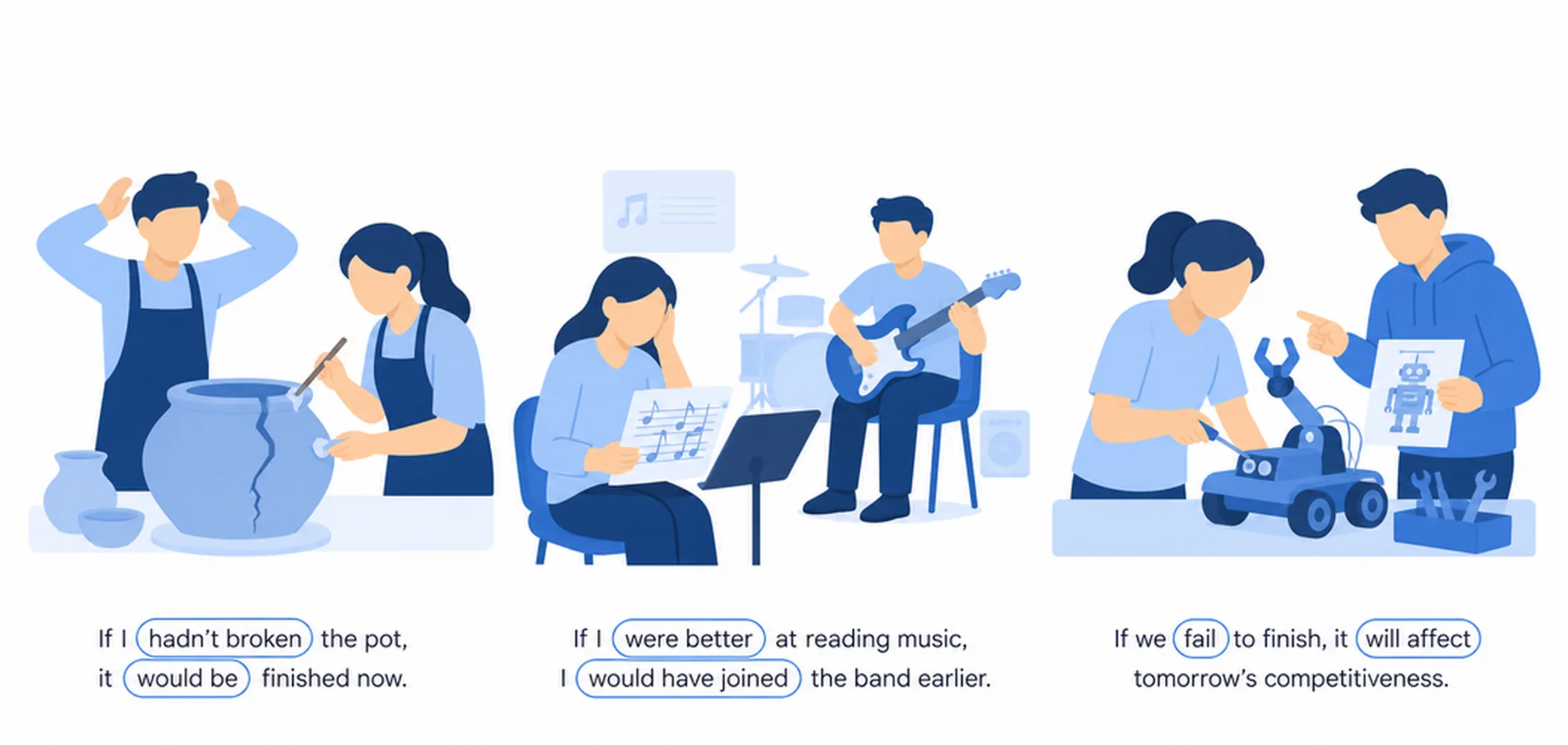
Grammar C1 Mixed Conditionals

Mixed conditionals — examples

Mixed conditionals — examples

What Are Mixed Conditionals?

Mixed conditionals blend elements of different conditional structures to express hypothetical situations where the condition and result exist in different time frames. Unlike standard conditionals (second, third), which maintain temporal consistency, mixed conditionals allow you to link a past condition with a present consequence, or vice versa. This sophisticated structure is essential for expressing how past events continue to influence present circumstances, or how hypothetical present situations would have changed past outcomes. Mixed conditionals are primarily used in advanced academic, professional, and literary English.

The Two Main Patterns

The first pattern combines a past condition (third conditional) with a present result (second conditional): If + past perfect, would/could/might + base verb. This expresses that something didn't happen in the past, so the present situation is as it is now. Example: If you had studied engineering, you would be working in a different sector today. The second pattern reverses this: a present condition (second conditional) with a past result (third conditional): If + past simple, would/could/might + have + past participle. This suggests that a current hypothetical situation would have produced different outcomes in the past. Example: If you were more ambitious, you would have applied for that promotion five years ago. Both patterns require careful attention to verb tenses to maintain logical coherence.

Register and Appropriateness

Mixed conditionals are characteristic of advanced, formal discourse and appear frequently in academic writing, professional communication, and sophisticated conversation. They enable precise expression of complex causal relationships and counterfactual reasoning. At C1 level, controlling mixed conditionals demonstrates grammatical precision and nuanced thinking. Use them when you need to explain how past decisions shape present realities, or how hypothetical present traits would have altered history. Avoid overusing them in casual speech; they sound unnatural in informal contexts.

Mixed Conditional Examples

Type A: Past unreal condition → Present result

Structure: If + past perfect (condition in the past) + would/could/might + bare infinitive (result now).

Career / Life choices

If she had studied medicine, she would be a doctor by now.

The past perfect "had studied" places the unfulfilled condition in the past (she did not study medicine), while "would be" shows the hypothetical present state that would exist as a result today.
Financial decisions

If they hadn't invested so recklessly in 2010, they wouldn't be struggling with debt right now.

The negative past perfect highlights a past mistake; the negative "wouldn't be struggling" reflects its ongoing present consequence.
Personal health

If he hadn't started smoking as a teenager, his lungs might be in much better condition today.

"Might be" (rather than "would be") is used here to convey a degree of uncertainty about the present result — we cannot be entirely sure.
Language learning

If I had grown up in a bilingual household, I could speak Spanish fluently now.

"Could speak" expresses an ability that would exist in the present had the past condition (growing up bilingual) been true.
Relationships

If we hadn't moved to the same city back then, we wouldn't be friends today.

A past event (moving to the same city) is the origin of a present reality (being friends). The mixed conditional shows how the present friendship depends on that past circumstance.
Type B: Present/permanent unreal condition → Past result

Structure: If + simple past (present or general unreal condition) + would/could/might + have + past participle (hypothetical past result).

Character traits

If he were a more patient person, he wouldn't have quit the project so quickly.

"Were" signals a present or permanent character trait that is imagined as different; "wouldn't have quit" shows the past action that would not have occurred as a result of that different trait.
Skills and abilities

If she were a stronger swimmer, she could have entered the race last weekend.

Her current level of ability (not being a strong swimmer) is the permanent condition; "could have entered" expresses the past opportunity that was missed because of it.
Social situations

If I weren't so shy, I might have spoken to her at the conference yesterday.

The speaker's shyness is an enduring present trait; "might have spoken" describes a past social interaction that did not happen because of it, with "might" adding a note of tentativeness.
Professional performance

If he weren't so stubborn about process, he could have completed the assignment ahead of schedule.

The present trait (stubbornness) is treated as a permanent characteristic; "could have completed" imagines the past outcome that would have been possible with a different approach.
Bonus: Natural dialogue and spoken forms

Mixed conditionals appear frequently in everyday speech, often with contractions and informal register.

Spoken / Informal — Type A

"Honestly, if you'd told me the truth earlier, we wouldn't be in this mess right now."

The contracted "you'd told" (you had told) is the past unreal condition; "wouldn't be in this mess" is the present consequence. This is a typical Type A mixed conditional in everyday spoken English.
Formula
Formula
If + subject + had + past participle + , subject + would/could/might + base verb
If she had learned Mandarin at university, she would be earning significantly more now.
Formula
If + subject + were + -ing / past simple + , subject + would/could/might + have + past participle
If he were more disciplined, he would have completed his thesis by now.

Examples

If you hadn't moved abroad, you wouldn't be speaking three languages today.
Past condition → present consequence · Past life choice affects current abilities
If he were genuinely interested in climate science, he would have pursued a career in environmental research.
Present hypothetical trait → past consequence · Suggests he lacked the interest then
She wouldn't be so financially secure now if she hadn't invested in property ten years ago.
Past condition → present result · Real or hypothetical past decision causes present state
If you were truly committed to your goals, you would have said no to that distraction months ago.
Present hypothetical quality → past action · Questions a past decision based on present character
They would still be married if either of them had been willing to compromise earlier.
Past condition (unmet) → present consequence · Explains ongoing situation through past choice
If she weren't naturally gifted at mathematics, she wouldn't have excelled in her physics degree.
Present innate quality → past achievement · Natural ability enables past success
When to use it
Academic Analysis
Explain how historical or biographical decisions shaped present outcomes or analyse counterfactual scenarios in essays and dissertations.
"If Marx had emigrated earlier, he might not have written Das Kapital, and the labour movement would have developed differently."
Professional Reflection
Discuss career decisions, missed opportunities, or strategic choices in performance reviews, mentoring, or business discussions.
"If we had diversified our portfolio five years ago, we wouldn't be so vulnerable to market fluctuations now."
Personal Reasoning
Express regret, hypothetical outcomes, or explain current circumstances through past choices in thoughtful conversation.
"If I had learned to set boundaries earlier, I wouldn't be feeling so overwhelmed by work commitments today."
Literary & Journalistic
Craft nuanced narratives or feature pieces that explore how past events continue to shape present realities.
"Had the author not experienced poverty in childhood, his novels wouldn't resonate so deeply with working-class readers."
Philosophical Discourse
Engage in complex ethical or existential discussions about consequences, identity, and hypothetical alternatives.
"If humans were truly rational beings, we would have addressed climate change decades ago."
Signal words
if unless had would have would be could have might have were otherwise in that case
Common Mistakes
Wrong
If he had studied harder, he would pass the exam today.
Correct
If he had studied harder, he would be passing the exam today / he would pass the exam tomorrow.
Past condition requires continuous or future present tense, not simple present for current/immediate situations.
Wrong
If you were more careful, you would break the vase yesterday.
Correct
If you were more careful, you wouldn't have broken the vase yesterday.
Present hypothetical condition requires past perfect with 'would have' for past consequences.
Wrong
If she had applied for the job, she would be getting the promotion now.
Correct
If she had applied for the job, she would get the promotion now.
Mixed conditionals use past condition with present result; the present result should use simple future 'would get', not continuous 'would be getting'.
Wrong
If he would have known the truth, he would have acted differently then.
Correct
If he had known the truth, he would have acted differently then.
'Would have' in the if-clause is non-standard; use simple past perfect instead.
Wrong
If they were living in the city, they would have avoided the traffic jam last week.
Correct
If they were living in the city, they wouldn't have been stuck in traffic last week. / If they had been living in the city, they would have avoided it.
Present continuous in if-clause doesn't align logically with past consequence; use past perfect if condition is in the past.
KEY TAKEAWAYS

What to Remember

  • Mixed conditionals combine different conditional structures to link events across different time frames.
  • Use past subjunctive in the condition clause even when expressing present or future consequences.
  • Use modal + have + past participle in the result clause for past conditions with present effects.
  • Use modal + base verb in the result clause for present conditions with past consequences.
  • Common mistake: don't use standard conditional structures; mixed conditionals require deliberate blending of different forms.
← Previous
Mixed conditional — present condition, past result
Next →
Mixed conditionals vs third conditional