What Are Mixed Conditionals?
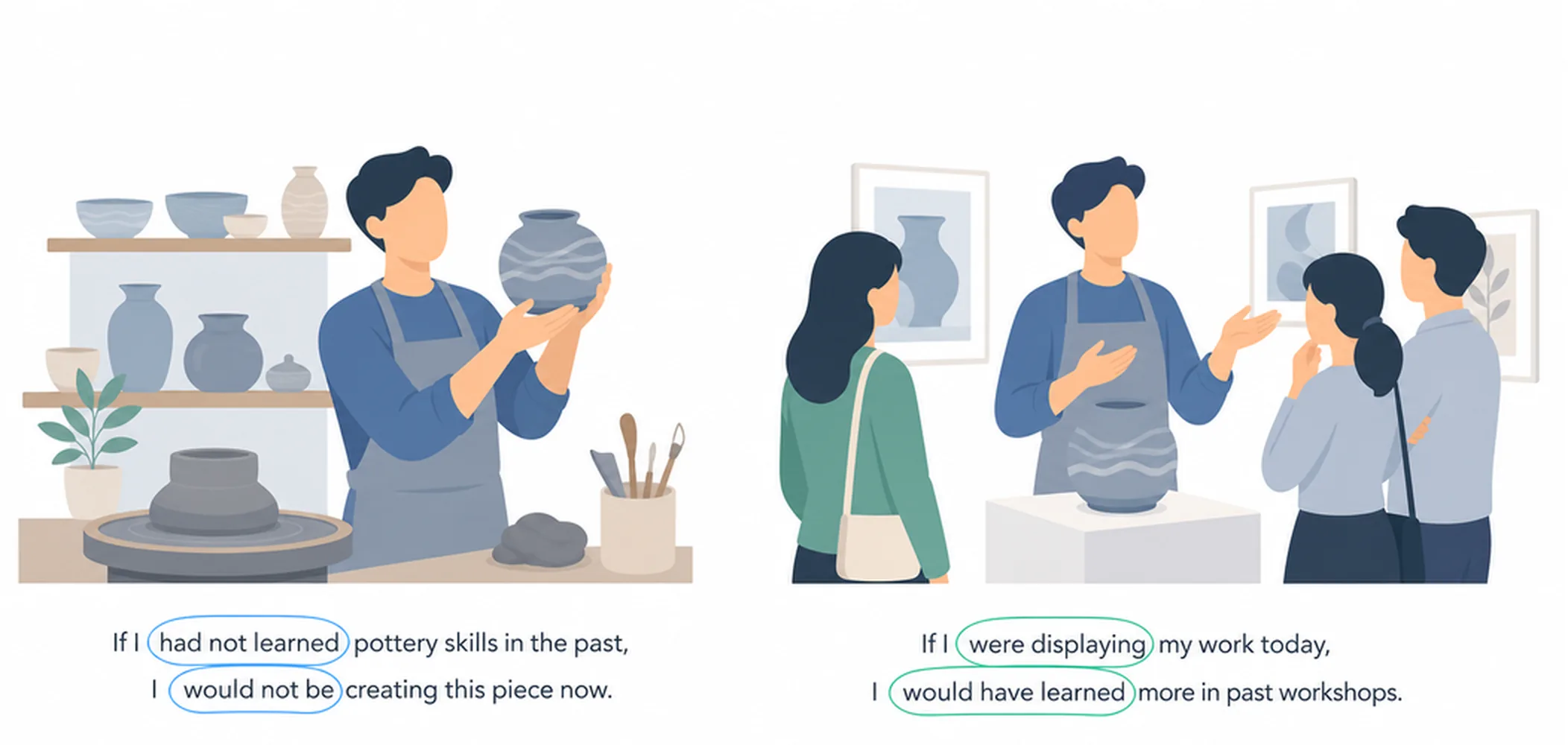
Mixed conditionals are a sophisticated grammatical structure that blend elements from different conditional forms to express relationships between hypothetical past events and their present consequences, or present/future states stemming from past conditions. Unlike simple conditionals, which maintain consistency in time reference, mixed conditionals deliberately cross temporal boundaries to reflect real-world scenarios where a past event has ongoing relevance. This occurs when the condition refers to one time period while the consequence refers to another—a mismatch that standard conditional patterns alone cannot efficiently capture.
The Two Primary Patterns
The first pattern combines a past condition (Third Conditional form) with a present consequence (Second Conditional form). This expresses: 'If the past had been different, the present would be different now.' The structure uses past perfect in the if-clause and would + base verb in the main clause. The second pattern reverses this: a present/standing condition (Second Conditional) produces a past result (Third Conditional). This conveys: 'Because the present/past state is/was as it is, something happened in the past.' Here, the if-clause uses past simple or were, while the consequence employs would have + past participle. Both patterns allow speakers to articulate complex causal relationships across time.
Why Mixed Conditionals Matter
Mixed conditionals are essential for sophisticated English discourse, particularly in argumentation, counterfactual reasoning, and nuanced explanations of causality. They reflect how we actually think about cause and effect in natural language—recognising that past events have present implications, and that ongoing states often explain historical outcomes. Mastering this structure signals linguistic maturity and enables C1 learners to express complex hypothetical relationships with precision and grammatical accuracy.
Mixed Conditionals at a Glance: Pattern Comparison
| Feature | Mixed Conditional Type 1 (Past condition → Present result) |
Mixed Conditional Type 2 (Present/general condition → Past result) |
|---|---|---|
| Form |
If-clause: If + past perfect (had + past participle) Main clause: would / could / might + bare infinitive |
If-clause: If + past simple (were / V-ed) Main clause: would / could / might + have + past participle |
| If-Clause Time Frame | Past — refers to something that did not happen in the past | Present / general — refers to an imaginary or hypothetical present state or characteristic |
| Main Clause Time Frame | Present — describes the current situation or ongoing consequence that would exist now | Past — describes what would have happened at a specific earlier time given that present condition |
| When to Use | Use when a past event did not happen and you want to talk about its present consequence — how things would be different now because of that past event. | Use when a present characteristic or state is unreal / hypothetical and you want to talk about a past consequence — what would have happened at an earlier time if you were different. |
| Positive Example | If she had studied medicine, she would be a doctor now. (She didn't study medicine → she is not a doctor today.) |
If he were more careful, he would have avoided that accident. (He is careless by nature → he had that accident in the past.) |
| Negative Example | If they hadn't moved abroad, they wouldn't be fluent in Spanish now. (They did move → they are fluent now.) |
If I weren't so shy, I wouldn't have turned down that job offer. (I am shy → I turned down the offer back then.) |
| Question Example | If you had taken that job, would you be living in Paris now? | If you were braver, would you have spoken up at the meeting yesterday? |
| Key Signal Words | now, today, at the moment, currently, still, right now, these days — time markers in the main clause pointing to the present | yesterday, last week, last year, at that time, back then, in [past year] — time markers in the main clause pointing to the past |
| 🔑 Key Difference: The core distinction lies in which clause crosses the time boundary. In Mixed Conditional Type 1, the if-clause reaches back into the past (past perfect) while the main clause stays in the present (would + infinitive), showing how a past action still shapes today's reality. In Mixed Conditional Type 2, it is the opposite: the if-clause describes an unreal present condition (past simple / were), while the main clause reaches back into the past (would + have + past participle), showing how a present personal trait or state would have altered a specific past event. Both patterns are "mixed" precisely because the two clauses belong to different time frames — unlike the standard second or third conditional, where both clauses share the same time reference. | ||
Examples



What to Remember
- Mixed conditionals combine different time frames: past condition with present consequence, or present condition with past consequence.
- The most common pattern uses past perfect in the condition clause with would/could/might + base verb in result.
- Use past perfect (had + past participle) when the condition refers to an unreal past situation with present effects.
- The result clause can reference present time even when the condition describes a past hypothetical scenario.
- Avoid mixing conditionals with simple conditionals; mixed conditionals specifically require temporal inconsistency between condition and result clauses.