What Are Mixed Conditionals?
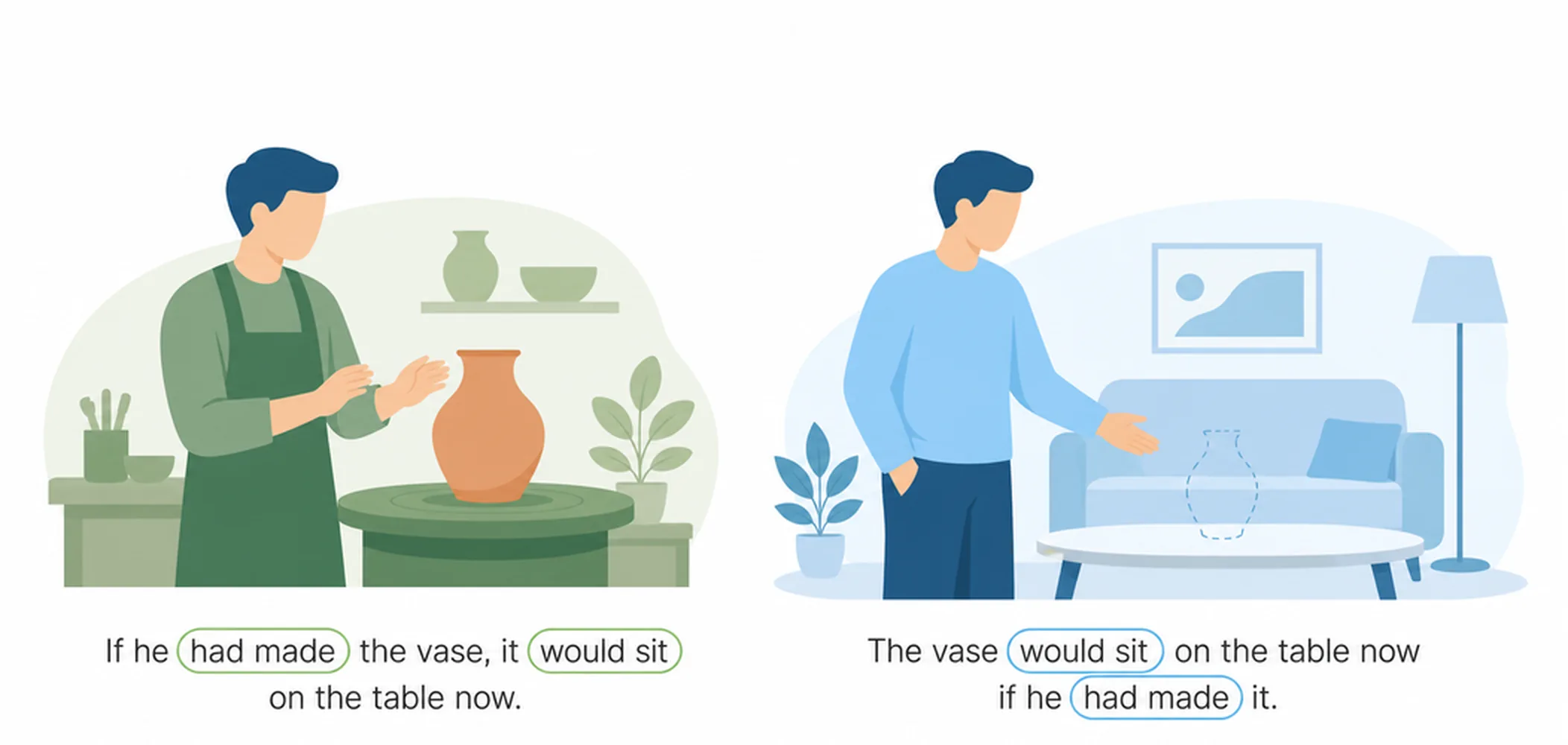
Mixed conditionals combine elements from different conditional types to express relationships between past and present that don't fit neatly into standard conditional patterns. The mixed conditional structure you'll encounter most frequently pairs a past, impossible condition (typically from the third conditional) with a present result or state (typically from the second conditional). This creates sentences where a hypothetical past event has shaped or is currently affecting the present reality. Unlike pure conditionals, mixed conditionals reflect the actual complexity of how past events influence current situations.
Structure: Past Condition + Present Result
The formula reverses the traditional conditional formula: you use the past perfect (had + past participle) in the if-clause to describe what didn't happen in the past, and you use the present conditional (would + base verb) in the main clause to describe the current consequence or state. This combination signals: 'If X had happened in the past, then Y would be true now.' The temporal shift from past to present is the defining feature that makes this construction a mixed conditional. Understanding this asymmetry is crucial—the condition is hypothetically past, but its effect extends into the present moment.
Why Use Mixed Conditionals?
Native speakers use mixed conditionals to explain current situations or states by reference to past events that didn't occur. They're particularly useful for expressing regret, explaining ongoing consequences, or speculating about how different past choices would have altered the present. For example, explaining why someone is unemployed now (result) might reference a decision they didn't make five years ago (condition). Mixed conditionals also appear in analytical writing, psychological reasoning, and counterfactual historical arguments—contexts where you need to link past possibilities directly to present reality.
Mixed Conditional vs. Second and Third Conditionals
| Feature | Mixed Conditional Past condition → Present result |
2nd Conditional Present condition → Present result |
3rd Conditional Past condition → Past result |
|---|---|---|---|
| Form | If + past perfect, would/could/might + bare infinitive (if-clause: past perfect · main clause: present conditional) |
If + simple past, would/could/might + bare infinitive (both clauses refer to present/future unreal situations) |
If + past perfect, would/could/might + have + past participle (both clauses refer to past unreal situations) |
| When to use | When a past event that did not happen would have a present consequence. The condition is unreal and finished; the result affects the current moment. | When an imaginary or unlikely present/future situation would produce a present/future result. Both the condition and result are hypothetical now. | When a past event that did not happen would have produced a different past result. Everything stays in the past — regrets, criticism, or speculation about history. |
| Time reference | Condition: past (unreal) Result: present / now |
Condition: present / future (unreal) Result: present / future |
Condition: past (unreal) Result: past (unreal) |
| Positive example | "If she had studied medicine, she would be a doctor now." (She didn't study medicine in the past → she is not a doctor today.) |
"If she studied medicine, she would be a doctor." (She doesn't study medicine now → she is not a doctor.) |
"If she had studied medicine, she would have been a doctor." (She didn't study → she wasn't a doctor at some past point.) |
| Negative example | "If he hadn't eaten so much junk food, he wouldn't be overweight now." (He ate junk food → he is overweight today.) |
"If he didn't eat so much junk food, he wouldn't be overweight." (He eats junk food now → he is overweight now.) |
"If he hadn't eaten so much junk food, he wouldn't have been overweight." (He ate junk food → he was overweight at that time.) |
| Question example | "If you had taken that job, would you be living abroad now?" (You didn't take the job → are you living abroad now?) |
"If you took that job, would you be happy?" (Imagining a present scenario.) |
"If you had taken that job, would you have been happy?" (Speculating about a past result.) |
| Key signal words | now, today, still, at this moment, currently in the result clause — signalling that the consequence is felt in the present | No time-shift markers needed; context implies a present/general imaginary scenario | then, at that time, yesterday, last year, by then — signalling that both events are anchored in the past |
| Reality check | The past event did not happen; its hypothetical effect still applies now | The present situation is not true; the result is also not true now | The past event did not happen; the past result also did not happen |
| Key Difference: The mixed conditional is uniquely defined by its time split: the if-clause uses the past perfect (like the 3rd conditional) to describe an unreal past condition, while the main clause uses the present conditional — would/could/might + bare infinitive — (like the 2nd conditional) to show that this past non-event has a consequence that is still relevant in the present. In contrast, the pure 2nd conditional keeps both clauses in the present/future hypothetical frame, and the pure 3rd conditional keeps both clauses entirely in the past hypothetical frame. Only the mixed type bridges two different time zones, making it the essential tool for expressing present regrets or present states that stem from past decisions. | |||
Examples





What to Remember
- Use past perfect in the if-clause to express a hypothetical past condition that didn't happen.
- Use present simple or present continuous in the main clause to show current result or state.
- The structure is: If + past perfect, + present simple/continuous.
- This pattern shows how an imaginary past situation is currently affecting or shaping present reality.
- Don't mix past perfect result with past condition; that structure belongs to the third conditional instead.