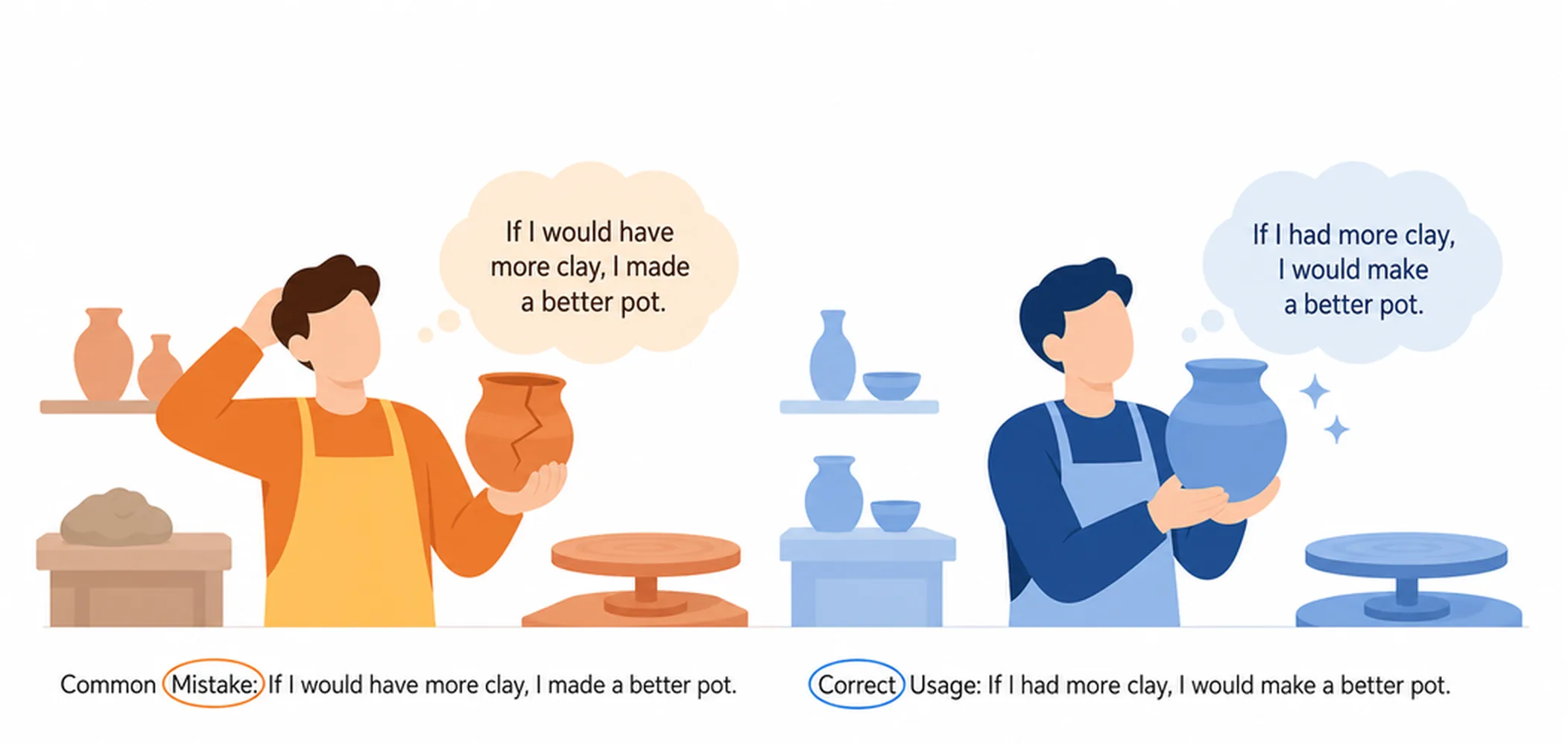
Why Learners Struggle with the Second Conditional
The second conditional is tricky because it mixes two different tenses in one sentence. Learners often confuse it with the first conditional or mix up the verb tenses because they're thinking in their native language. The good news? Once you understand the pattern, these mistakes are easy to fix.
Second Conditional vs First Conditional: Side-by-Side Comparison
| Feature | First Conditional | Second Conditional |
|---|---|---|
| Form | If + present simple, will + base verb | If + past simple, would + base verb |
| When to use | For real, possible, or likely situations in the present or future. The condition could genuinely happen. | For unreal, imaginary, or unlikely situations in the present or future. The condition is hypothetical or contrary to fact. |
| Likelihood | High or realistic probability — the speaker believes the condition may well occur. | Low or zero probability — the speaker considers the condition impossible, unlikely, or purely imaginary. |
| Positive example | If it rains tomorrow, I will take an umbrella. (Rain tomorrow is possible.) |
If it rained every day, I would move to another city. (This is an unlikely or imagined scenario.) |
| Negative example | If she doesn't study, she won't pass the exam. (Not studying is a real possibility.) |
If she didn't have to work, she wouldn't wake up so early. (She does have to work — this is contrary to reality.) |
| Question example | If you get the job, will you move to London? (Getting the job is a real possibility.) |
If you could live anywhere, where would you go? (A hypothetical, imaginary question.) |
| Key signal words | probably, maybe, perhaps, tomorrow, soon, when this happens | imagine, hypothetically, in an ideal world, if only, I wish |
| Common mistake | ✗ If it will rain, I will take an umbrella. (Do not use will in the if-clause.) |
✗ If I would have more money, I would travel. (Do not use would in the if-clause.) |
| Key Difference: The most common mistake learners make is using the second conditional (past simple + would) when they mean the first conditional, or vice versa. Ask yourself: "Is this situation realistic and possible?" If yes, use the first conditional (if + present simple, will + base verb). If the situation is imaginary, hypothetical, or very unlikely, use the second conditional (if + past simple, would + base verb). Remember: the past tense in the second conditional does not refer to past time — it signals that the situation is unreal or hypothetical in the present or future. | ||
Formula
✔ Positive
If
+
Subject
+
simple past
+
object
+
,
+
Subject
+
would
+
base verb
If I had time, I would help you.
✖ Negative
If
+
Subject
+
didn't
+
verb
+
,
+
Subject
+
would
+
base verb
If I didn't work tomorrow, I would sleep late.
? Question
What
+
would
+
Subject
+
do
+
if
+
Subject
+
simple past
+
?
What would you do if you saw a ghost?
Examples

If I were taller, I would play basketball.
Hypothetical situation · Unreal condition

What would you do if you won the lottery?
Question form · Imagination

If she didn't have a fear of flying, she would travel more.
Negative condition · Everyday speech
If I had your number, I would call you.
Common everyday situation · Polite refusal
When to use it
Imaginary Situations
Use the second conditional to talk about situations that are not real or unlikely to happen. Perfect for dreams, wishes, and fantasy scenarios.
If I were a professional chef, I would cook amazing meals every day.
Polite Advice
Give advice tactfully by using the second conditional. It sounds softer and more polite than direct commands.
If I were you, I wouldn't trust that company.
Hypothetical Questions
Ask questions about what someone would do in an imaginary situation. Common in conversations and interviews.
What would you do if your best friend lied to you?
Story Telling
Use the second conditional to describe what characters would do in fictional or imaginary scenes.
If she knew the truth, she would never forgive him.
Signal words
if
unless
otherwise
in that case
as long as
provided that
what if
Common Mistakes
✕
Wrong
If I would have more money, I would buy a new car.
✓
Correct
If I had more money, I would buy a new car.
Never use 'would' in the if-clause. Use simple past (had) instead.
✕
Wrong
If she goes to London, she will visit the museum.
✓
Correct
If she went to London, she would visit the museum.
This is first conditional form. Second conditional needs past tense (went) + would.
✕
Wrong
If I was you, I would say no.
✓
Correct
If I were you, I would say no.
Use 'were' with all subjects in second conditional, not 'was'.
✕
Wrong
If he studied harder, he will pass the exam.
✓
Correct
If he studied harder, he would pass the exam.
Use 'would' in the main clause, not 'will'. Will = first conditional.
✕
Wrong
If they had enough time, they would went to the beach.
✓
Correct
If they had enough time, they would go to the beach.
After 'would', use the base form of the verb (go), not past tense (went).
✕
Wrong
If I didn't have work tomorrow, I go out tonight.
✓
Correct
If I didn't have work tomorrow, I would go out tonight.
Missing 'would' in the result clause. Both parts need proper structure.
✕
Wrong
If you would know him, you would like him.
✓
Correct
If you knew him, you would like him.
Don't use 'would' in either clause of a second conditional sentence.
KEY TAKEAWAYS
What to Remember
- Use "if" + past simple, then would/could/might + base verb in main clause.
- Remember the if-clause always uses past tense, even though you're talking about present/future situations.
- Don't use will or would in the if-clause; use simple past instead.
- The second conditional expresses impossible or unlikely situations, not real possibilities like the first conditional.
- Never mix tenses within the pattern; keep past simple in if-clause and would + infinitive in main clause.