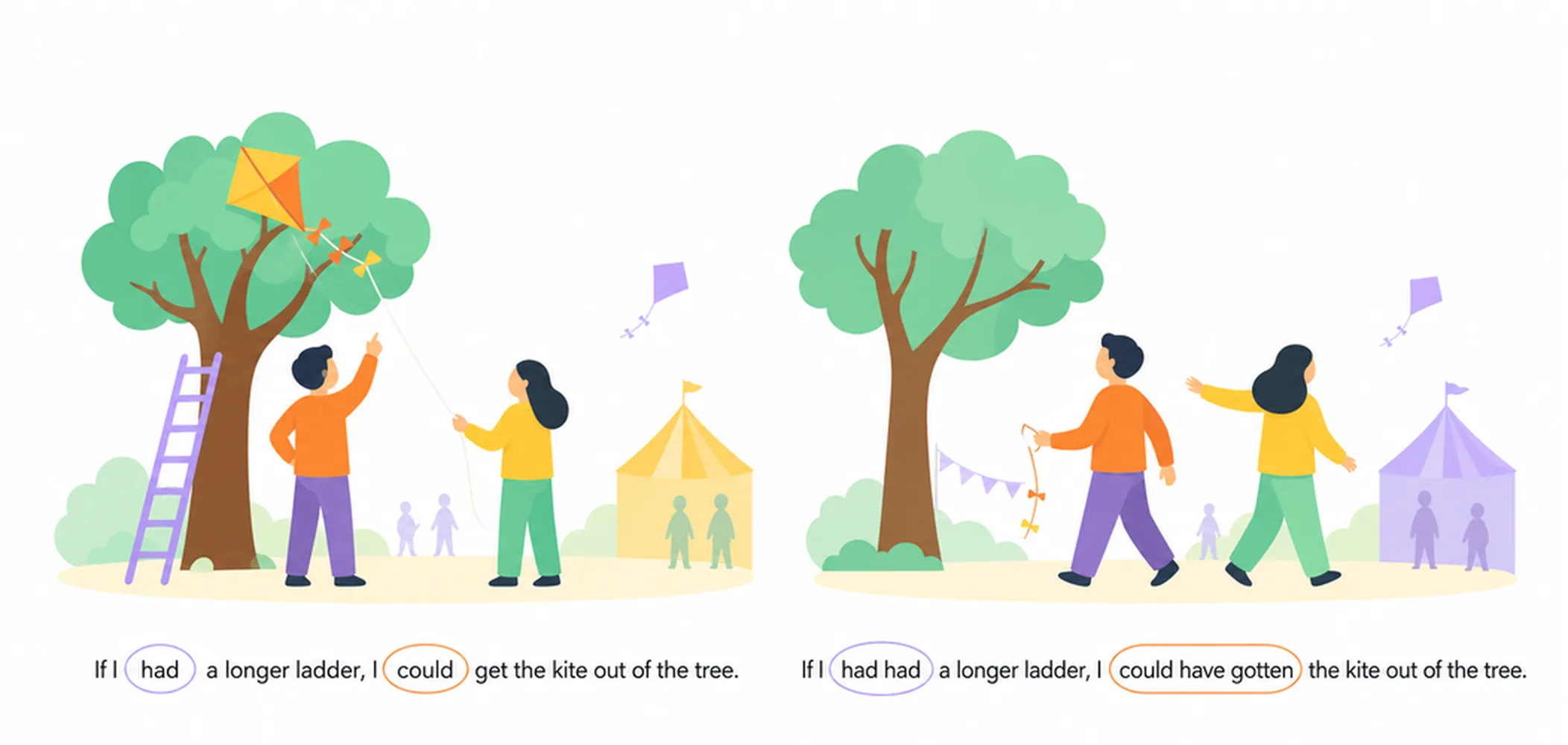
Second vs Third Conditional: The Key Difference
Both second and third conditionals describe imaginary situations, but they differ in time. The second conditional talks about situations that are unlikely or impossible right now or in the future. The third conditional talks about situations that were impossible in the past because they didn't happen. Choose the second conditional when you imagine 'what if' in the present; choose the third conditional when you regret or imagine an alternative past.
Second vs Third Conditional: The Formulas
Second Conditional
Imaginary or unlikely situation in the present or future
Third Conditional
Imaginary or impossible situation in the past
Affirmative Form
Second Conditional: Affirmative
If clause:
If + subject + past simple + object
Main clause:
subject + would + base verb + object
Example: If I had more time, I would travel the world.
Third Conditional: Affirmative
If clause:
If + subject + had + past participle + object
Main clause:
subject + would have + past participle + object
Example: If I had had more time, I would have travelled the world.
Negative Form
Second Conditional: Negative
If clause:
If + subject + didn't + base verb + object
Main clause:
subject + would + not + base verb + object
Example: If she didn't work so hard, she would not be exhausted.
Third Conditional: Negative
If clause:
If + subject + hadn't + past participle + object
Main clause:
subject + would + not have + past participle + object
Example: If she hadn't worked so hard, she would not have succeeded in the exam.
Question Form
Second Conditional: Question
If clause:
If + subject + past simple + object
Main clause:
Would + subject + base verb + object?
Example: If you had the chance, would you move to another country?
Third Conditional: Question
If clause:
If + subject + had + past participle + object
Main clause:
Would + subject + have + past participle + object?
Example: If you had studied harder, would you have passed the test?
Examples

If I won the lottery, I would buy a house on the beach.
Second conditional · Present/Future imagination

If you studied more, you would get better grades.
Second conditional · General advice

If she were the manager, she would change the office rules.
Second conditional · Unlikely scenario

If I had gone to university, I would have become an engineer.
Third conditional · Past regret

If he had called me, I would have helped him with the problem.
Third conditional · Missed opportunity

If they had known about the accident, they would have taken a different route.
Third conditional · Alternative past action
When to use it
Imagining Present Changes
Use second conditional to describe what would happen if the current situation were different.
If I lived in London, I would visit the museums every weekend.
Expressing Past Regret
Use third conditional to show you wish something different had happened in the past.
If I had applied for that job, I might have got it.
Giving Advice or Suggestions
Use second conditional to suggest what someone should do or what would be better.
If you asked her politely, she would probably help you.
Explaining Missed Opportunities
Use third conditional to explain why something didn't happen because of a past action.
If you had told me earlier, I would have come to the party.
Signal words
if
unless
would
could
might
would have
could have
might have
Common Mistakes
✕
Wrong
If I would have more time, I would learn Spanish.
✓
Correct
If I had more time, I would learn Spanish.
Second conditional uses past simple (had), not would. Use would only in the main clause.
✕
Wrong
If he had studied, he will pass the exam.
✓
Correct
If he had studied, he would have passed the exam.
Third conditional requires would have + past participle in the main clause, not will.
✕
Wrong
If I was rich, I buy a car.
✓
Correct
If I were rich, I would buy a car.
Second conditional needs would + base verb in the main clause. Use 'were' (not 'was') with I/he/she/it.
KEY TAKEAWAYS
What to Remember
- Use the second conditional for imaginary situations in the present or future that are unlikely or impossible.
- Second conditional uses 'if + past tense + would + base verb' structure consistently.
- Choose the third conditional to express regret or imagine what could have happened differently in the past.
- Third conditional requires 'if + past perfect + would have + past participle' for both parts.
- Don't confuse them: second conditional is about now/future possibilities; third conditional is about impossible past situations.