What is the Second Conditional?
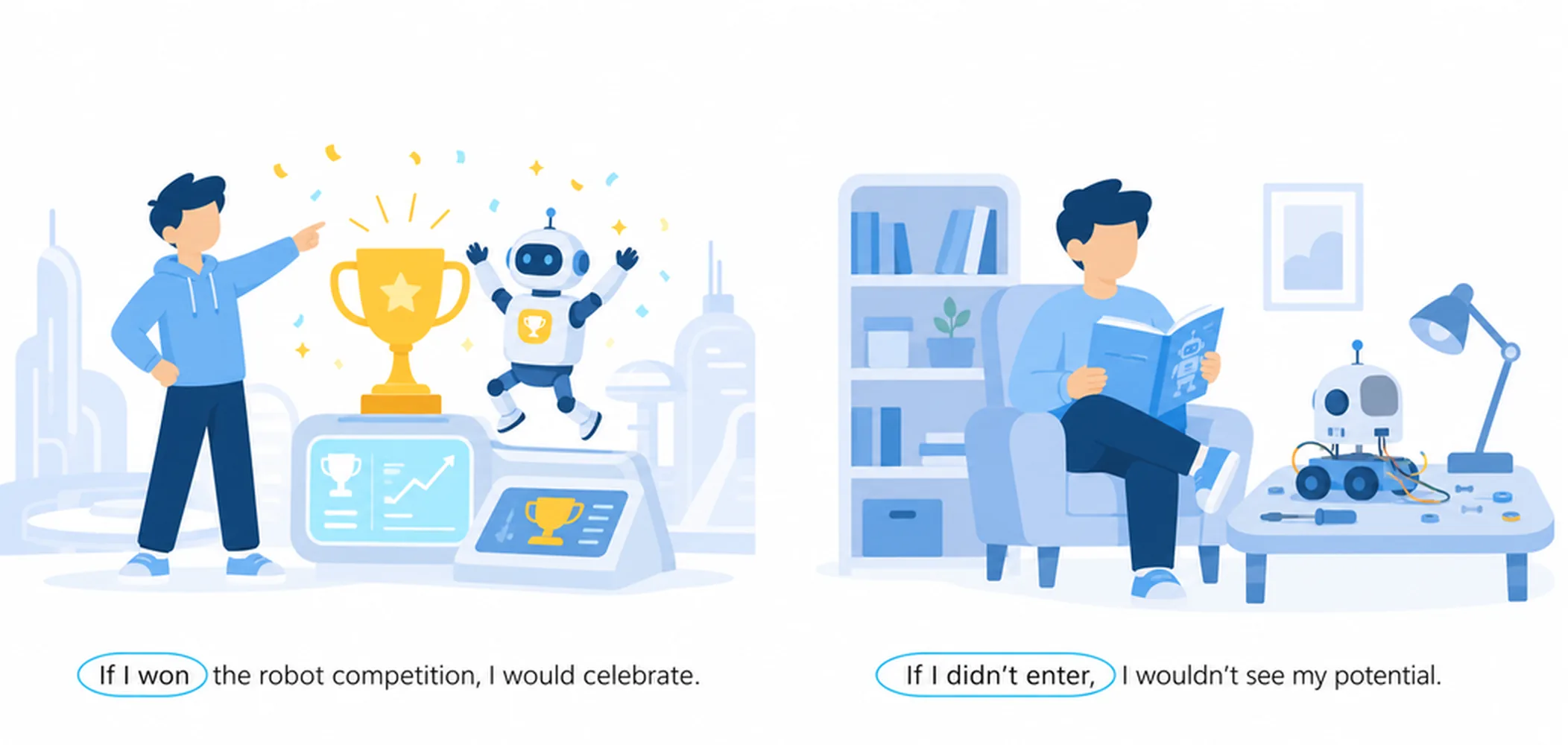
The second conditional is a grammar structure used to talk about imaginary or hypothetical situations that are unlikely to happen in the present or future. It expresses a condition that probably won't occur and what would happen if it did. For example, if you say 'If I won the lottery, I would travel around the world,' you're describing something that is unlikely to happen. The second conditional helps us express dreams, wishes, and impossible situations in English.
Key Characteristics
The second conditional has two main parts: the 'if' clause (condition) and the main clause (result). In the 'if' clause, you use the past simple tense, even though you're talking about the present or future. In the main clause, you use 'would' + base verb. Notice that the tense is not actually past—it's called the 'past simple' in form but it refers to imaginary present or future situations. The structure is flexible: you can start with the 'if' clause or the main clause, and the meaning stays the same.
Second Conditional vs. First Conditional
| Feature | First Conditional | Second Conditional |
|---|---|---|
| Form | If + present simple, will + base verb | If + past simple, would + base verb |
| When to use | For real, likely, or possible situations in the present or future. The speaker believes the condition could genuinely happen. | For unreal, imaginary, or unlikely situations in the present or future. The speaker does not expect the condition to be true. |
| Likelihood | Real / probable — the condition is possible or even expected to occur. | Unreal / hypothetical — the condition is unlikely or contrary to current reality. |
| Time reference | Present or future | Present or future (imagined, not factual) |
| Positive example | "If it rains, I will take an umbrella." | "If it rained every day, I would move to a sunnier city." |
| Negative example | "If she doesn't study, she won't pass the exam." | "If I didn't have this job, I wouldn't be able to pay my rent." |
| Question example | "If you finish early, will you call me?" | "If you could live anywhere, where would you live?" |
| Key signal words | will, can, may, might, should (in the result clause); present simple in the if clause | would, could, might (in the result clause); past simple in the if clause; often paired with if I were you… |
| ⓘ Key Difference: The first conditional describes situations the speaker considers genuinely possible — "This could really happen." The second conditional describes imaginary or unlikely situations — "This is just a hypothetical idea; I don't expect it to be true right now." The shift from will to would and from present simple to past simple signals this move from reality into imagination. | ||
Examples





What to Remember
- The second conditional describes imaginary or unlikely situations in the present or future.
- Use IF + past simple in the condition clause, then WOULD + base verb in the result.
- Remember that the past tense in the IF clause is not about past time, but hypothetical.
- Common mistake: don't use WOULD in the IF clause; use simple past instead.
- The second conditional expresses unreal conditions, dreams, wishes, and situations that probably won't happen.