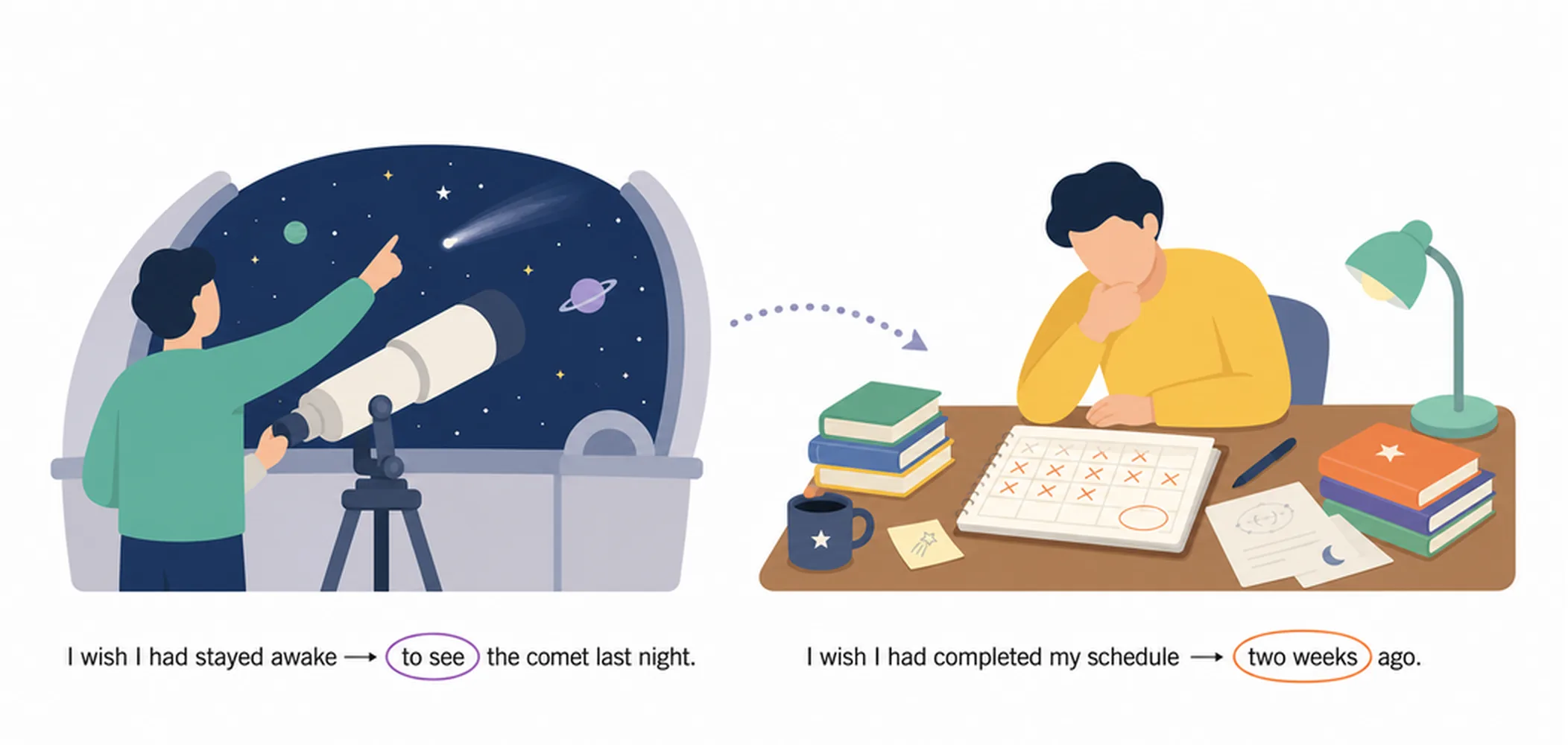
Understanding Third Conditional with Wish
The third conditional expresses hypothetical situations in the past—events that didn't happen and their imaginary consequences. When we combine this with 'wish', we express regret or frustration about past events. The structure emphasizes that we're talking about something impossible to change because it already occurred. This is one of the most practical ways to talk about how we feel about the past in English.
The pattern combines 'wish' + past perfect (had + past participle) in the dependent clause. The main verb 'wish' is in the simple present tense. This construction allows you to express regret smoothly: 'I wish I had studied harder' means you didn't study hard, and now you regret it. The formula is flexible—you can focus on wishing someone had done something, or wishing a situation had been different.
Expressing Different Types of Regret
Third conditional with 'wish' handles various emotional contexts. You can express personal regret (wishing you'd made a different choice), sympathetic regret (wishing someone else had acted differently), or regret about circumstances (wishing things had been different). The tone remains formal enough for professional contexts yet accessible for everyday conversation. Understanding the subtle differences helps you use this structure authentically.
Common Patterns and Variations
Beyond the basic 'wish + past perfect' pattern, you'll encounter 'wish + past perfect + conditional perfect' when the imaginary consequence is important: 'I wish I had left earlier; I wouldn't have missed the meeting.' You can also use 'only' for emphasis: 'If only I had known!' This variation shifts the focus slightly but conveys stronger regret. Recognizing these variations helps you understand native speakers and express nuanced emotions about past situations.
Third Conditional vs. Wish + Past Perfect: Side-by-Side
| Feature | Third Conditional (If + past perfect, would have + past participle) | Wish + Past Perfect |
|---|---|---|
| Form | If + subject + had + past participle, subject + would have + past participle | Subject + wish(es) + subject + had + past participle |
| When to Use | To speculate about how a past situation could have been different, and what the result would have been. Focuses on a hypothetical condition and its imagined consequence. | To express regret or dissatisfaction about something that did or did not happen in the past. Focuses purely on the feeling of regret, without stating a consequence. |
| Positive Example | If I had studied harder, I would have passed the exam. | I wish I had studied harder. |
| Negative Example | If she hadn't left so early, she would have seen the fireworks. | She wishes she hadn't left so early. |
| Question Example | If you had taken the job, would you have moved abroad? | Do you wish you had taken the job? |
| Key Signal Words | if, had, would have, could have, might have | wish, had (past participle), if only |
| Key Difference: The third conditional presents a complete hypothetical scenario — it links an unreal past condition to an imagined past result, showing cause and effect. Wish + past perfect, on the other hand, expresses only the emotional response of regret about the past without speculating on an alternative outcome. In short, the third conditional says "if X had happened, Y would have happened", while wish + past perfect simply says "I regret that X did not happen." | ||
Examples






What to Remember
- Use 'wish' + past perfect (had + past participle) to express regret about past events.
- Third conditional talks about impossible situations in the past that cannot be changed now.
- The structure is: wish + subject + had + past participle + consequence clause.
- Common mistake: Don't use simple past after 'wish'; always use past perfect forms.
- This grammar expresses both regret and imaginary consequences for events that already happened.