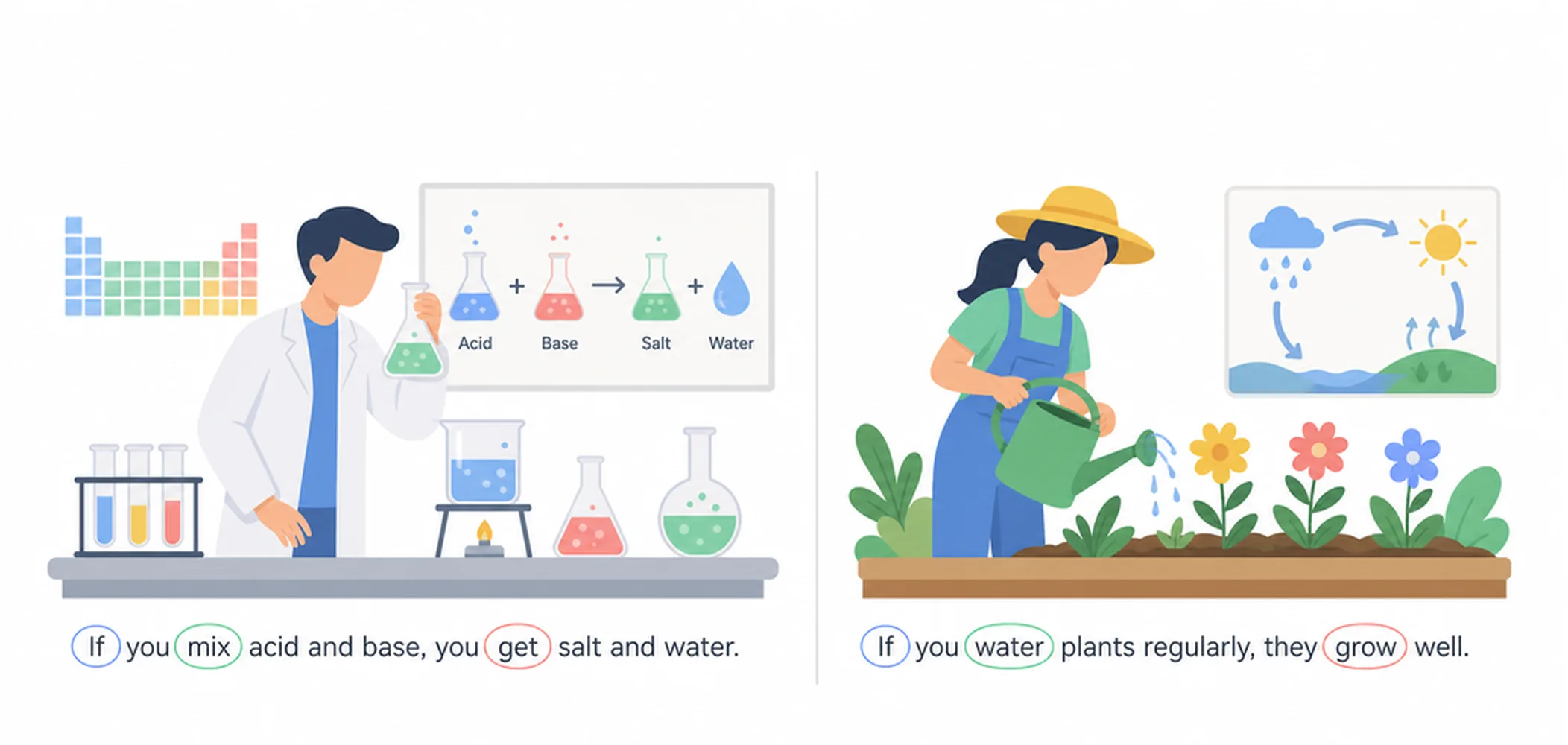
What is the Zero Conditional?
The zero conditional describes facts, general truths, and things that always happen. Use it when the result is certain or automatic. The structure is simple: if + present simple, present simple. Unlike other conditionals, zero conditional sentences describe real situations, not imaginary or possible futures.
How to Form the Zero Conditional
Key Components
Subject
Verb (present simple)
Object / Rest
Negative (don't/doesn't)
Structure 1: Positive — If-clause First
Affirmative
IF Subject present simple verb (object/complement), Subject present simple verb (object/complement).
EXAMPLE:
If you heat water to 100°C, it boils.
Structure 2: Positive — Main Clause First
Affirmative
Subject present simple verb (object/complement) IF Subject present simple verb (object/complement).
Note: When the main clause comes first, no comma is used between the clauses.
EXAMPLE:
Water boils if you heat it to 100°C.
Structure 3: Negative Form
Negative
IF Subject don't / doesn't base verb (object/complement), Subject don't / doesn't base verb (object/complement).
EXAMPLE:
If you don't study, you don't pass the exam.
Formula
✔ Positive
If
+
subject
+
present simple verb
+
,
+
subject
+
present simple verb
If you heat water to 100°C, it boils.
✖ Negative
If
+
subject
+
do not / does not
+
verb
+
,
+
subject
+
do not / does not
+
verb
If you don't study, you don't pass the exam.
? Question
What / When / Where
+
do / does
+
subject
+
verb
+
if
+
subject
+
present simple verb
What do you do if you miss the bus?
Examples

If you mix red and blue paint, you get purple.
General truth · Scientific fact

If it rains, the grass grows better.
General truth · Natural process

If you don't water plants, they die.
Negative statement · Cause and effect

If people exercise regularly, they feel healthier.
Habit · General truth

What happens if you forget to charge your phone?
Question form · Everyday situation

Does coffee keep you awake if you drink it in the evening?
Yes/No question · Habitual result
When to use it
Scientific Facts
Use zero conditional to explain natural laws and scientific processes that always happen the same way.
If you freeze water below 0°C, it becomes ice.
Daily Habits & Routines
Describe what typically happens when a condition is met in everyday life.
If my alarm goes off, I wake up immediately.
Rules & Instructions
Explain rules, instructions, or procedures with automatic results.
If you add salt to hot water, it dissolves faster.
Questions About Results
Ask questions about what happens when a condition occurs in real situations.
What do you do if you arrive late to work?
Signal words
always
usually
often
never
whenever
every time
in case
Common Mistakes
✕
Wrong
If you will heat water, it boils.
✓
Correct
If you heat water, it boils.
Use present simple in the if-clause, not will. Zero conditional uses present, not future.
✕
Wrong
If you don't study, you will not pass.
✓
Correct
If you don't study, you don't pass.
Both clauses need present simple. Avoid using will in the result clause for zero conditional.
✕
Wrong
If you pressed the button, the light is turning on.
✓
Correct
If you press the button, the light turns on.
Keep both verbs in the same tense (present simple) for consistency and accuracy.
KEY TAKEAWAYS
What to Remember
- Use zero conditional to express facts, general truths, and things that always happen automatically.
- The structure is: if + present simple, present simple in both clauses.
- Zero conditional describes real situations, not imaginary, possible, or hypothetical future events.
- The result must be certain or automatic, not uncertain or dependent on conditions.
- Both clauses use present simple tense; never use future tense in zero conditional.