What Is the Zero Conditional?
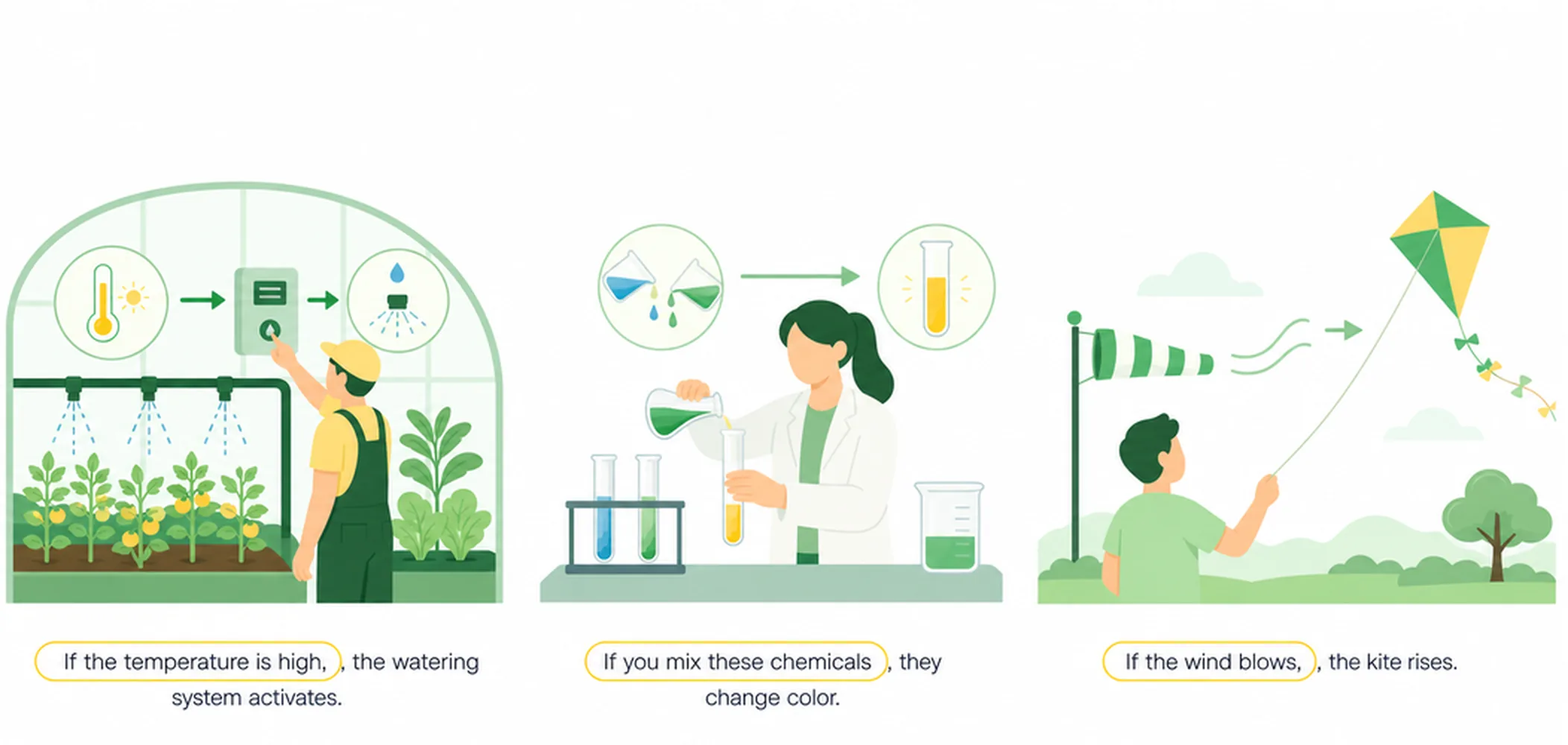
The zero conditional is used to describe facts, general truths, and things that always happen under certain conditions. It expresses cause and effect that are permanent or universal—not specific to one situation. When the condition happens, the result always follows. For example, water boils when it reaches 100 degrees Celsius. This is a natural law, not an imaginary situation.
The zero conditional uses the simple present tense in both the 'if' clause and the main clause. The structure is straightforward and the same pattern repeats every time the condition occurs.
Structure and Meaning
The basic pattern is: If + simple present, simple present. You can also reverse the order and start with the main clause: Simple present + if + simple present. Both are correct. The 'if' in zero conditional often means 'when' because the result is certain, not uncertain. Notice that there is no future meaning here—we're talking about things that are always true right now.
Common Uses
Use the zero conditional for natural laws and scientific facts (water freezes at zero degrees), regular habits and routines (I eat breakfast if I wake up early), instructions and rules (you fail the test if you don't study), and general truths (people get tired if they don't sleep). It's very common in explanations, instructions, and statements about how the world works.
Common situations where you use the zero conditional:
Zero Conditional vs Other Conditionals
| Zero Conditional | First Conditional | Second Conditional | Third Conditional | |
|---|---|---|---|---|
| Form | If + present simple, present simple | If + present simple, will + base verb | If + past simple, would + base verb | If + past perfect, would have + past participle |
| When to use | To express universal truths, scientific facts, and habits that are always true when a certain condition is met | To talk about real and possible future situations and their likely results | To talk about unreal, imaginary, or hypothetical present or future situations | To talk about unreal or imaginary situations in the past and their hypothetical past results |
| Positive example | If you heat water to 100°C, it boils. | If it rains tomorrow, we will cancel the picnic. | If I had more time, I would travel the world. | If she had studied harder, she would have passed the exam. |
| Negative example | If you don't water plants, they don't survive. | If you don't leave now, you won't catch the train. | If I didn't have a car, I wouldn't drive to work. | If they hadn't missed the flight, they wouldn't have lost the deal. |
| Question example | What happens if you mix bleach and ammonia? | Will you call me if you arrive late? | Would you move abroad if you got the job? | Would you have apologised if you had known the truth? |
| Key signal words | always, never, generally, every time, usually, when | will, won't, might, can, tomorrow, soon, in the future | would, could, might, imagine, were to | would have, could have, might have, had + past participle |
| Key Difference: The zero conditional is the only conditional that expresses absolute, timeless truths — the result is always guaranteed whenever the condition is met, with no element of doubt, imagination, or hypothetical thinking. The first conditional deals with realistic future possibilities; the second shifts into hypothetical or imaginary present/future territory; and the third moves entirely into the realm of the unreal past, reflecting on events that did not happen and cannot be changed. Where the other conditionals rely on modal verbs such as will, would, or would have to signal uncertainty or unreality, the zero conditional uses only the present simple tense in both clauses, underlining the certainty and repeatability of the outcome. | ||||
Examples





What to Remember
- Use zero conditional to express universal truths, natural laws, or things that always happen.
- The pattern is: If + simple present tense, simple present tense in both clauses.
- Zero conditional describes permanent facts and cause-and-effect relationships, not imaginary or hypothetical situations.
- You can reverse the word order and start with the main clause instead.
- Both clauses must use simple present tense; never use will or would in zero conditional.