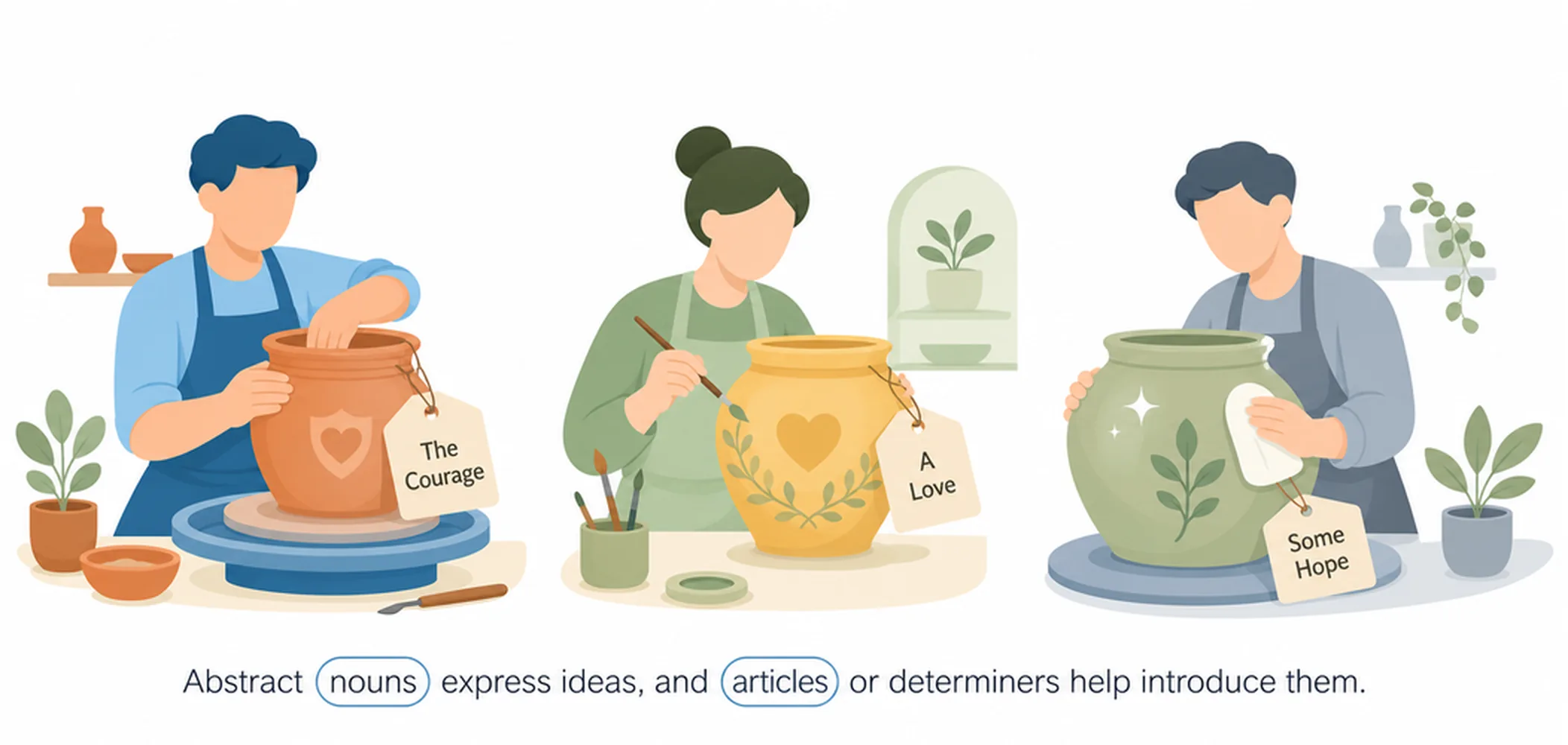
What are abstract nouns?
Abstract nouns are words for things you cannot see, touch, or hold. They describe ideas, feelings, qualities, and states. Examples include love, happiness, freedom, time, and knowledge. Unlike concrete nouns (like table, dog, or water), abstract nouns refer to things that exist only in the mind or as concepts.
Articles with abstract nouns
Abstract nouns can be countable or uncountable, and this changes how we use articles. Uncountable abstract nouns (like happiness, information, or courage) usually take no article or the definite article 'the'. Countable abstract nouns (like idea, problem, or solution) can take 'a', 'an', or 'the'. When talking about abstract nouns in general, we often use no article at all.
Using determiners with abstract nouns
Determiners like 'some', 'any', 'much', 'a lot of', and 'little' help us talk about abstract nouns. With uncountable abstract nouns, use 'much', 'a lot of', 'little', and 'some'. With countable abstract nouns, use 'many', 'a few', 'several', and 'some'. The determiner you choose depends on whether the noun is countable and whether you want to show a positive or negative amount.
Abstract Nouns: Articles and Determiners at a Glance
| Noun Type | Article / Determiner | Condition | Example | Note |
|---|---|---|---|---|
| Uncountable — general | ❌ No article (zero article) | Referring to the concept in general, not a specific instance | Happiness is important. Courage matters. | Most common use of abstract nouns; no article needed |
| Uncountable — specific | ✅ the | A particular instance is identified by context, a phrase, or a clause | The happiness she felt was overwhelming. The courage of the soldiers. | A following of-phrase or relative clause often signals the |
| Uncountable — general quantity | ✅ some / any / much / little / no | Expressing an indefinite or questioned amount | She showed some compassion. Is there any hope? There's little doubt. | Use some (affirmative), any (questions/negatives), much/little (degree) |
| Countable singular — first mention / non-specific | ✅ a / an | One unspecified instance of the abstract quality; noun used countably | It was a pleasure to meet you. She had a fear of heights. | Many abstract nouns can shift to countable when modified by an adjective or clause |
| Countable singular — specific / known | ✅ the | A specific, identifiable single instance already established or uniquely defined | The fear that gripped him was real. The pleasure of reading never fades. | Relative clause or of-phrase typically makes it specific |
| Countable plural — general | ❌ No article (zero article) | Multiple instances referred to in general | Fears can be overcome. Doubts crept in. | Parallel to uncountable general — no article for broad reference |
| Countable plural — specific | ✅ the | Specific set of instances already known or identified | The doubts he had proved unfounded. The fears of the community were addressed. | Use the when listener/reader can identify which ones |
| Countable plural — indefinite quantity | ✅ some / any / many / few / several / no | Unspecified number of instances | She had some regrets. Are there any objections? Few certainties remain. | Choose determiner based on quantity and sentence type (affirmative/question/negative) |
| Any type — possessive | ✅ my / your / his / her / its / our / their | The abstract quality belongs to or is associated with a specific person or group | His anger surprised everyone. Their freedom was restored. | Possessives replace articles entirely — never combine with a/an/the |
| Any type — demonstrative | ✅ this / that / these / those | Pointing to a specific concept already mentioned or contextually clear | This anxiety is understandable. Those doubts were misplaced. | This/that = singular or uncountable; these/those = plural countable |
Examples






What to Remember
- Abstract nouns describe ideas, feelings, and qualities that you cannot see or physically touch.
- Uncountable abstract nouns like happiness and courage usually take no article or the article.
- Countable abstract nouns like idea or problem can use a, an, or the.
- Use no article with uncountable abstract nouns in general statements about concepts.
- Some abstract nouns can be countable or uncountable depending on the context or meaning.