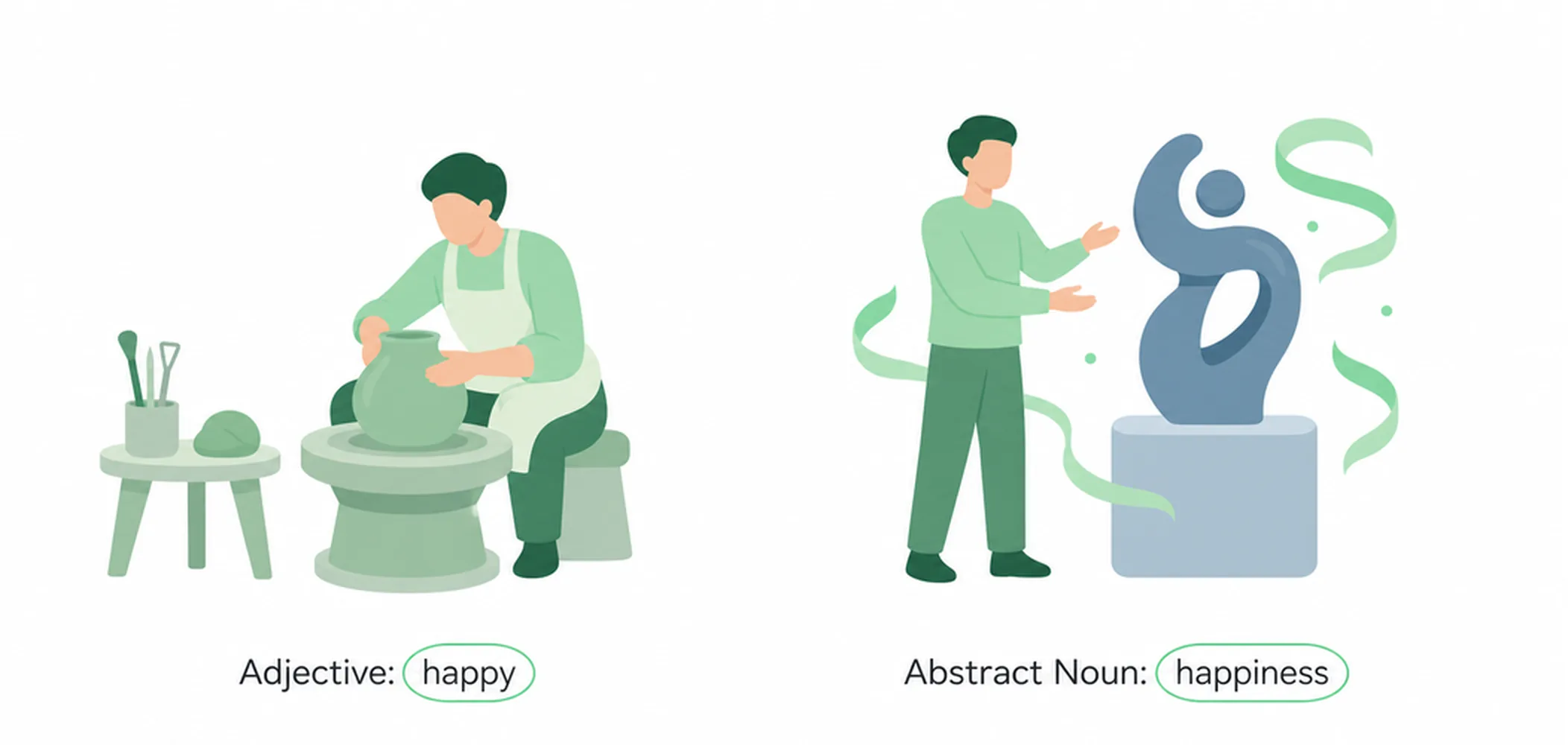
What are abstract nouns from adjectives?
Abstract nouns are words that describe ideas, feelings, or qualities that you cannot touch or see. We can make many abstract nouns by adding suffixes to adjectives. For example, the adjective 'happy' becomes the noun 'happiness'. Learning these patterns will help you describe qualities and states in English more naturally.
Adjective to Abstract Noun: Suffix Guide
| Suffix | Adjective | Abstract Noun | Spelling Change | Note |
|---|---|---|---|---|
| -ness | happy | happiness | y → i before -ness | Most productive suffix; works with almost any adjective |
| dark | darkness | None | ||
| kind | kindness | None | ||
| aware | awareness | None (keep final -e) | ||
| -ity / -ty | equal | equality | None | Common with Latin-root adjectives; stress may shift |
| curious | curiosity | -ous → drop -ous, add -ity | ||
| active | activity | Drop final -e | ||
| loyal | loyalty | None (-ty variant) | ||
| -ance / -ence | tolerant | tolerance | -ant → -ance | Suffix mirrors adjective ending: -ant → -ance; -ent → -ence |
| patient | patience | -ent → -ence | ||
| elegant | elegance | -ant → -ance | ||
| -th | warm | warmth | None | Old English suffix; limited, fixed set of words |
| wide | width | -de → -dth (vowel shift) | ||
| strong | strength | Vowel change: o → e | ||
| -dom | free | freedom | None | Small closed set; also attaches to nouns (e.g., king → kingdom) |
| wise | wisdom | Drop final -e | ||
| bored | boredom | Drop final -d, add -dom | ||
| -ry / -ery | brave | bravery | Drop final -e, add -ery | Less common; often conveys a quality or collective state |
| modest | modesty | None | ||
| decent | decency | -ent → -ency | ||
| Irregular | long |
Formula
✔ Positive
Adjective
+
+
+
Suffix
+
=
+
Abstract Noun
kind + -ness = kindness
Examples

The beauty of the painting is amazing.
Abstract noun from 'beautiful' · Using -y suffix

Her kindness towards others is wonderful.
Abstract noun from 'kind' · Using -ness suffix

The popularity of this band is growing fast.
Abstract noun from 'popular' · Using -ity suffix

I admire your honesty in this difficult situation.
Abstract noun from 'honest' · Using -y suffix

The difference between the two ideas is small.
Abstract noun from 'different' · Using -ence suffix
Freedom is important to many people.
Abstract noun from 'free' · Using -dom suffix
When to use it
Describing qualities
Use abstract nouns to talk about human qualities and characteristics.
"Her intelligence and kindness make her a great teacher."
Talking about feelings
Express emotions and mental states with abstract nouns from adjectives.
"The sadness in his eyes was difficult to ignore."
Academic writing
Use abstract nouns in essays and formal writing to sound more professional.
"The importance of education cannot be overestimated."
Signal words
-ness
-ity
-ty
-ence
-ance
-dom
-ship
-ment
Common Mistakes
✕
Wrong
The happyness of the children was clear.
✓
Correct
The happiness of the children was clear.
Drop the 'y' before adding -ness: happy → happiness, not happyness.
✕
Wrong
I like the beautiness of this flower.
✓
Correct
I like the beauty of this flower.
Use -ty, not -iness, for adjectives ending in 'ful': beautiful → beauty.
✕
Wrong
The personalty of my friend is very friendly.
✓
Correct
The personality of my friend is very friendly.
Use -ity, not -ality, for some adjectives: personal → personality.
KEY TAKEAWAYS
What to Remember
- Abstract nouns describe ideas, feelings, or qualities you cannot physically see or touch.
- Add common suffixes like -ness, -ity, -ment, and -tion to adjectives to form abstract nouns.
- The adjective happy becomes the abstract noun happiness by adding the suffix -ness.
- Some adjectives change their spelling before adding a suffix, like happy to happiness.
- Abstract nouns are different from concrete nouns, which describe things you can see or touch.