Why Do Learners Make Mistakes with Abstract Nouns?
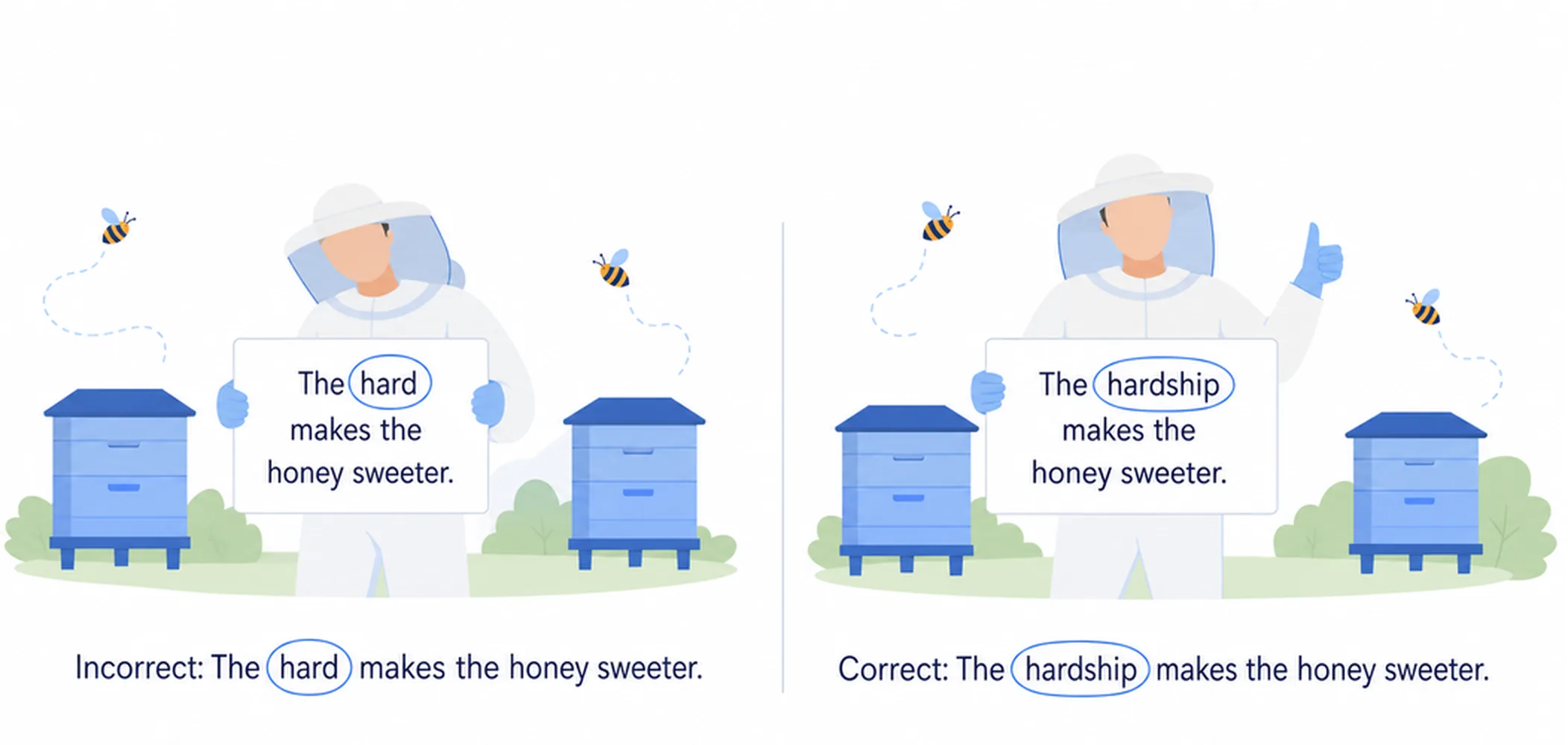
Abstract nouns name things you cannot see or touch—like love, happiness, freedom, or information. Many learners make mistakes because abstract nouns behave differently from concrete nouns (things you can touch). For example, you cannot count abstract nouns the same way, and they often need different articles or verb forms. Understanding these common errors will help you use abstract nouns correctly.
Abstract Nouns vs Concrete Nouns — Key Differences
| Feature | Abstract Nouns | Concrete Nouns |
|---|---|---|
| Definition | Refer to ideas, qualities, feelings, states, or concepts that cannot be perceived by the five senses (e.g., freedom, happiness, knowledge, advice). | Refer to physical, tangible objects or beings that can be seen, touched, heard, smelled, or tasted (e.g., chair, dog, apple, book). |
| Countability | Most abstract nouns are uncountable (mass nouns) and cannot be counted directly. They represent a concept as a whole. Common mistake: Treating them as countable. She gave me two advices. She gave me two pieces of advice. |
Most concrete nouns are countable and can be counted individually. Correct usage: She gave me two books. I have three dogs. |
| Article Usage | When used in a general sense, abstract nouns take no article. Common mistake: Adding an indefinite article. A knowledge is power. Knowledge is power. A definite article (the) is used when the concept is specifically identified. The knowledge she gained was invaluable. |
Countable concrete nouns in the singular require an article (or other determiner) in most contexts. A dog ran past. The book on the table is mine. Omitting the article is often incorrect in singular usage. Dog ran past. |
| Pluralization | Most abstract nouns cannot be pluralized in standard usage because they are uncountable. Common mistakes: His furnitures filled the room. They shared many informations. His furniture filled the room. They shared a lot of information. Note: Some abstract nouns can be pluralized when they shift meaning to specific instances (e.g., freedoms, fears). |
Countable concrete nouns can and often should be pluralized when referring to more than one item. The chairs were arranged in a circle. She bought three apples. The books on the shelf belong to her. |
| Verb Agreement | Uncountable abstract nouns always take a singular verb, regardless of meaning or context. Common mistake: Using a plural verb. The equipment were delivered late. Her progress were remarkable. The equipment was delivered late. Her progress was remarkable. |
Verb agreement depends on whether the noun is singular or plural. The chair is broken. (singular → singular verb) The chairs are broken. (plural → plural verb) Agreement errors are usually straightforward to spot because the number is visible in the noun form. |
| Quantifiers Used With | Abstract (uncountable) nouns pair with mass quantifiers: much, a lot of, a great deal of, a bit of, little/a little, some, any, no Common mistake: Using count quantifiers. I have many homeworks tonight. I have a lot of homework tonight. There are few informations available. There is little information available. |
Countable concrete nouns pair with count quantifiers: many, a number of, few/a few, several, each, every, one/two/three… I have many assignments tonight. There are few sources available. She bought several oranges. |
| Partitive Expressions | To count or individualize abstract nouns, a partitive (of-phrase) is required: a piece of advice, a bit of fun, an act of kindness, a stroke of luck, a sense of freedom Can you give me a piece of advice? It was an act of great courage. |
Concrete nouns do not generally require partitive constructions to be counted, though partitives can be used for portions: a slice of bread, a glass of water, a piece of cake Can you give me two books? (no partitive needed) She drank a glass of water. (partitive for portion) |
| Common Examples | love, hate, fear, courage, wisdom, justice, beauty, anger, sadness, information, advice, knowledge, furniture, equipment, luggage, progress, research, traffic, weather, music, homework | table, chair, car, tree, river, mountain, person, city, flower, stone, cup, computer, dog, house, letter, coin, road, building, pencil, shirt |
| Positive Example | Patience is a virtue. She showed great courage under pressure. The research was published last year. |
A chair is a piece of furniture. She showed me the painting on the wall. The reports were published last year. |
| Negative Example (Common Errors) | I need an information. → I need some information. She has many luggages. → She has a lot of luggage. They made good progresses. → They made good progress. |
I need chair. → I need a chair. She has much bag. → She has many bags. They made good report. → They made a good report. |
| Question Example | How much experience do you have? Is there any evidence to support this? How many experiences do you have? (unless asking about specific events) |
How many books do you own? Are there any chairs available? How much book do you own? |
| Key Signal Words | Uncountable signals: much, little, a little, a great deal of, a lot of, some, any, no, a piece of, a bit of, an act of | Countable signals: many, few, a few, several, a number of, each, every, one, two, three, a/an, the |
| Key Difference: The most critical distinction is that abstract nouns are predominantly uncountable, meaning they cannot take indefinite articles (a/an), cannot be pluralized with -s, and must pair with mass quantifiers (much, a little, a lot of) rather than count quantifiers (many, a few, several). Concrete nouns, by contrast, are usually countable and follow standard rules of article use, pluralization, and count-quantifier agreement. The most frequent errors occur when learners apply the grammar rules of countable concrete nouns — adding articles, plural endings, or count quantifiers — directly to abstract nouns that do not permit them. The fix is typically to either use a partitive expression (a piece of advice) or switch to an appropriate mass quantifier (some information, a lot of progress). | ||
Formula
✔ Positive
Subject
+
verb
+
[uncountable abstract noun]
+
.
She has great courage.
Examples

Love requires patience and understanding.
Uncountable abstract nouns · No article needed

I need some advice about my career.
Uncountable abstract nouns · Use 'some' instead of 'a'

The government introduced new laws to protect freedom.
Abstract noun · Uncountable, follows verb 'protect'

Her intelligence and determination impressed everyone.
Abstract nouns · Plural form works only when listing separate qualities
When to use it
Speaking about feelings
Use uncountable abstract nouns to describe emotions without articles or plurals.
"I felt happiness when I saw my family."
Giving suggestions
Use uncountable nouns like 'advice' or 'help' with 'some' or without a number.
"Can you give me some advice about learning English?"
Discussing concepts
Abstract nouns often stand alone or with 'the' when talking about general ideas.
"Freedom and justice are important values."
Signal words
some
much
a lot of
a piece of
a kind of
a type of
no article (before uncountable nouns)
the (when specific)
Common Mistakes
✕
Wrong
I have two informations for you.
✓
Correct
I have two pieces of information for you.
Information is uncountable. Use 'piece of' or other counters with uncountable abstract nouns.
✕
Wrong
She showed me a great kindnesses yesterday.
✓
Correct
She showed me great kindness yesterday.
Kindness is usually uncountable. Do not add -s unless talking about different types of kindness.
✕
Wrong
The advices from my teacher were helpful.
✓
Correct
The advice from my teacher was helpful.
Advice is uncountable. Use 'advice' (not 'advices') with singular verbs.
✕
Wrong
I need a help with this problem.
✓
Correct
I need help with this problem.
Help (as assistance) is usually uncountable and does not use 'a'. Say 'help' or 'some help'.
✕
Wrong
His courage was very rare and unusual.
✓
Correct
His courage was very rare.
Abstract nouns do not need extra adjectives like 'unusual' if one adjective already describes them. Avoid redundancy.
✕
Wrong
I enjoy the musics and the arts very much.
✓
Correct
I enjoy music and art very much.
Music and art as general abstract nouns are uncountable. Do not add -s unless talking about specific genres or works.
✕
Wrong
Her happiness is a very strong feeling.
✓
Correct
Her happiness is a strong feeling.
Abstract nouns usually do not need 'very' before 'strong'. Use one strong descriptive word instead.
KEY TAKEAWAYS
What to Remember
- Abstract nouns name things you cannot see or touch, like love, happiness, and freedom.
- Abstract nouns are usually uncountable, so avoid using "a" or "an" before them.
- Use "the" with abstract nouns only when they are specific or previously mentioned.
- Abstract nouns often take singular verb forms even when they seem to mean multiple things.
- Common mistake: Don't add -s or -es to abstract nouns to make them plural.