What is the difference?
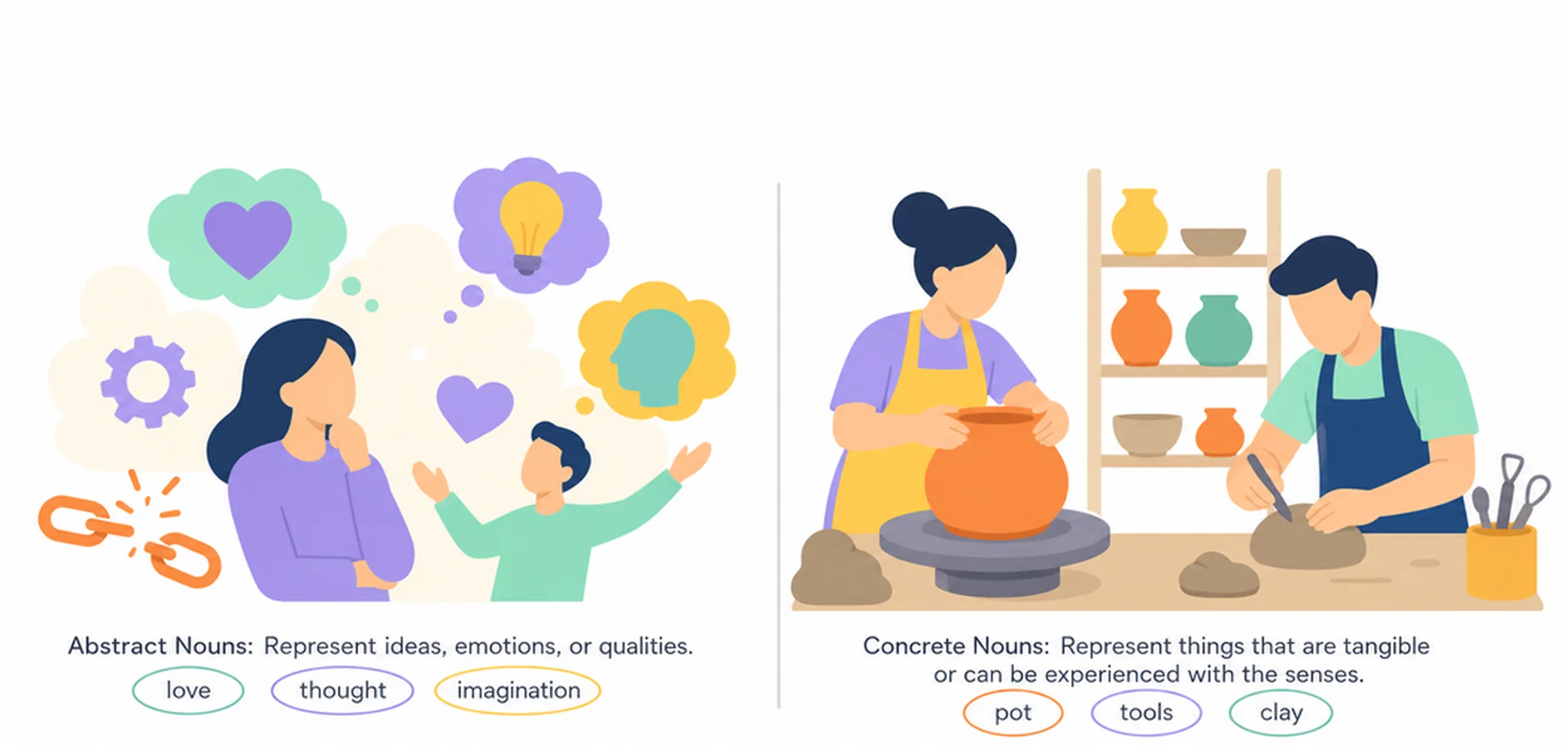
Concrete nouns are things you can see, touch, taste, smell, or hear. You can touch a table, see a cat, or hear music. Abstract nouns are ideas, feelings, or concepts that you cannot touch or see. You cannot touch happiness, but you can feel it. Understanding this difference helps you use nouns correctly in English.
Abstract vs Concrete Nouns: Side-by-Side Comparison
| Attribute | Abstract Nouns | Concrete Nouns |
|---|---|---|
| Definition | Nouns that refer to ideas, concepts, emotions, qualities, or states that have no physical existence and cannot be directly perceived by the senses. | Nouns that refer to tangible, physical things that exist in the material world and can be directly perceived through one or more of the five senses. |
| Sensory Perception | Cannot be seen, heard, touched, smelled, or tasted. They exist only in the mind as concepts or experiences. | Can be perceived through at least one of the five senses — sight, hearing, touch, taste, or smell. |
| Form | Intangible; no physical form or measurable dimensions. Often derived from adjectives or verbs (e.g., free → freedom, kind → kindness). | Tangible; has a definite physical form, shape, or structure that occupies space and can be measured or counted. |
| When to Use | Use when expressing emotions, theories, philosophies, qualities, or any concept that exists beyond the physical world — common in academic, literary, and philosophical writing. | Use when referring to real, physical objects, people, places, or substances — common in everyday speech, descriptive writing, and factual reporting. |
| Positive Example | Her courage inspired the entire team. (courage = abstract noun) |
She placed the book on the wooden table. (book, table = concrete nouns) |
| Negative Example | There was no justice in the verdict. (justice = abstract noun — you cannot hold or see justice) |
There was no bridge across the river. (bridge, river = concrete nouns — their absence is physically observable) |
| Question Example | What does freedom mean to you? (freedom = abstract noun) |
Where did you put the keys? (keys = concrete noun) |
| Common Categories | Emotions (love, fear), qualities (honesty, bravery), ideas (democracy, theory), states (childhood, peace), fields of study (philosophy, science). | People (teacher, child), places (city, garden), objects (chair, computer), substances (water, wood), animals (dog, eagle). |
| Key Signal Words / Suffixes | Often formed with suffixes: -tion (admiration), -ness (darkness), -ity (creativity), -ment (achievement), -ism (idealism), -dom (wisdom). | No specific suffixes define them; they are typically root words describing observable things. Can usually be preceded by a/an or the and used with quantity words (e.g., three apples). |
| Countability | Mostly uncountable (e.g., happiness, knowledge), though some can be countable (e.g., an idea, a belief). | Can be either countable (e.g., three chairs) or uncountable (e.g., water, sand), but most are countable. |
| Use in Writing Style | Heavy use can make writing feel vague or overly formal. Best balanced with concrete language to give abstract ideas clarity and grounding. | Makes writing vivid, specific, and easy to visualise. Strong descriptive and narrative writing relies heavily on concrete nouns. |
Key Difference: The fundamental distinction lies in physical existence. Concrete nouns name things you can experience with your senses — you can see a mountain, touch a stone, or hear a bell. Abstract nouns name things that exist only as concepts or feelings — you cannot physically touch love, point to justice, or weigh wisdom. When in doubt, ask: "Can I perceive this with my five senses?" If yes, it is a concrete noun; if no, it is abstract.
Examples





What to Remember
- Concrete nouns refer to things you can perceive with your five senses.
- Abstract nouns represent ideas, feelings, emotions, and concepts you cannot physically touch.
- You can see, hear, touch, taste, or smell concrete nouns like apple.
- You cannot physically perceive abstract nouns like love, freedom, or happiness.
- Use this distinction to choose appropriate descriptive words and understand noun meanings better.