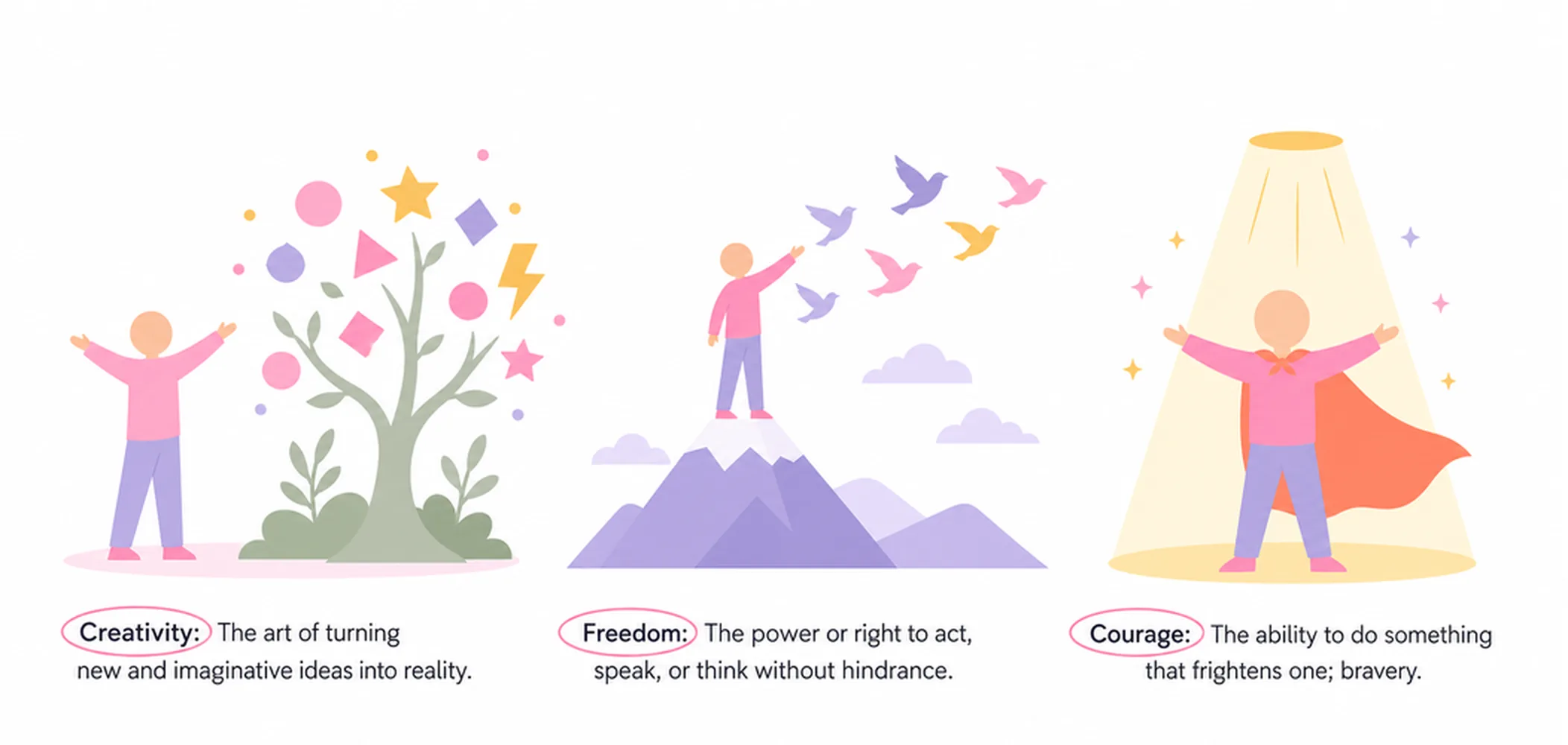
What are abstract nouns?
Abstract nouns are words that name ideas, feelings, and concepts. You cannot touch, see, or hold them. They exist only in your mind or in language. For example, happiness, love, and freedom are abstract nouns. They describe things you feel or think about, not physical objects. Every language has abstract nouns because we need words to talk about our thoughts and emotions.
Abstract nouns vs concrete nouns
Concrete nouns are things you can touch or see: a chair, a cat, water, or a book. Abstract nouns are different. You cannot touch kindness or see friendship. Both types are important in English, but abstract nouns are harder for learners because you cannot point to them. When you learn a concrete noun like apple, you can imagine the fruit. When you learn an abstract noun like courage, you need to understand the meaning in your mind.
Common abstract nouns
Many abstract nouns come from adjectives or verbs. Add -ness, -ity, or -tion to make them. For example: happy becomes happiness, possible becomes possibility, and educate becomes education. Other common abstract nouns are beauty, hope, knowledge, peace, success, and truth. These words appear often in conversations about feelings, goals, and life experiences. Learning them helps you express yourself better in English.
Abstract nouns vs concrete nouns: side-by-side comparison
| Feature | Abstract Nouns | Concrete Nouns |
|---|---|---|
| Definition | Words that name ideas, concepts, feelings, qualities, or states that have no physical existence. | Words that name physical things, people, places, or objects that exist in the material world. |
| Can Be Seen? | No — abstract nouns cannot be seen with the eyes. | Yes — concrete nouns can be seen directly. |
| Can Be Touched? | No — abstract nouns have no physical form and cannot be touched or held. | Yes — concrete nouns occupy physical space and can be touched or handled. |
| Can Be Heard / Smelled / Tasted? | No — they are not perceivable through any of the five senses. | Yes — many concrete nouns can be experienced through one or more of the five senses. |
| Paired Example 1 | Freedom — the concept of being free; felt internally but not seen or touched. | Door — a physical object you can see, touch, open, and close. |
| Paired Example 2 | Love — an emotion or feeling that exists in the mind and heart, not in physical space. | Flower — a physical plant you can see, smell, and touch. |
| Paired Example 3 | Justice — a moral principle or ideal with no physical shape or size. | Hammer — a physical tool with measurable weight and dimensions. |
| Paired Example 4 | Courage — a quality of character experienced internally and observed only through behaviour. | Mountain — a concrete geographical feature that can be seen and climbed. |
| Common Categories | Emotions (anger, joy), qualities (beauty, wisdom), ideas (democracy, truth), states (childhood, peace). | People (teacher, child), places (city, park), objects (chair, book), animals (cat, eagle). |
| Countability | Often uncountable (e.g., information, happiness), though some can be counted (e.g., an idea, two fears). | Often countable (e.g., three books, two dogs), though some are uncountable (e.g., water, sand). |
| Use with Articles | Often used without an article when speaking generally: "Honesty is important." | Typically used with articles when specific: "The dog is in the garden." |
| How to Identify | Ask: "Can I physically touch or see this thing?" If no, it is likely an abstract noun. | Ask: "Can I physically touch or see this thing?" If yes, it is a concrete noun. |
| Positive Example Sentence | "She showed great courage during the crisis." | "She picked a beautiful flower from the garden." |
| Key Signal Words / Suffixes | Common suffixes: -tion (nation), -ness (darkness), -ity (equality), -ment (enjoyment), -ance (tolerance), -hood (childhood). | No specific suffixes; identified primarily by physical existence. Often refer to everyday tangible objects, people, or places. |
| 🔑 Key Difference: The fundamental distinction is physical existence. Concrete nouns name things that exist in the physical world and can be directly perceived through the five senses — you can see a book, touch a stone, or smell a rose. Abstract nouns, by contrast, name things that exist only as ideas, feelings, qualities, or concepts — you cannot hold freedom, taste justice, or point directly at love. Both types are equally important in English: concrete nouns anchor language in the physical world, while abstract nouns allow us to express thoughts, values, and emotions. | ||
Examples






What to Remember
- Abstract nouns name ideas, feelings, and concepts that you cannot touch or see.
- Concrete nouns are physical objects you can touch, see, or hold with your hands.
- Abstract nouns exist only in your mind or in language, not in reality.
- Common abstract nouns include happiness, love, freedom, anger, beauty, and knowledge.
- You use abstract nouns to talk about thoughts, emotions, and ideas, not physical things.