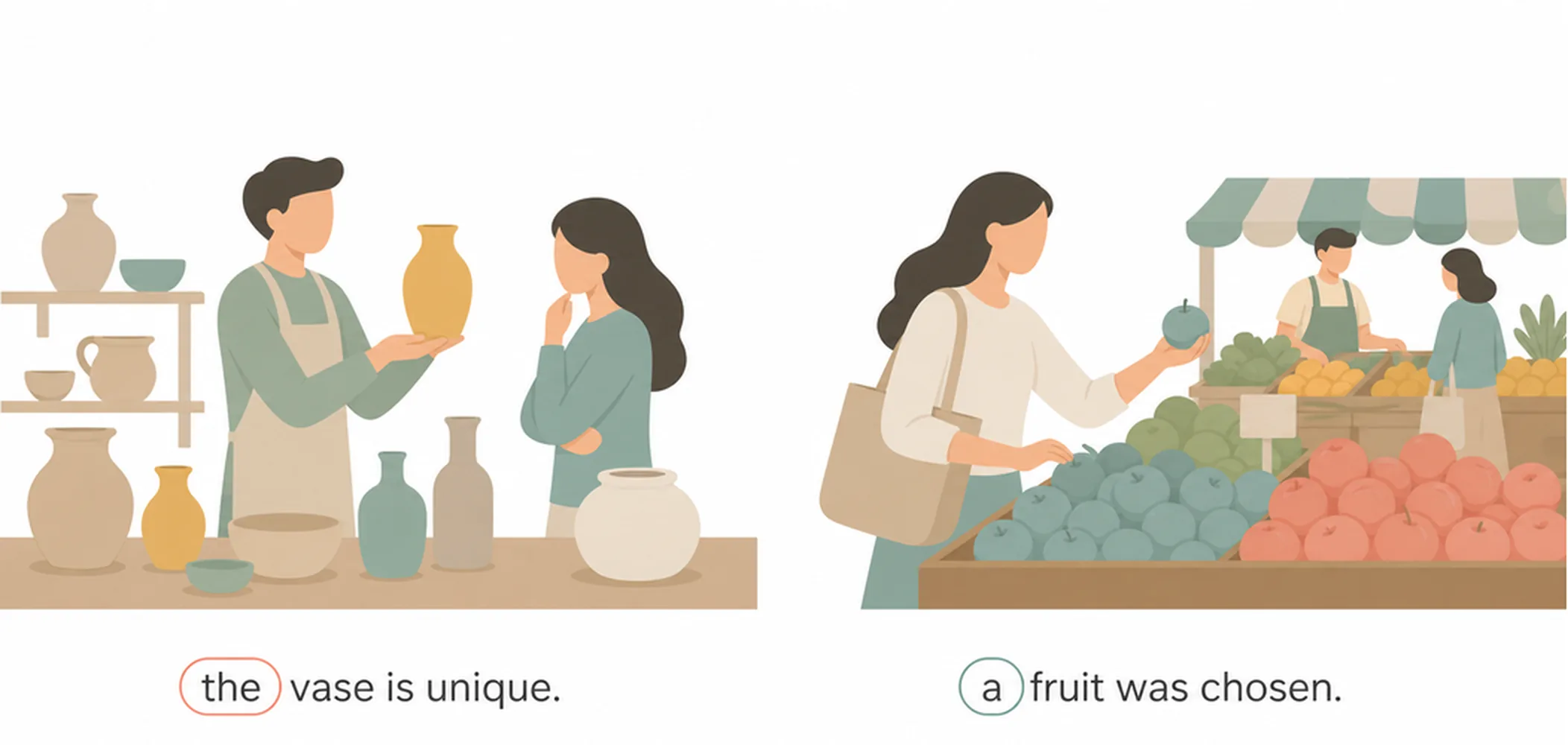
What Are Articles?
Articles are small words we use before nouns. There are three articles in English: a, an, and the. They tell us if a noun is specific (definite) or general (indefinite). Articles are very common in English, and we use them almost every day when we speak or write.
The Indefinite Articles: A and An
We use a and an for nouns that are not specific. They mean "one" of something. Use a before words that start with a consonant sound. Use an before words that start with a vowel sound (a, e, i, o, u). For example: a dog, a house, an apple, an orange. Both a and an are the same—they just help words sound better when spoken aloud.
The Definite Article: The
We use the when we talk about something specific or known. The means we already know which person, place, or thing we mean. For example: The dog is brown (we know which dog). Use the before both singular and plural nouns, and it does not matter if the word starts with a consonant or vowel sound.
A vs An vs The: Side-by-Side Comparison
| Dimension | A | AN | THE |
|---|---|---|---|
| Type | Indefinite article | Indefinite article | Definite article |
| When to Use | Before a singular countable noun starting with a consonant sound; used when the noun is mentioned for the first time or is non-specific | Before a singular countable noun starting with a vowel sound (a, e, i, o, u); used when the noun is mentioned for the first time or is non-specific | Before a specific or previously mentioned noun that both the speaker and listener know; used with singular, plural, or uncountable nouns |
| Noun Type | Singular countable nouns only | Singular countable nouns only | Singular, plural, and uncountable nouns |
| Sound Rule | Used before a consonant sound (e.g., a dog, a university) | Used before a vowel sound (e.g., an apple, an hour) | No sound restriction; used before any sound |
| Positive Example | I saw a cat in the garden. She wants a new job. |
He ate an orange for breakfast. She is an engineer. |
The cat I saw was black. Please close the door. |
| Negative Example | I don't have a car. He is not a doctor. |
She didn't bring an umbrella. It is not an easy task. |
I didn't like the movie. He didn't finish the homework. |
| Question Example | Is there a bank nearby? Can you recommend a good restaurant? |
Do you have an appointment? Is she an artist? |
Did you see the news today? Where is the nearest exit? |
| Key Signal Words / Contexts | First mention, any one of many, professions, nationalities (consonant sound) | First mention, any one of many, professions, nationalities (vowel sound) | Second mention, unique nouns (the sun, the moon), superlatives, specific shared knowledge |
| Common Mistakes | Using "a" before a vowel sound: ❌ a apple → ✅ an apple | Using "an" before a consonant sound: ❌ an university → ✅ a university | Using "the" with general plural nouns: ❌ The dogs are loyal (general) → ✅ Dogs are loyal |
| 🔑 Key Difference: A and AN are both indefinite articles used with singular countable nouns when referring to something non-specific or mentioned for the first time — the only difference between them is the sound of the following word (consonant sound → a; vowel sound → an). THE is the definite article used when the noun is specific, already known to the listener, or unique — it can be used with singular, plural, and uncountable nouns regardless of the starting sound. | |||
Examples






What to Remember
- Articles (a, an, the) are small words we use before nouns in English sentences.
- Use "a" before consonant sounds and "an" before vowel sounds (a, e, i, o, u).
- "A" and "an" are indefinite articles meaning "one" of something that is not specific.
- "The" is the definite article used for specific nouns that are already known or mentioned.
- Remember: Check the sound, not the letter—use "an" before vowel sounds like "an hour."