Grammar A2 Articles — A, An, The

When to use A vs An — guide

When to use A vs An — guide

A vs An: The Simple Rule

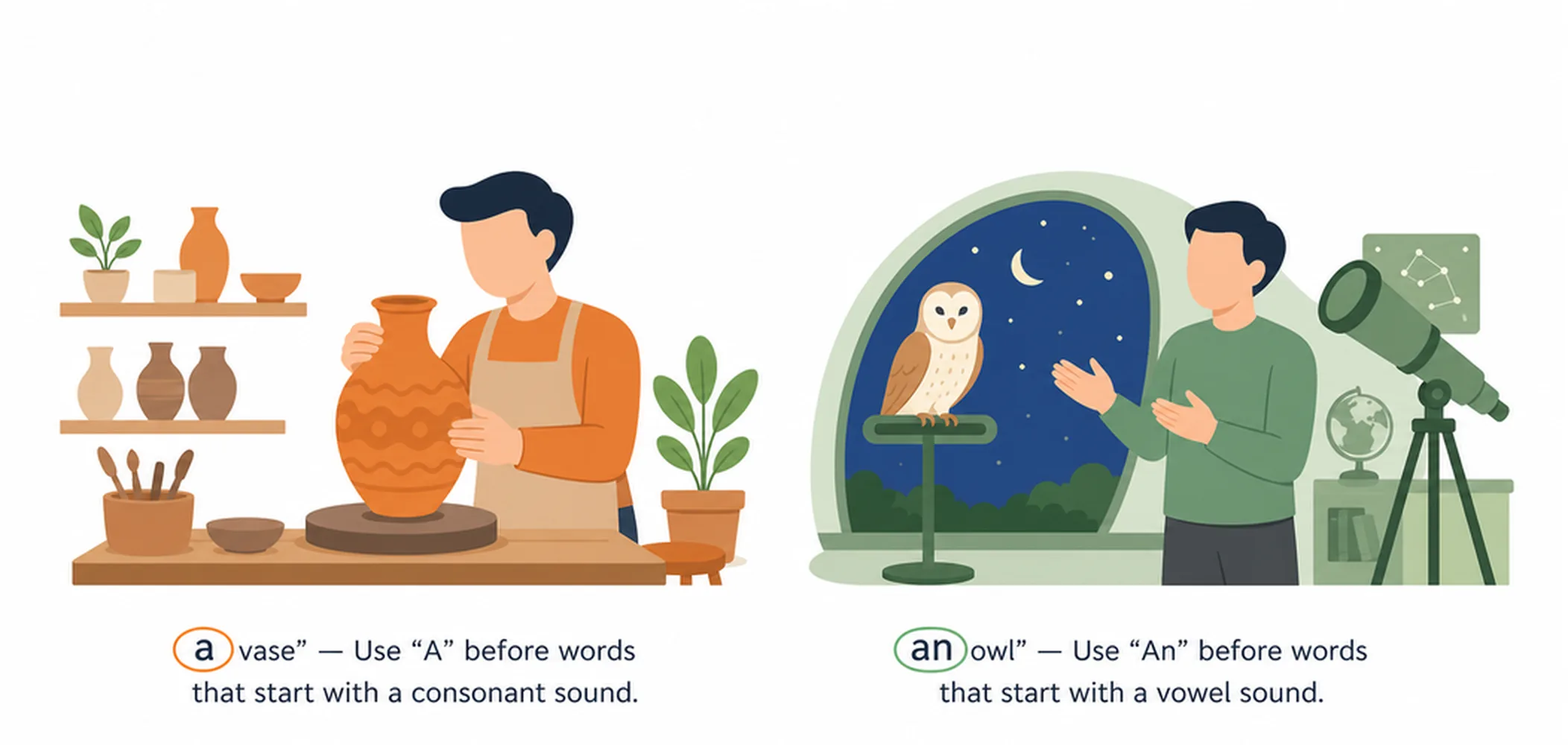
The choice between 'a' and 'an' is easy! The rule is simple: use 'an' before words that start with a vowel sound, and use 'a' before words that start with a consonant sound. This small choice helps your English sound natural and correct.

A or An? How to Decide

Choosing between a and an is simple: the choice depends on the sound that follows, not the letter itself.

Use When to Use Example
a Before words that begin with a consonant sound a cat, a dog, a yellow umbrella
an Before words that begin with a vowel sound an apple, an elephant, an hour
Key Point: Sound, Not Spelling

The critical factor is the sound at the beginning of the word, not how it is spelled. For example:

An hour – even though hour begins with the letter "h", it is pronounced with a vowel sound, so we use an.

A university – even though university begins with "u" (a vowel), it is pronounced with a consonant sound (yoo-), so we use a.

A one-time offer – even though one begins with "o", it is pronounced with a consonant sound (w-), so we use a.

In short: always listen to the first sound of the word. If it sounds like a consonant, use a. If it sounds like a vowel, use an.

Examples

I need a new pen for class.
Consonant sound (p) — use 'a'
She is an excellent teacher.
Vowel sound (e) — use 'an'
I saw a university building.
Consonant sound (y) — use 'a' even though 'u' is a vowel
He got an MBA degree.
Vowel sound (em) — use 'an' based on pronunciation
When to use it
Before Consonant Sounds
Use 'a' when the next word starts with a consonant sound (b, c, d, f, g, h, j, k, l, m, n, p, r, s, t, v, w, y, z).
"I need a new pen for class."
Before Vowel Sounds
Use 'an' when the next word starts with a vowel sound (a, e, i, o, u). This makes speaking easier and smoother.
"She is an excellent teacher."
Listen to the Sound, Not the Letter
Remember: it's about the SOUND, not the letter. Some words look like they start with a vowel but sound like a consonant, or the opposite.
"He works as an electrician." (e-sound at the start) "I saw a university building." (y-sound at the start, not vowel sound)
Before Abbreviations and Numbers
For abbreviations and numbers, use 'a' or 'an' based on how you say them aloud, not how they are written.
"She got an MBA degree." (You say 'em-bee-ay') "I waited for an hour." (You say 'ow-er')
Signal words
before consonant sounds before vowel sounds singular countable noun first mention one of something listen to the sound not the letter indefinite article before a job or hobby before a nationality before a description
Common Mistakes
Wrong
I want a apple.
Correct
I want an apple.
'Apple' starts with a vowel sound (a), so use 'an' not 'a'.
Wrong
She is an student.
Correct
She is a student.
'Student' starts with a consonant sound (s), so use 'a' not 'an'.
Wrong
He is a honest person.
Correct
He is an honest person.
'Honest' starts with a vowel sound (o) even though 'h' is silent, so use 'an'.
Wrong
I need an new book.
Correct
I need a new book.
'New' starts with a consonant sound (n), so use 'a' not 'an'.
KEY TAKEAWAYS

What to Remember

  • Use 'an' before words starting with a vowel sound (a, e, i, o, u).
  • Use 'a' before words starting with a consonant sound (b, c, d, f, g, etc.).
  • Focus on the sound, not the spelling—'an hour' not 'a hour'.
  • Common mistake: Don't use 'a' before vowel sounds or 'an' before consonants.
  • Both 'a' and 'an' refer to one non-specific person, place, or thing.
← Previous
What are articles in English?
Next →
When to use THE — definite article rules