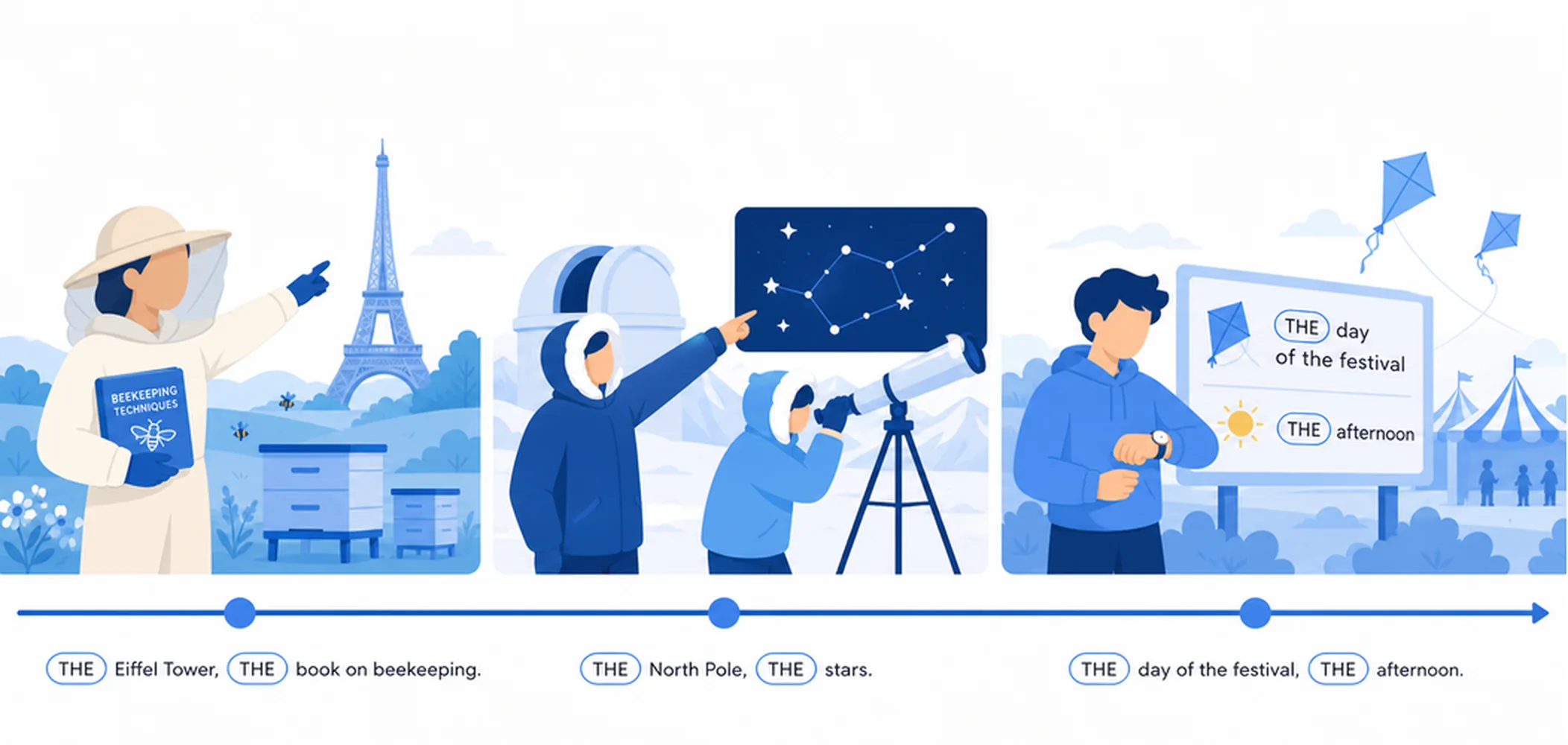
When Do We Use 'The'?
The definite article 'the' is used when we talk about specific people, animals, things, or places that are known or unique. We use 'the' when the reader or listener knows exactly which thing we mean. Understanding when to use 'the' is important for clear English communication.
How to Decide When to Use 'The'
Deciding when to use the definite article 'the' depends on whether the noun is specific and identifiable to both the speaker and listener. Use these key rules to determine when 'the' is appropriate.
| Rule | When to Use 'The' | Example |
|---|---|---|
| Unique or specific things | Use 'the' when referring to something that is one of a kind or specific in context | The sun is bright. The President will speak today. |
| Previously mentioned | Use 'the' when you've already introduced a noun and are referring to it again | I saw a cat. The cat was orange. |
| Known to both speaker and listener | Use 'the' when both people know which thing you mean from shared knowledge | The kitchen is messy. The Eiffel Tower is in Paris. |
| Superlatives and ordinals | Use 'the' with superlatives (best, worst, largest) and ordinals (first, second) | She is the best student. This is the first time. |
| Plural nouns for a whole category | Use 'the' when referring to a group as a whole | The elephants are endangered. The French enjoy wine. |
| Names of oceans, seas, rivers, mountain ranges | Use 'the' with these geographical features | The Atlantic Ocean. The Thames. The Rocky Mountains. |
| Institutions and organizations | Use 'the' with many established institutions | The United Nations. The BBC. The Red Cross. |
Do NOT use 'the' with uncountable nouns, plural countable nouns used generally, proper nouns (names of people, single countries, single mountains), or meals, diseases, and transport mentioned generally. For example: "Milk is white" (not "the milk"), "Dogs are loyal" (not "the dogs"), "London is busy" (not "the London"), "I go to school by car" (not "the car").
Examples

Can you pass the salt, please?
Specific thing · Everyday usage

I read a book yesterday. The book was very interesting.
Second mention · Common pattern

The moon appears at night.
Unique thing · Always use 'the'

The United States is a large country.
Country name · Specific plural or group
When to use it
Specific Things
Use 'the' when you talk about one specific thing that the listener knows.
"Can you close the door, please?" (We both know which door)
Unique Things
Use 'the' for things that are one and only in the world or in a context.
"The sun is hot today." (There is only one sun)
Second Mention
Use 'the' the second time you mention something. First mention uses 'a' or 'an'.
"I saw a cat. The cat was orange and very friendly."
Places & Groups
Use 'the' with countries (the United Kingdom), oceans (the Atlantic), and groups (the police).
"The Amazon is the largest rainforest in the world."
Signal words
the only
the first
the last
the best
the same
in the morning
in the evening
in the kitchen
at the moment
on the left
on the right
in the world
Common Mistakes
✕
Wrong
The music is important for human development.
✓
Correct
Music is important for human development.
Use the definite article 'the' only when referring to specific, known things, not general concepts or things in general.
✕
Wrong
The London is the capital of the England.
✓
Correct
London is the capital of England.
Don't use 'the' before city names or most country names (except plural/group names).
✕
Wrong
I have a dog. A dog is very intelligent.
✓
Correct
I have a dog. The dog is very intelligent.
Use 'the' for second mention. The listener now knows which dog you mean.
KEY TAKEAWAYS
What to Remember
- Use 'the' when talking about specific people, animals, things, or places that are already known.
- Use 'the' with unique things like "the sun" or "the president" that exist only one.
- Use 'the' when the listener or reader knows exactly which person or thing you mean.
- Don't use 'the' with general nouns or when mentioning something for the first time.
- Use 'the' with plural nouns and uncountable nouns when they are specific and known.